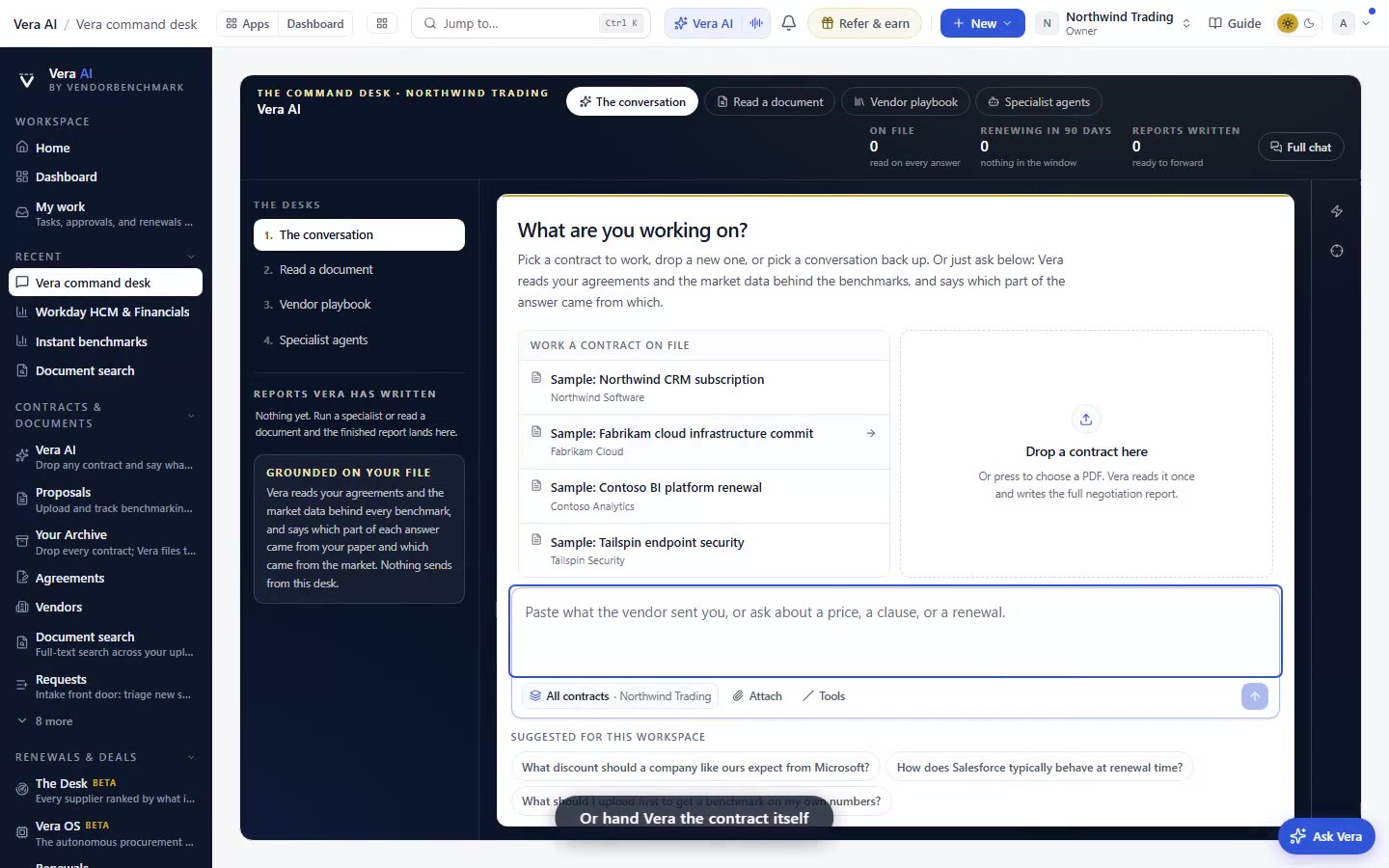
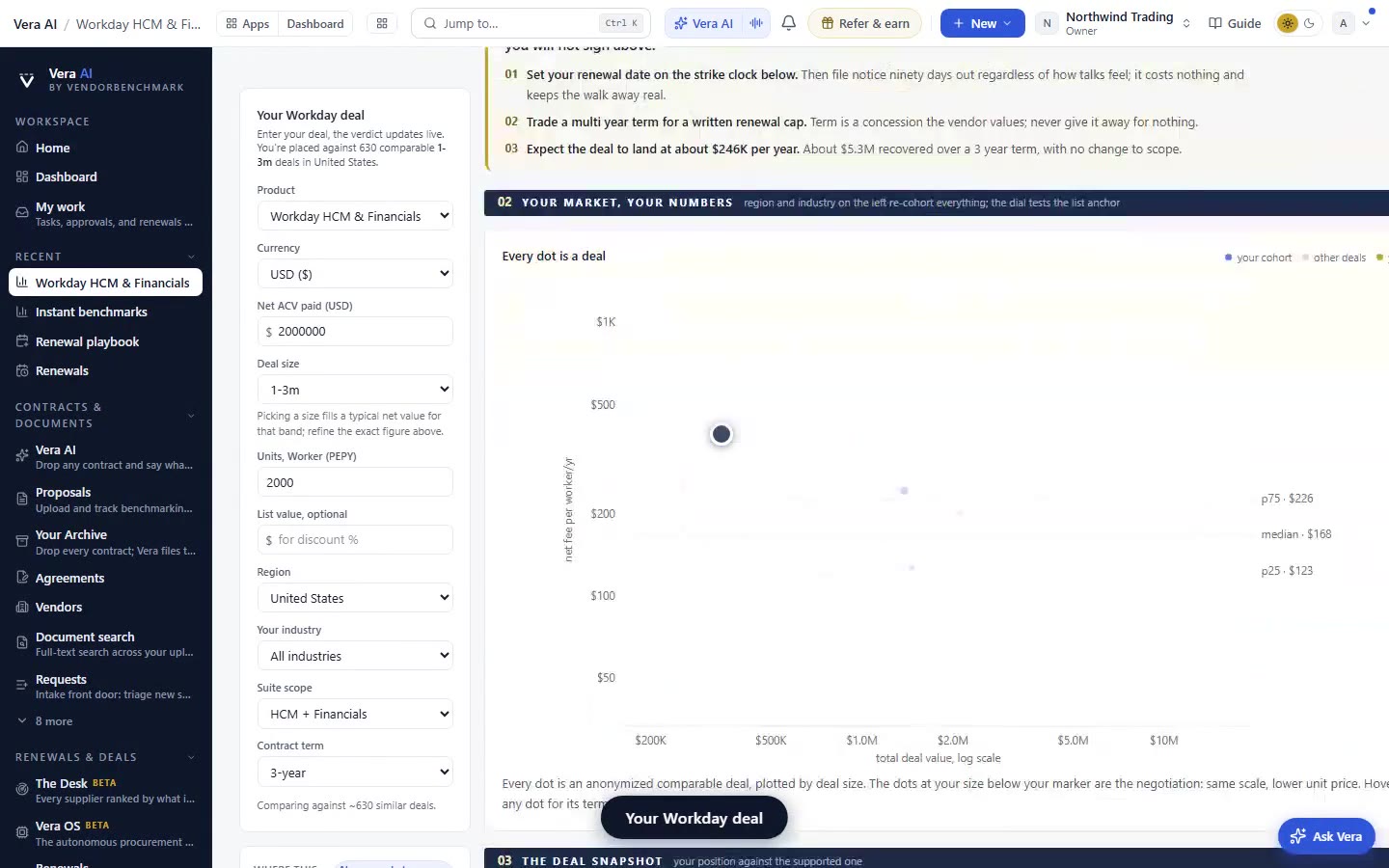
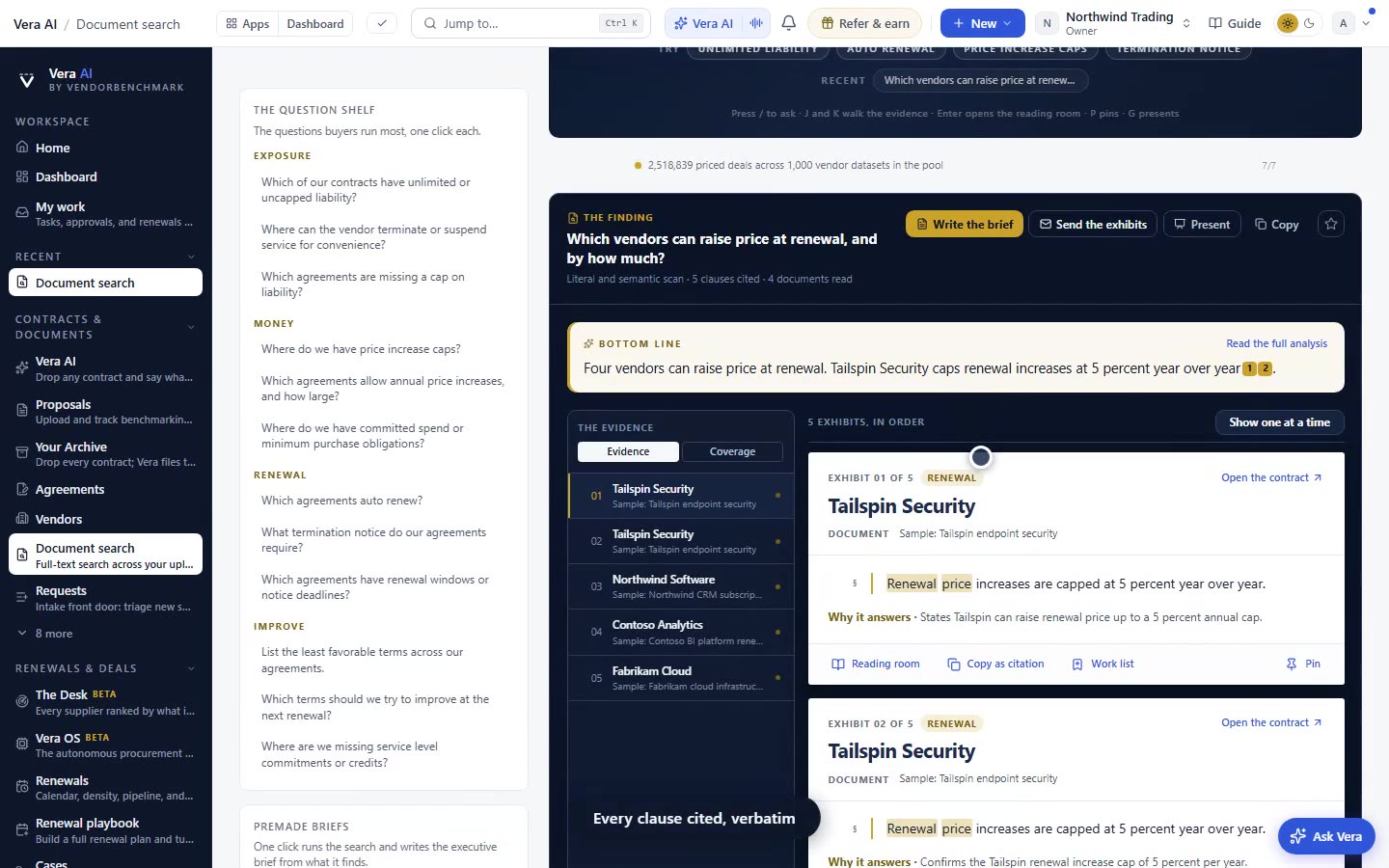
The studio home: your ask bar, the Front of desk, and the reading room
We shipped a home page for the studio layout. It opens light, puts a working ask bar at the top, and shelves everything Vera has delivered so you stop hunting for your own work.
PRODUCT UPDATE - FROM THE ANALYST DESK. If you run procurement, you already know the tax that nobody puts on a slide. You open the tool, and the first thirty seconds are spent finding where you were. Which tab held the benchmark. Where the contract you dropped in last Tuesday ended up. Which of the ten instruments you needed for this particular renewal. The work is fine once you are inside it. The problem is the doorway. This release rebuilds the doorway. The studio layout now has its own home, and it is built so that a buyer lands, asks, and gets to the instrument in one move rather than four.
The named problem: the empty desk that makes you rebuild context
Most enterprise tools open on a dashboard that is really a launcher. It greets you, it shows some tiles, and then it makes you do the archaeology. For a procurement buyer mid quarter, that archaeology is expensive. You are holding a renewal date in your head, a target discount, and a half formed question about whether the price list moved. The old home did not hold any of that. It asked you to navigate first and think second.
The studio home inverts the order. It opens as a light page with your greeting and a working ask bar, meaning you can think first and navigate second, or skip navigation entirely. Type a question and Vera answers with cited figures. Drop a contract straight onto the bar and it goes into decode without a single menu click. This is the same command surface we described when Vera AI opens as a command desk, now placed at the front door rather than behind it.
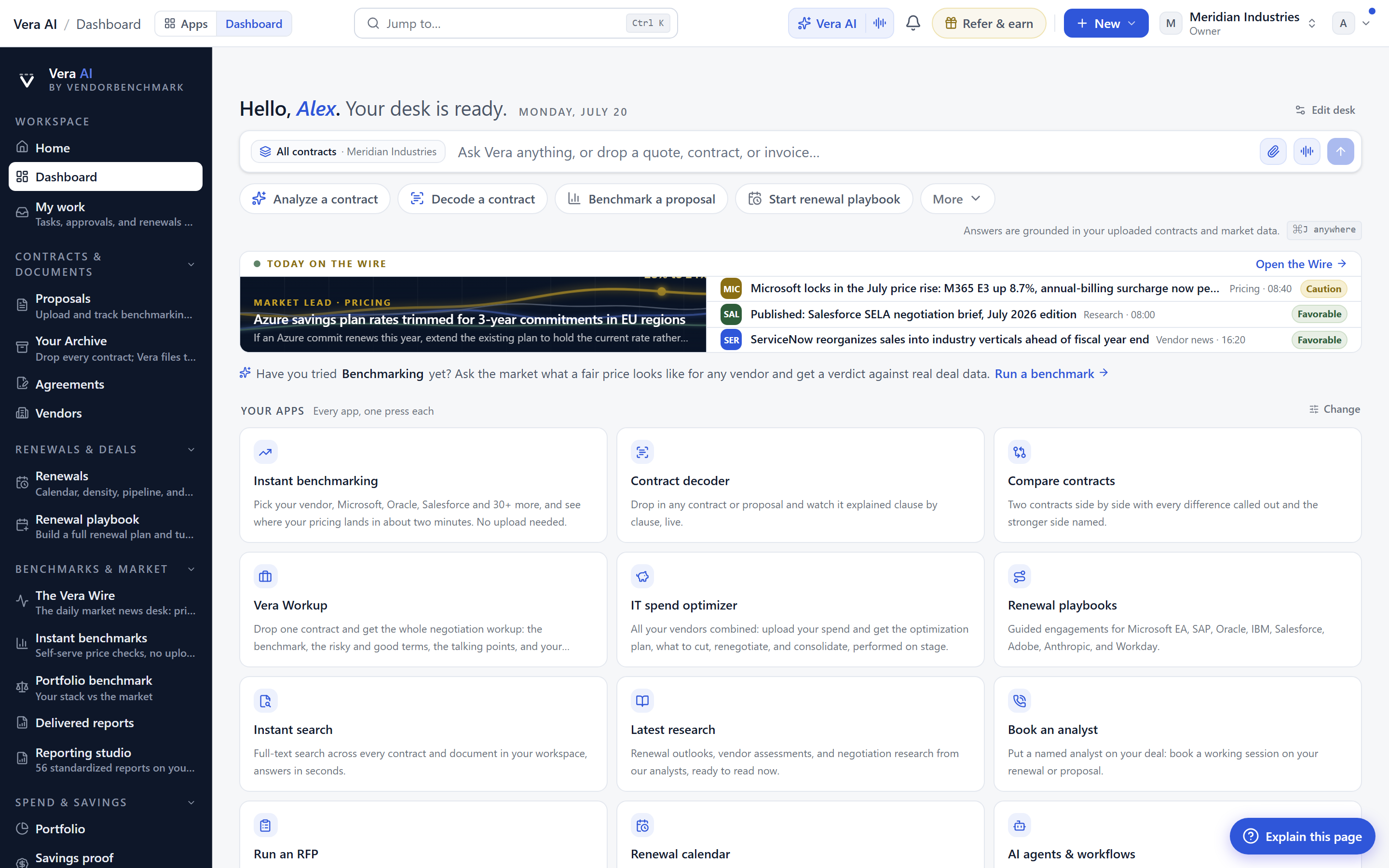
The Front of desk: ten instruments, one page, app windows over the top
The ten principal instruments now live on their own Front of desk page. This matters more than a layout note suggests. Before, each instrument was a destination you traveled to and then traveled back from, which is how you lose your place. Now every tile opens as an app window over the page. You stay on the Front of desk, the instrument floats in front of you, and when you close it you are exactly where you were. It reads less like switching apps and more like laying tools on a bench and putting them back.
For the buyer, the practical effect is that a single renewal can touch the benchmark, the clause library, and the negotiation war room without ever losing the thread. If you are working a renewal from the start, the interview approach we described in start the renewal with an interview, not a blank dashboard now runs from this same surface, so the kickoff and the instruments share one home. You can walk the Front of desk to see how the windows stack.
The reading room: the Learn and follow wall
Below the ask bar and the Front of desk panel sits the Learn and follow wall, which is the reading room in plain terms. Big tiles for Research, The Vera Wire, What's new, the user manual, the blog, the Off List podcast, webinars, and the demo videos. The point of collecting these is not to make the page busier. It is to separate two modes that used to be tangled. When you are working a deal you want the ask bar and the instruments. When you are learning the market or catching up on a price list movement you want the reading room. Putting them in one scroll, but in distinct zones, lets you choose your mode without leaving home.
Projects: everything Vera delivered, shelved and filterable
The bottom left icon on the studio rail is Projects, and it shelves everything Vera delivered as cards. Every benchmark she ran, every dossier she built, every decode she finished, held as a card you can filter by vendor family. This is the part buyers ask for most and get least in enterprise tools, a durable record of your own deliverables that does not require you to remember where you saved them. If you ran three Oracle items and two Salesforce items this quarter, you filter to the family and the cards surface. It is the difference between the tool remembering your work and you remembering it.
For teams pooling leverage, this also makes handoff cleaner. When a colleague picks up a category, the Projects shelf is the trail, which pairs naturally with the approach in buying blocs, pooling leverage without exposing your numbers.
The honest limits
Three things this release does not do, stated plainly. First, the studio home reorganises where your work lives and how you reach it. It does not change what the instruments produce. A benchmark is the same benchmark, drawn from the same 1,483 vendors, whether you reach it through the old navigation or the new Front of desk window. If your underlying data is thin for a niche vendor, a prettier doorway will not thicken it.
Second, Projects shelves what Vera delivered, not everything you did outside the tool. Emails to your account team, a spreadsheet you kept locally, a call you never logged, none of that appears on the shelf. It is a record of the tool's output, not a system of record for your whole negotiation. Treat it as the former and it is honest and useful. Expect the latter and it will disappoint you.
Third, the app window model is a change in muscle memory. If your team learned the old destination-and-back rhythm, expect a short adjustment before the floating windows feel faster than they did before. In our own testing the payback came within the first few sessions, but it is a real cost on day one, and we would rather name it than pretend the transition is free. For teams that live in the negotiation surface, the same window logic already runs there, as in peer intros becomes a full-screen workspace, so the pattern is not new to the platform, only new to the home.
Net assessment for the buyer. This is an infrastructure release dressed as a home page. It does not add a benchmark or a report type. What it removes is the doorway tax, the thirty to ninety seconds of context rebuilding you paid every time you opened the tool or switched instruments. Small per event, large per quarter. If you run a lot of renewals, this is the release that gives you back the hours you were not counting.
Fredrik has spent more than twenty years in enterprise software, with time at Oracle, IBM, SAP, and Salesforce before moving to the buy side. He structured and priced the kind of large agreements most buyers only see once or twice in a career, which taught him where the leverage sits and how far a vendor will actually move. He started VendorBenchmark to hand that knowledge to every sourcing team.