The register in Entitlement Agent is a record you can defend, and it takes the one you already keep
Your spreadsheet register answers to no one when the auditor arrives. This one carries entitlement, deployment, priced delta, evidence, and sign-off on the same row. Bring the file you already keep.
You already keep a register. It lives in a spreadsheet, it has a tab per vendor, and it is out of date the day after you close the tab. When the auditor sends the deployment questionnaire, that spreadsheet cannot answer the question the auditor is actually asking, which is not what you bought but what is running. So you rebuild it by hand, under time pressure, and you hope the numbers hold. This update is about making the register carry the answer before the question arrives, and about taking the register you already keep as the starting point rather than asking you to start again. It follows the direction we set when the Entitlement Agent began to work like an application.
The named problem: your register answers the wrong question
A licence register built from contracts records entitlement. It says the paper grants 500 seats of the professional edition, 12 cores of the database, unlimited internal users of the reporting module. That is what you paid for. It is not what the vendor's audit clause measures. The clause measures consumption on a named date, and the gap between entitlement and consumption is where the shortfall invoice comes from. When the two live in different systems, in a spreadsheet you maintain and a usage export the vendor controls, you spend the audit window reconciling them under a clock that favours the vendor. The register you can defend puts both on the same row. Each licence line now carries what the paper grants beside what is actually running, the source that reading came from, and the day it was true.
Next to those two figures sits the difference, priced at the list rate written on your own paper. Not a market rate, not an estimate, the rate you agreed to. That means the exposure on a line is a number you can read without a calculator and without a call to the vendor, and it means you know the size of the problem before the vendor names it. This is the same principle we wrote about in the answers sit on the paper. The defence is not a new claim. It is the arithmetic your own documents already imply, made visible on the line.
Evidence on the line, and who stands behind it
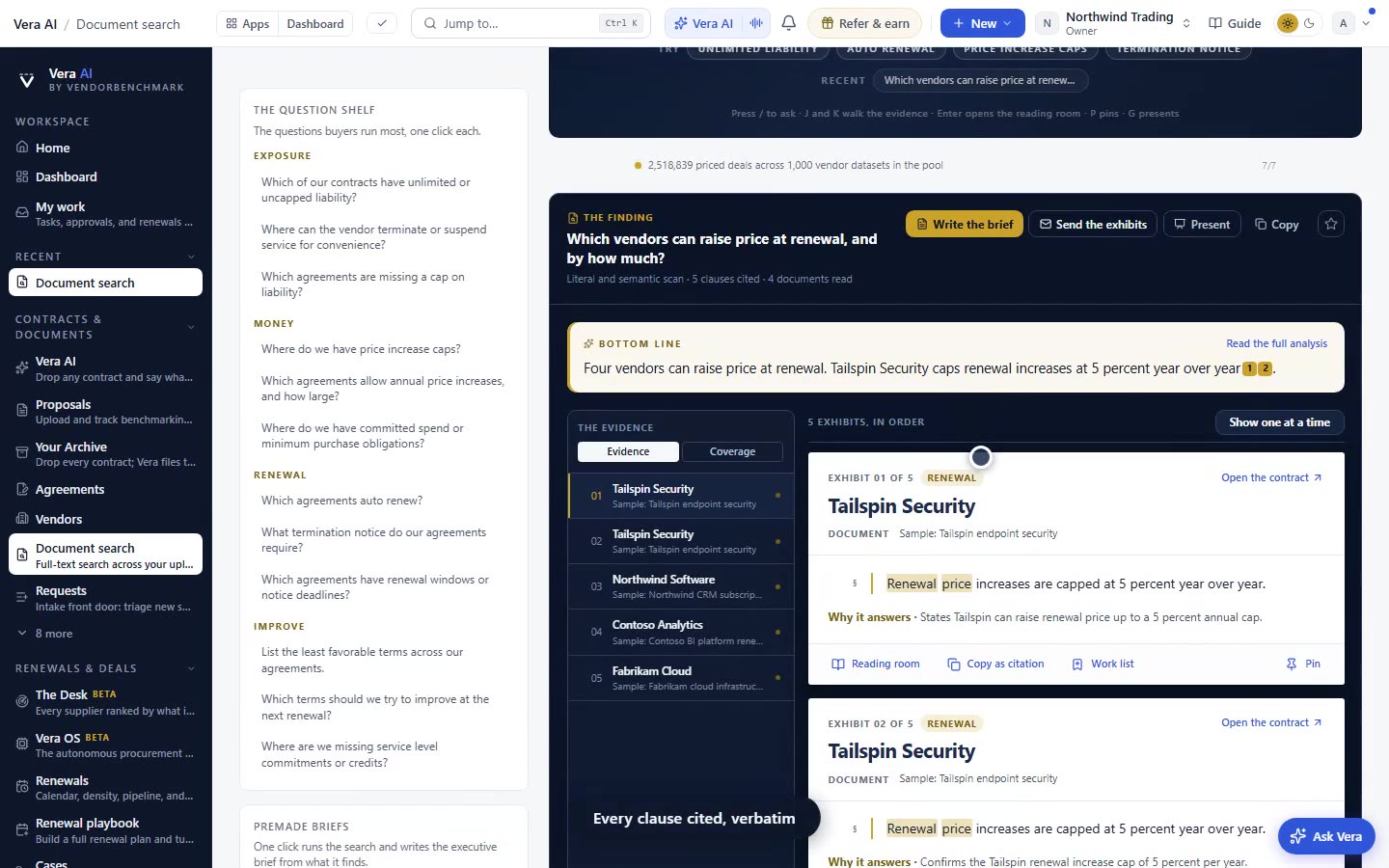
A number without a source is an opinion. Every line now carries five links of evidence, so the entitlement figure points to the order form clause, the deployment figure points to the export it came from, and the priced delta points to the rate on the paper. An auditor asking to see the basis for a figure sees it on the row, not after a two day search. This is the difference between a register you keep and a register you can defend, and it is why we call it a record rather than a report.
The register also records who verified each line and when. That single column changes the character of the document. It stops being a working file that anyone edited last and becomes a chain of accountability, where each verified line names the person who checked it against the evidence and the date they did so. When the auditor, or your own finance team, or the CFO asks who stands behind a number, the answer is on the line. It fits the way the war room already works, where the paper opens beside every answer, a pattern we described in the report is a workspace now.
It works like an application, because a register is work
Reconciling a register is repetitive work across many rows, so the register behaves like an application built for that work rather than a page you read. Tick a set of rows and the verbs act on all of them at once, so marking twenty lines verified is one action, not twenty. Ctrl+Z walks back the last forty things one at a time, which matters when a bulk action does something you did not intend and you need to undo it precisely rather than reload and lose your place. These are small mechanics, and they are the difference between an afternoon and ten minutes when the register has hundreds of lines.
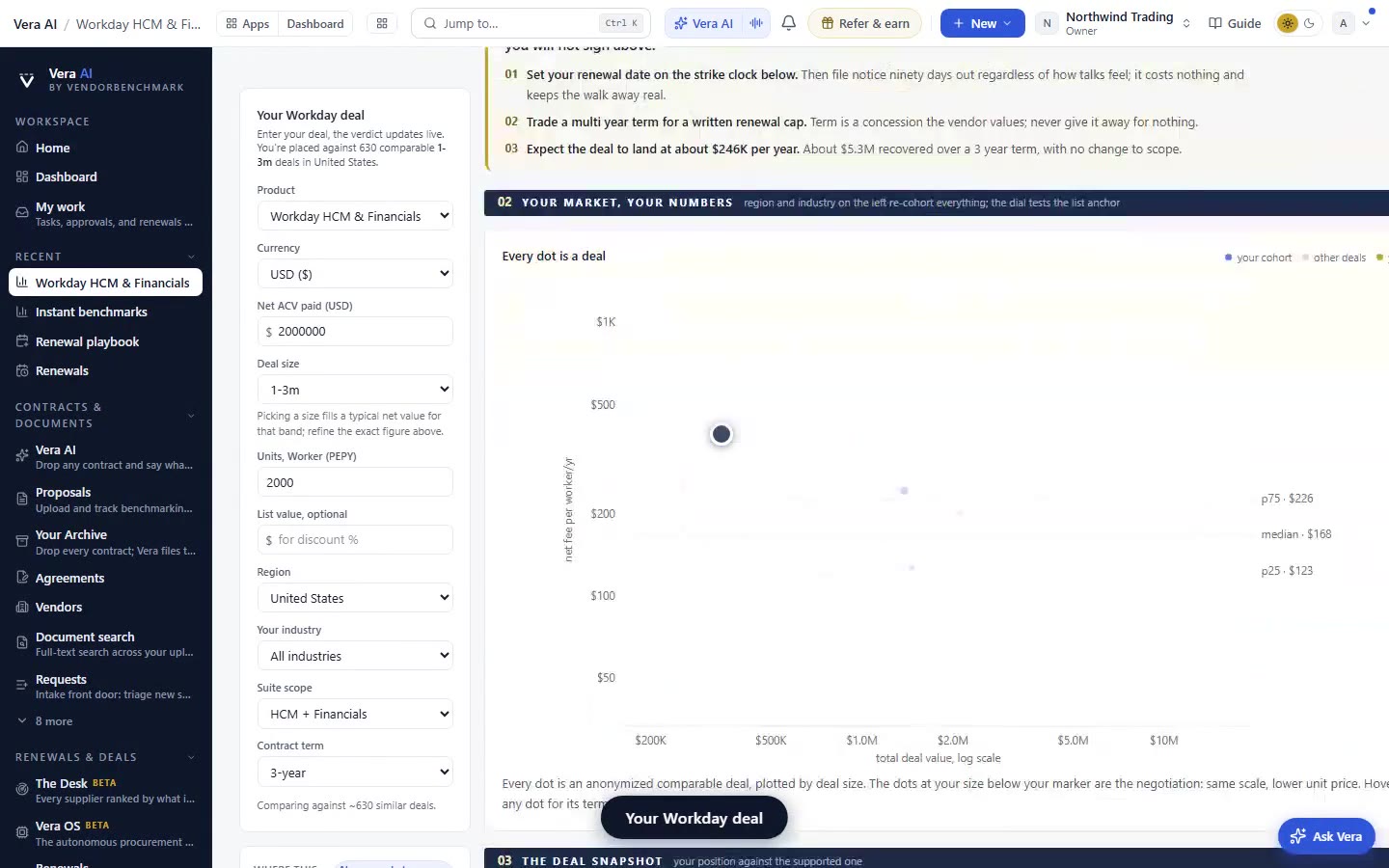
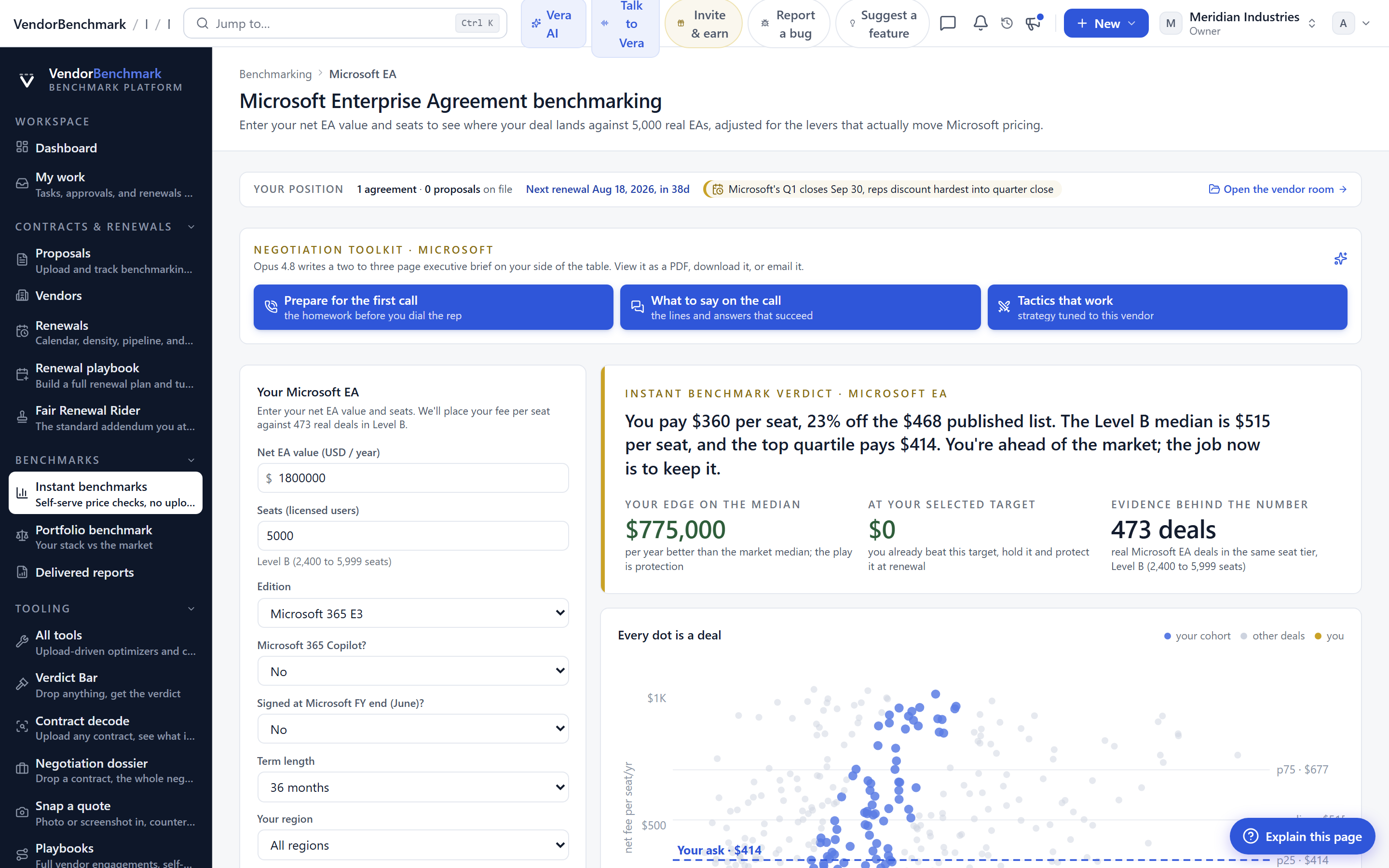
Press B on a line and the register answers the buyer's three benchmark questions on the row itself: whether the price you hold sits above or below the market band, where in the range it falls, and what a comparable buyer pays. That reading draws on the benchmark library, which covers 1,483 vendors, so the context arrives on the line without a trip to another screen. The register stops being a static ledger and becomes a place where the audit position and the negotiation position are visible together. If a line shows both a shortfall you owe and a price 20 percent above the market band, you know to net one against the other before the vendor frames it as a compliance matter alone.
Bring the register you already keep
You do not start over. Under File, Import a register, you can download the template or drop the file you already have. The import runs a dry run first, so you see what will land, what matched to existing vendors and contracts, and what will be created, before anything commits. You confirm, then it imports. What landed once is recognised and never duplicated, so you can run the import again next quarter with an updated file and only the changes take effect. This is the same discipline that lets the wider estate stay current instead of drifting, which matters when you are also tracking switching costs before the vendor prices them for you.
The honest limits
Be clear about what this does not do. The register is only as good as the deployment source you feed it. If your SAM export is stale or your vendor usage portal reports on a lag, the deployment figure carries that lag, and the priced delta is only as current as the day the source was true, which is why the date sits on the line. The tool records the source and the date honestly. It cannot make a monthly export into a real time one.
The priced delta uses the list rate on your paper, which is the right number for an audit conversation but not always the number you will actually pay. Vendors settle shortfalls at negotiated rates, and the list rate is the ceiling, not the outcome. Read the delta as your maximum exposure and your opening position, not as a bill. The benchmark reading on a line is context, not a guarantee that you will reach that price, and it depends on there being comparable coverage for that product in the library. Finally, the verifier column records accountability, it does not create it. A line marked verified by someone who did not truly check it is worth nothing, and the tool cannot tell the difference. The register makes a defensible record possible. The discipline to keep it honest is still yours, and it belongs alongside the rest of the entitlement work you already do on the paper.
Want to be updated when major licensing and pricing changes land? One analyst brief a week: the price rises, metric changes and audit campaigns that move software costs. Work email only.
Morten brings two decades of enterprise and software procurement, with stints across Oracle, IBM, SAP, and Salesforce shaping how he reads a deal. He has led sourcing through hundreds of renewals, from mid market order forms to nine figure global agreements, and learned that the buyers who win are the ones who walk in knowing the market. He built VendorBenchmark to make that pattern recognition repeatable.