The renewal desk now opens on the Wire Desk shell
The renewal book now wears the same desktop shell the agents wear. One stage, one board, one case, and the seven phases of a plan laid out as thread squares under each agreement.
Here is a problem most procurement leads recognise. You know a renewal is coming, you can even name the vendor, but the answer to what do I do about it this week lives in four different places. It is in the calendar, in a spreadsheet someone forked in March, in an email thread you have to excavate, and in your own head. Nobody is lying about the state of the book. It is just that the book has no single surface. We shipped one. The renewal desk now opens on the same Wire Desk shell the agents already wear, and you can read it in the same rooms the agents work in.
The named problem: a book with no front page
The renewal book is not short of data. It is short of a place where the data resolves into a decision. On any given Monday a buyer wants three things in order: what is the state of the whole book, which agreements need a move, and for the one renewal I am touching now, what exactly is on the table. Those are three zoom levels, and until now you assembled them by hand from separate tools every single time. The Wire Desk collapses them into one application with a title bar, a menu, and a tree of the book organised by consequence.
When a renewal is open, the tree shows the seven phases of its plan, five sheets, and an inspector that carries the case's facts, what is at stake, the moves, and the brief. This is the same architecture we used when the Negotiator's Guide moved onto benchmark sheets. One shell, many documents, consistent geography.
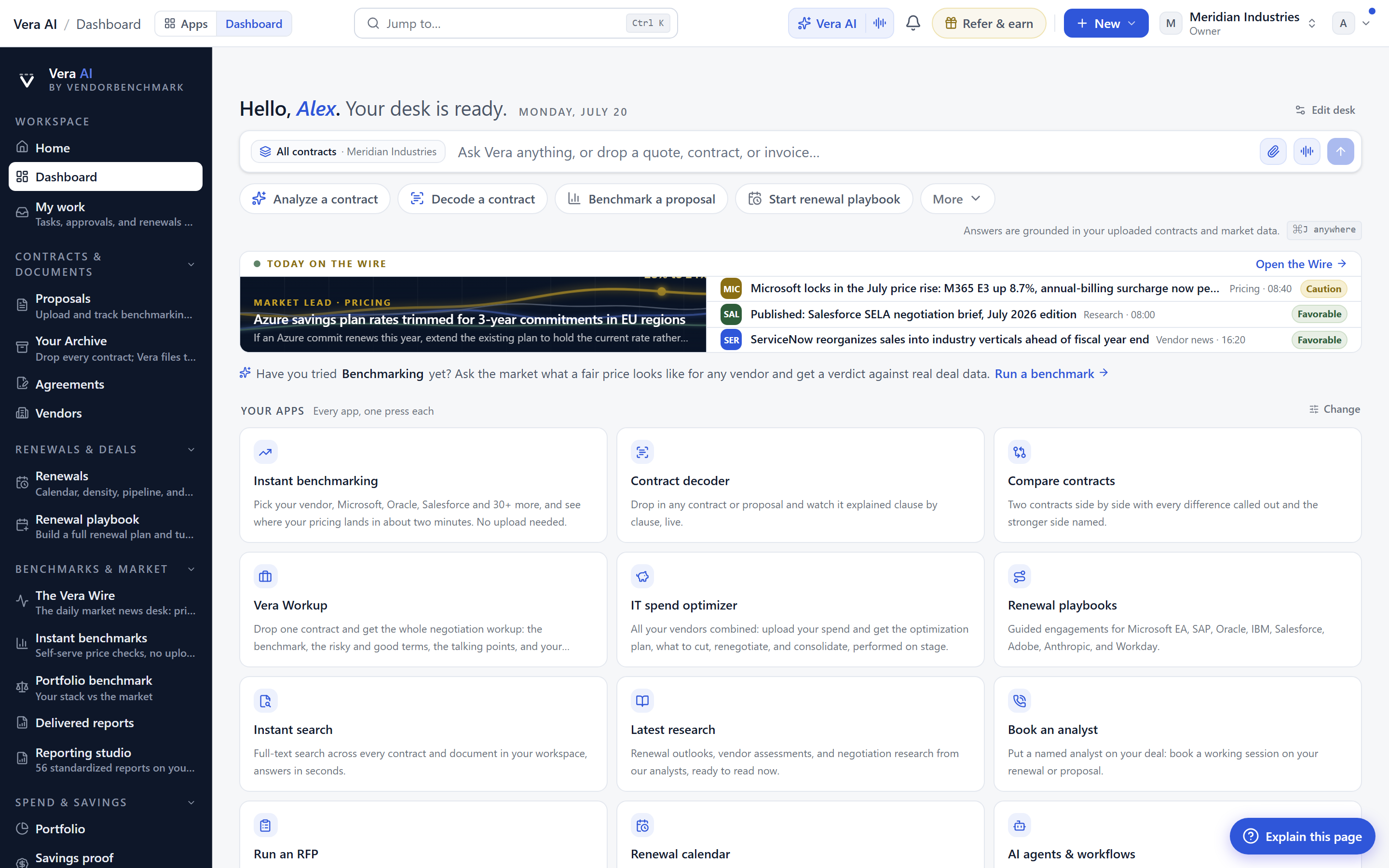
The stage: the book in one sentence
The stage is the first thing the desk shows you. It states the book in a single sentence, names the one press it points at, and stands four figures beside it. This is deliberate. A buyer opening the desk on a Monday should not have to interpret a dashboard of twelve tiles. The stage does the interpreting and hands you a recommended move, the way the Desk opens on the morning brief. The four figures are context for that one press, not a scoreboard to be admired.
If you disagree with the press the stage points at, the board is one click below and you can pick your own row. The stage is an opinion, not a lock.
The board: one row per agreement, phases as thread squares
Below the stage sits the board, and this is where the book becomes legible. Every agreement is one row. The plan's phases run across that row as thread squares, so a filled square is a phase done and an open square is a phase waiting. You can read the entire book's progress the way you read a train timetable, left to right, row by row. A renewal that is three squares into a seven phase plan is instantly distinguishable from one that has not started. This is the same plan structure a buyer approves when Vera researches the renewal plan and you approve the steps, now rendered as a live progress grid.
The board answers the second question, which agreements need a move, without a filter dialog or a saved view. The squares that are stalled are visible at a glance.
The case: one renewal argued in full
Click a row and the case opens under the board. The case argues one renewal in full. It carries the facts of the agreement, what is at stake, the moves available to you, and the brief you would take into the room. This is the renewal record as a working document rather than a static file, and it is the same room-inside-the-desk model we described when the renewal record became a room and Vera took a case from inside it.
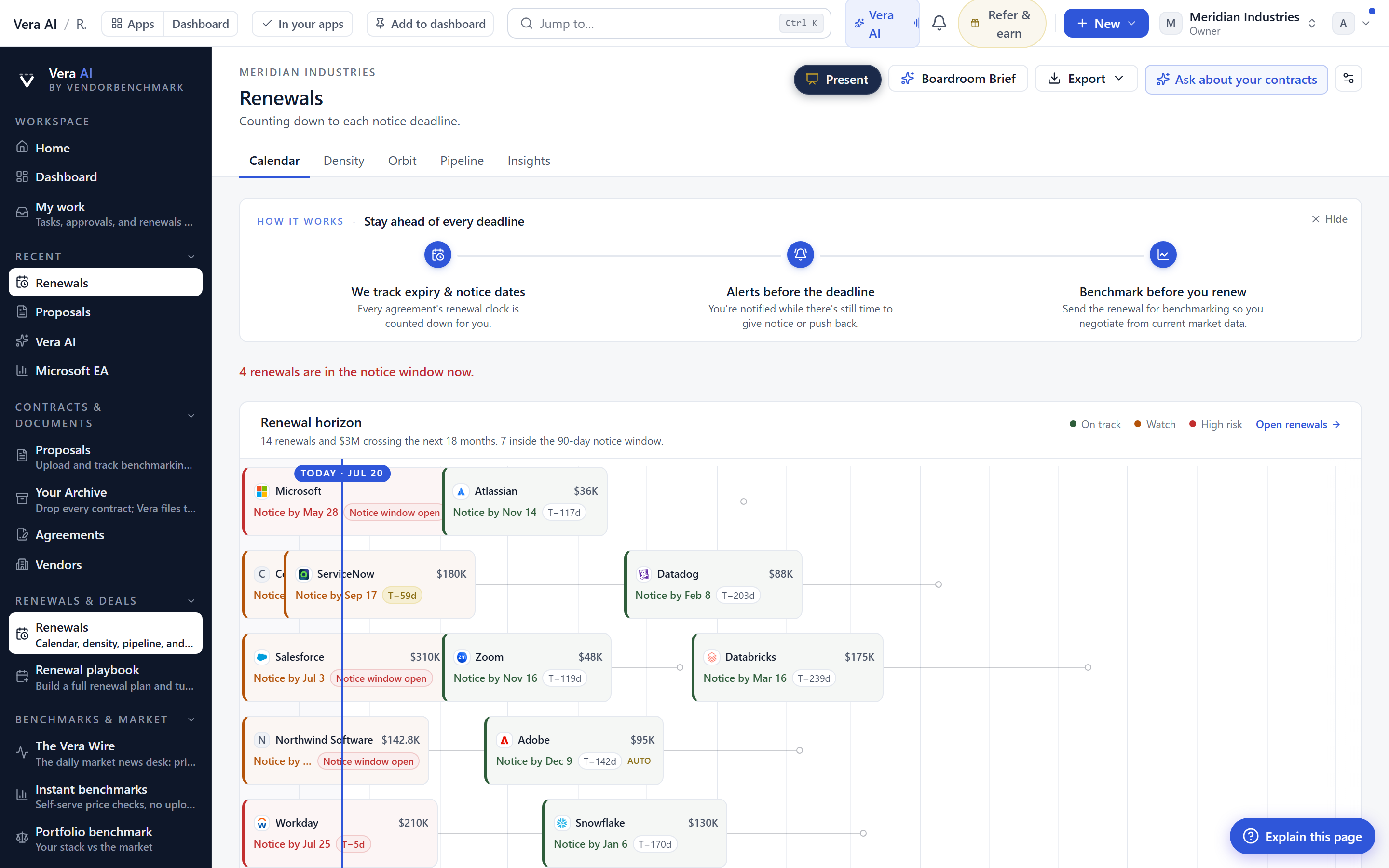
The case sits under the board rather than in a new tab because the buyer's job is to move between the whole book and the one renewal without losing their place. You argue the case, you glance up at the board, you pick the next row. The geography holds. Everything on the desk draws from the same benchmark library the agents read, so the figures in the case are the figures on the stage.
What actually changes for a buyer
Concretely, here is what moves from your hands to the desk. You can visit /renewals to see the book on your own agreements.
What the desk does not do
Be clear about the edges. The stage points at one press, but it is an opinion built from the plan and the benchmark, not a mandate. It can point at the wrong renewal for your quarter, and you should overrule it when your own priorities differ. The board shows plan progress as thread squares, but a filled square means a phase was recorded as done, not that it was done well. The desk does not audit the quality of a completed phase, only its completion.
The case argues one renewal in full, but full means everything the desk knows, which is bounded by what has been ingested. If a side agreement or a verbal commitment never reached the contract record, it is not in the case, and the brief will be confident about an incomplete picture. Treat the case as your strongest first draft, not as the final word. Finally, the desk is a Windows application shell today. It is fast and legible, but it assumes you are working at a desk, not from a phone between meetings. That is a deliberate trade, and we would rather name it than pretend the surface is everything to everyone.
None of these limits change the core arithmetic. The book now has one surface, the phases are visible as squares, and the case reads top to bottom. For a buyer, that is the difference between spending Monday morning assembling the book and spending it negotiating.
Want to be updated when major licensing and pricing changes land? One analyst brief a week: the price rises, metric changes and audit campaigns that move software costs. Work email only.
Morten brings two decades of enterprise and software procurement, with stints across Oracle, IBM, SAP, and Salesforce shaping how he reads a deal. He has led sourcing through hundreds of renewals, from mid market order forms to nine figure global agreements, and learned that the buyers who win are the ones who walk in knowing the market. He built VendorBenchmark to make that pattern recognition repeatable.


