20 · Worked examples, start to finish
The reference chapters explain screens and the cookbook gives recipes. This chapter does the third thing a manual owes you: it works complete cases end to end, every screen named, every number real. Four of the five run on the sample portfolio, the same one the screenshots show and the same one Load sample data puts in your workspace, so you can follow along live. The fifth walks the platform's own reference deliverable, whose figures are illustrative by design.
Each case ends with With your own vendor: the two or three pointers that turn the example into your Monday.
Case 1: the Northwind renewal, from upload to proven saving
The spine of the platform, walked once in full: a renewal quote becomes a delivered finding, the finding becomes a negotiation, and the outcome becomes a number finance accepts.
The situation. The sample workspace holds a CRM subscription with Northwind Software: $142,800 a year for 250 seats, a 7 percent uplift cap, and an auto-renewal with a 60 day notice window. The vendor's renewal proposal asks $162,792, a 14 percent increase.
The work.
- The breach is visible before anyone reads anything. The Agreements masthead counts the ask above the cap, and Anomalies flags it: 14 percent asked, 7 percent permitted. That alone reframes the first conversation.
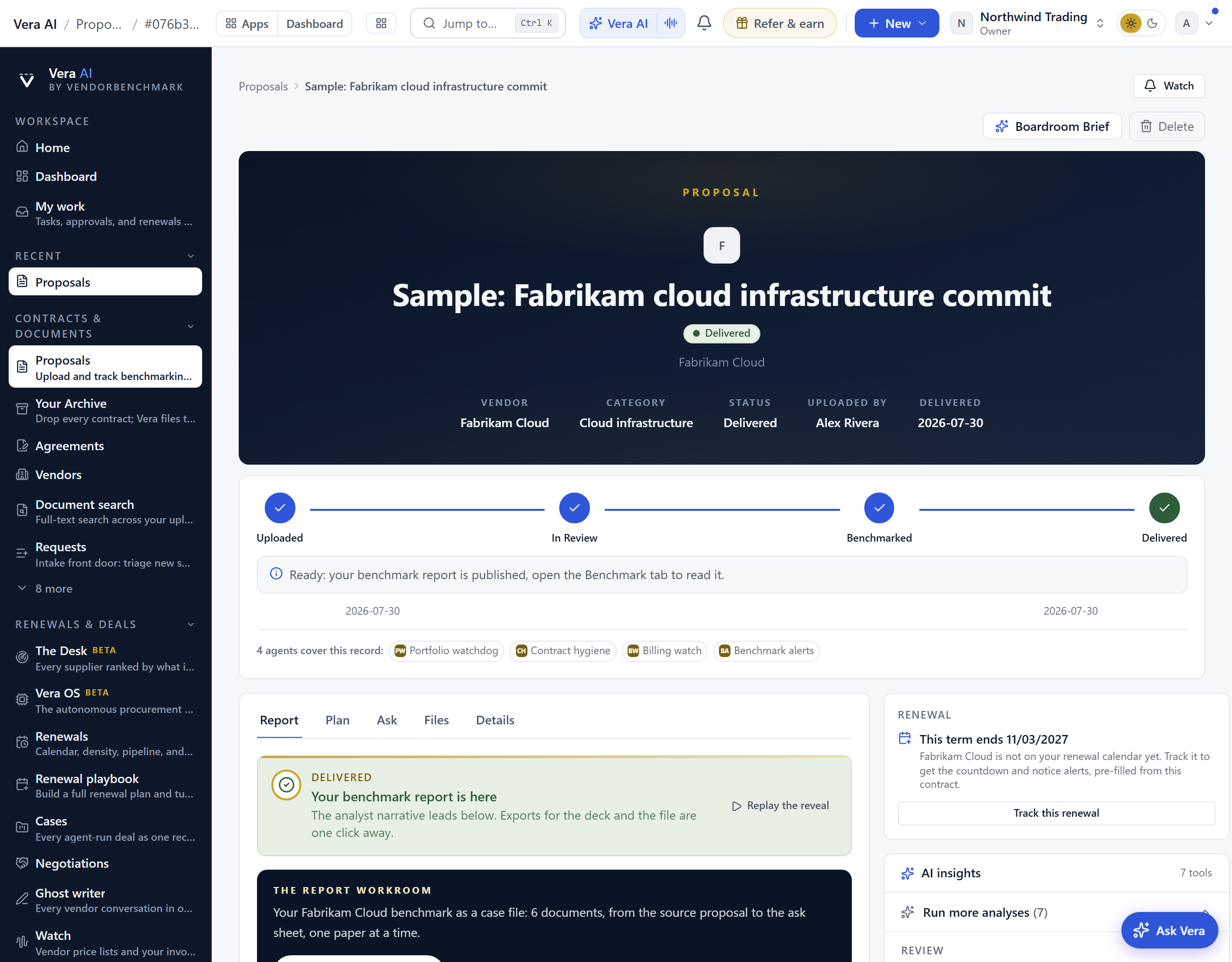
- The document goes in for expert review. Upload a proposal with the focus question "is this renewal uplift fair?". The status path runs Uploaded, In review, Benchmarked, Delivered, with email at each stage.
- The finding lands. The delivered report states it in the standard's order: the deal is above market with $28,650 a year in reach, evidenced by a seat price of $571 against a $504 market median (worth $16,750 a year) and a 12 percent discount off list against a 22 percent median (worth $11,900). The structural read compounds it: the 7 percent cap against a 5 percent median means the premium widens every year it is left alone.
- The finding becomes a mandate. A tracked Negotiation opens with the target at the median seat price of $504, the discount rebuild to 22 percent as the second ask, and the cap at 5 percent as the closing concession, exactly the levers the report priced.
- The conversation runs on the record. Vendor emails go through tactics analysis, every give and get lands in the concession ledger, and the vendor's promises are captured as commitments so they reach the final document.
- The outcome is recorded, then proven. The closed deal's reduction is answered into the 30 day What happened? follow-up, and the claim reconciles against the invoices that follow into the realized savings on the Savings statement. Only then is it a number for the board.
What it comes to. A 14 percent ask, met with a benchmarked counter, closed on evidence, with the saving invoice-verified rather than asserted. Every figure in the story traces: the report's numbers to the benchmark metrics, the saving to the invoices.
With your own vendor. Start where the sample starts: the agreement filed with both dates and the cap (Track agreements), the quote uploaded the day it arrives, and the mandate set from the report's levers, not from instinct (Plan and run a renewal negotiation).
Case 2: the renewal brief the platform writes from one uploaded quote
What the deal pricing brief contains and how to read it, walked against the platform's own reference deliverable: the MongoDB Atlas renewal benchmark. Its figures are illustrative, and they are exactly the shape your own uploaded quote comes back in.
The situation. A vendor proposes a 3 year Atlas commitment of $2.5M total, roughly $833K a year. The buyer's realized discount is not stated on the document.
The work.
- The quote goes in as document, not typing. Upload a quote reads the deal off the document; about three minutes later the brief opens in a deal pricing screen.
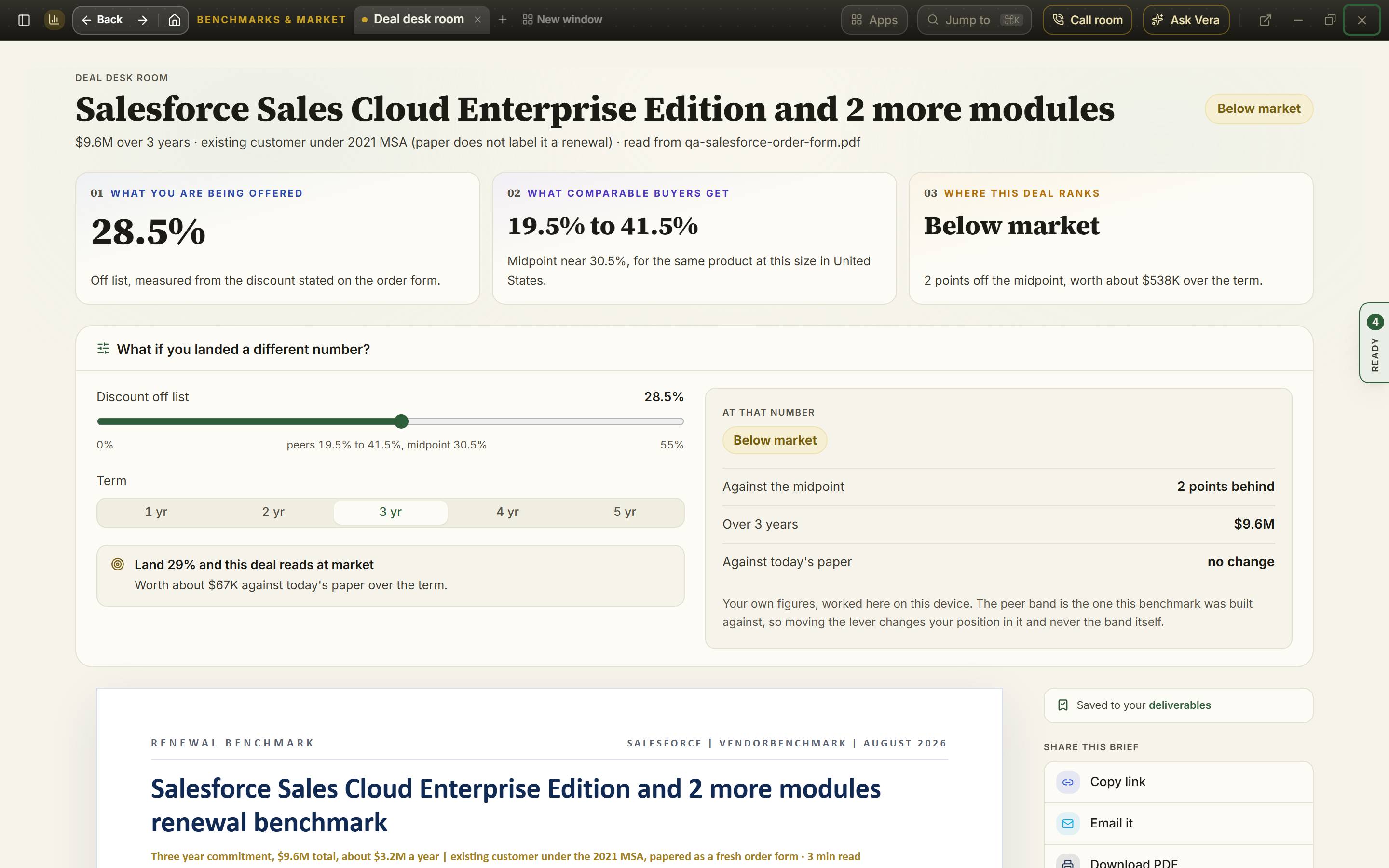
- The masthead answers the three questions before any prose. Four figures lead: a 17 percent assumed baseline discount, a 20 percent peer median at this size, a 21 percent supported target floor, and a 3 year opportunity above $120K. Not one of them is a percentile.
- The load-bearing assumption is stated and priced, never smuggled. The realized discount is unknown, so the brief says so, explains why 17 percent is credible for a first proposal, tells the reader how to verify it against public list rates, and carries a sensitivity table: if the true baseline is 14 percent the move to the floor is worth roughly $203K; if it is already 22 percent, the rate case is closed and the negotiation shifts to rollover, true forward overage, and a renewal cap.
- The peer table places the buyer inside it, by rank. Twelve comparable commitments on a ladder, the buyer ninth on discount depth at a commitment slightly above the cohort average, with the honest reading attached: below the midpoint, not off the map, so the case is midpoint alignment plus term structure, not a claim of mispricing.
- The levers close as a package. Rate to the 21 percent floor, pooled rollover, committed-rate overage, uplift waivers in writing, and a renewal cap at signature, with the sequencing stated and four talking points written to be said out loud.
What it comes to. A brief a senior analyst would sign: the discount, the range, and the rank in the first two seconds, the assumption priced, the ask anchored to the market's own trend line.
With your own vendor. Upload the document that carries the pricing, and read your brief in this order: masthead, assumption, ladder, levers. If your document shows no list price, the brief measures against the vendor's latest known list rate, says so in the assumption callout, and names what to have the vendor confirm; that brief is working correctly, and the handoff recipe turns that confirmation ask into the reply.
Case 3: the Microsoft true-up, defended
Walking into a true-up with the surplus already found, on the sample estate's own Microsoft position.
The situation. The sample estate runs 1,800 E3, 350 E5, and 900 F3 seats, and the flagged exposure on the E3 pool alone is $64,800 a year. The anniversary true-up is approaching, which is when unmanaged estates pay for their drift.
The work.
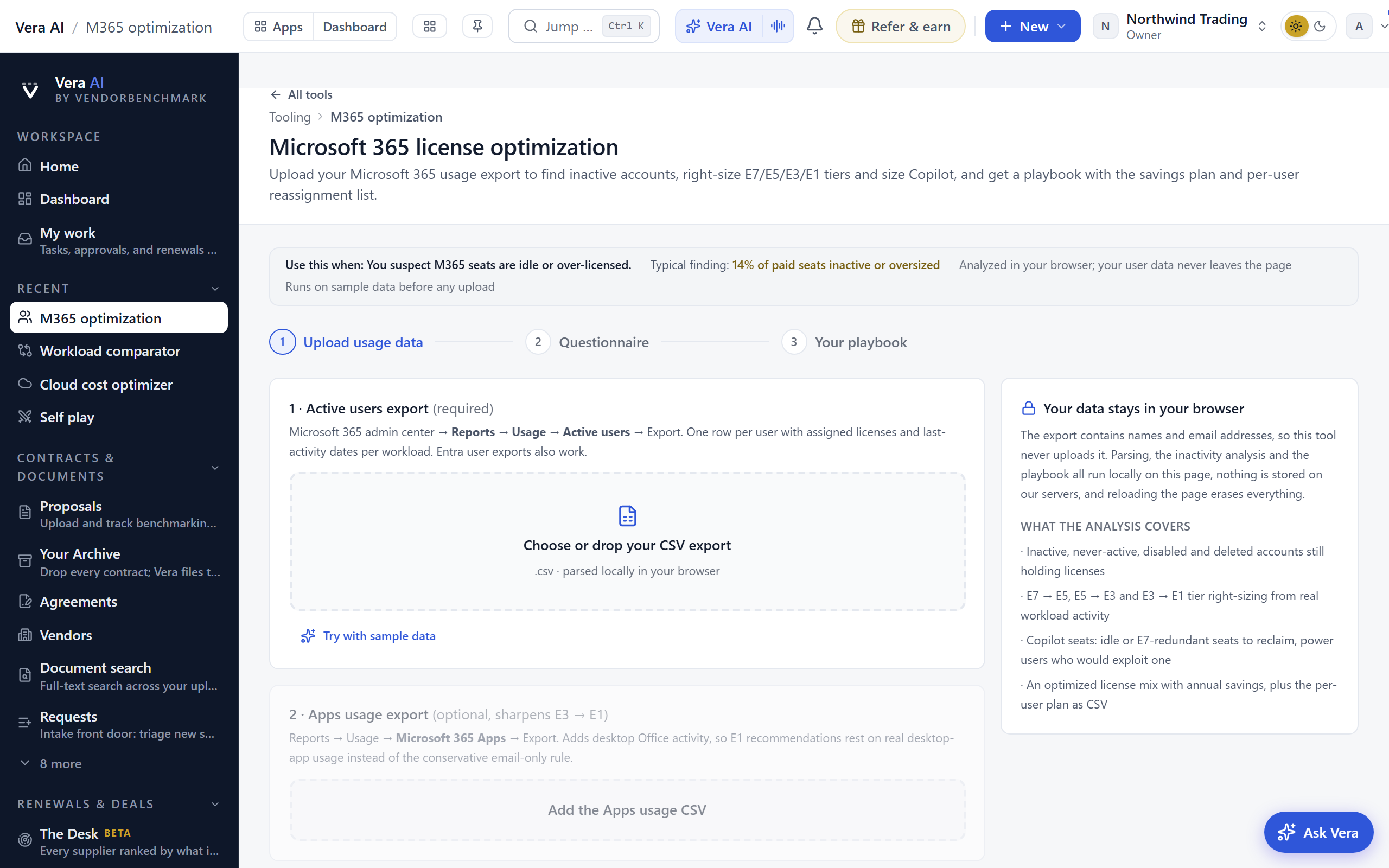
- The usage export goes into M365 optimization. The estate scan colors every licensed user's verdict and ends in the money bridge from today's spend to the optimized mix; the E3 surplus is the headline finding.
- The reassignment plan runs now, not at renewal. Inactive seats are reclaimed and oversized tiers stepped down per user, which is money this quarter and a smaller true-up base by definition.
- The finding becomes the negotiation case. The Microsoft EA playbook folds the right-sized estate into the renewal engagement, and the pricing-era control matters: the tool models the November 2025 removal of EA volume discount levels directly, so the benchmark matches the rules your agreement actually renews under.
- The timing is checked against Microsoft's calendar, not yours, on the Vendor calendar.
What it comes to. The true-up conversation starts from an estate you measured, with the surplus already off the table and the growth story priced under the correct discount regime.
With your own vendor. The same three moves in the same order, whatever the publisher: measure (Right-size licenses), fix what needs no negotiation, then negotiate the remainder from the playbook.
Case 4: the audit letter, answered
The day-one hour that decides an audit, run against the decoder's own worked sample.
The situation. An audit letter arrives naming Oracle. The estate's flagged Java position is real money: 2,600 employees under the employee metric, with $93,600 a year of flagged exposure, which is exactly the kind of backdrop that makes a fast, unconsidered reply expensive.
The work.
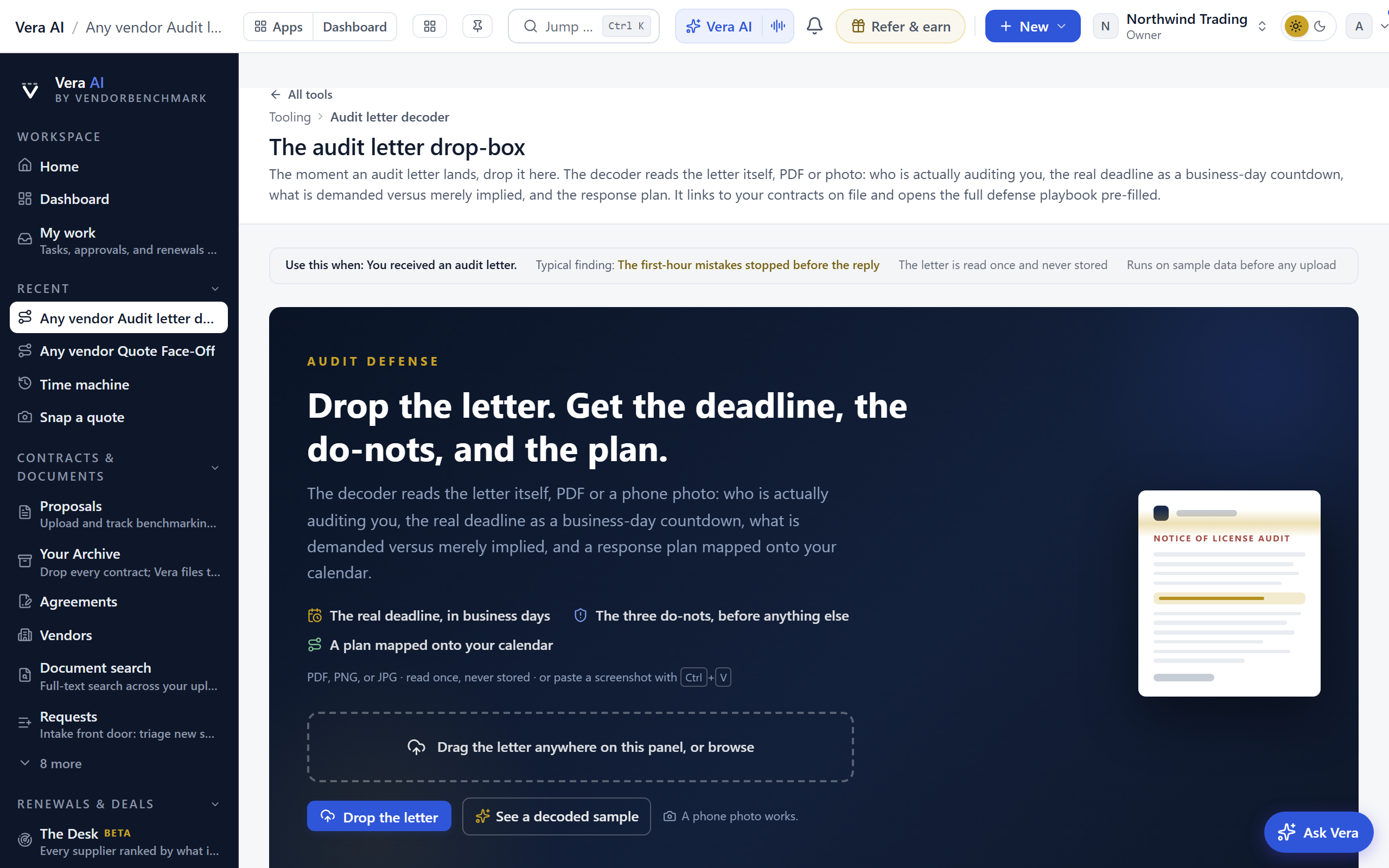
- The letter goes into the Audit letter decoder before anyone replies. Not sure what you would get? The page's See a decoded sample shows a fully decoded Oracle GLAS notice. The decode names who is actually auditing, turns the stated deadline into a business-day countdown, and separates what is demanded from what is merely implied.
- The three things not to do first are honored: no reply to the auditor yet, no vendor measurement scripts run, no data volunteered beyond the demand.
- The defensibility is checked on Data health: the audit exposure estimate says how strong the entitlement picture is before engagement, and connecting a SAM source strengthens it more than any letter-drafting can.
- The response runs on your timeline through the pre-filled defense playbook, and the audit worked as one negotiation with any nearby renewal, never two.
What it comes to. A considered first move, a countdown with margin, and a response built from records rather than recollection. The full recipe is the standing version.
With your own vendor. The decoder is vendor-agnostic and takes a phone photo. The discipline transfers unchanged: decode first, slow the clock, answer from document.
Case 5: the capless quote, repaired, and the year proven
The smallest case in money and the most common in practice: a quote with a structural hole, fixed before signature, with the outcome landing on the year's proof.
The situation. The sample Contoso Analytics renewal quote: 120 Creator seats at $450, $54,000 a year, net 45, an auto-renewal with only a 30 day notice window, and no uplift cap anywhere in the document. Nothing about the price is scandalous; the structure is the finding.
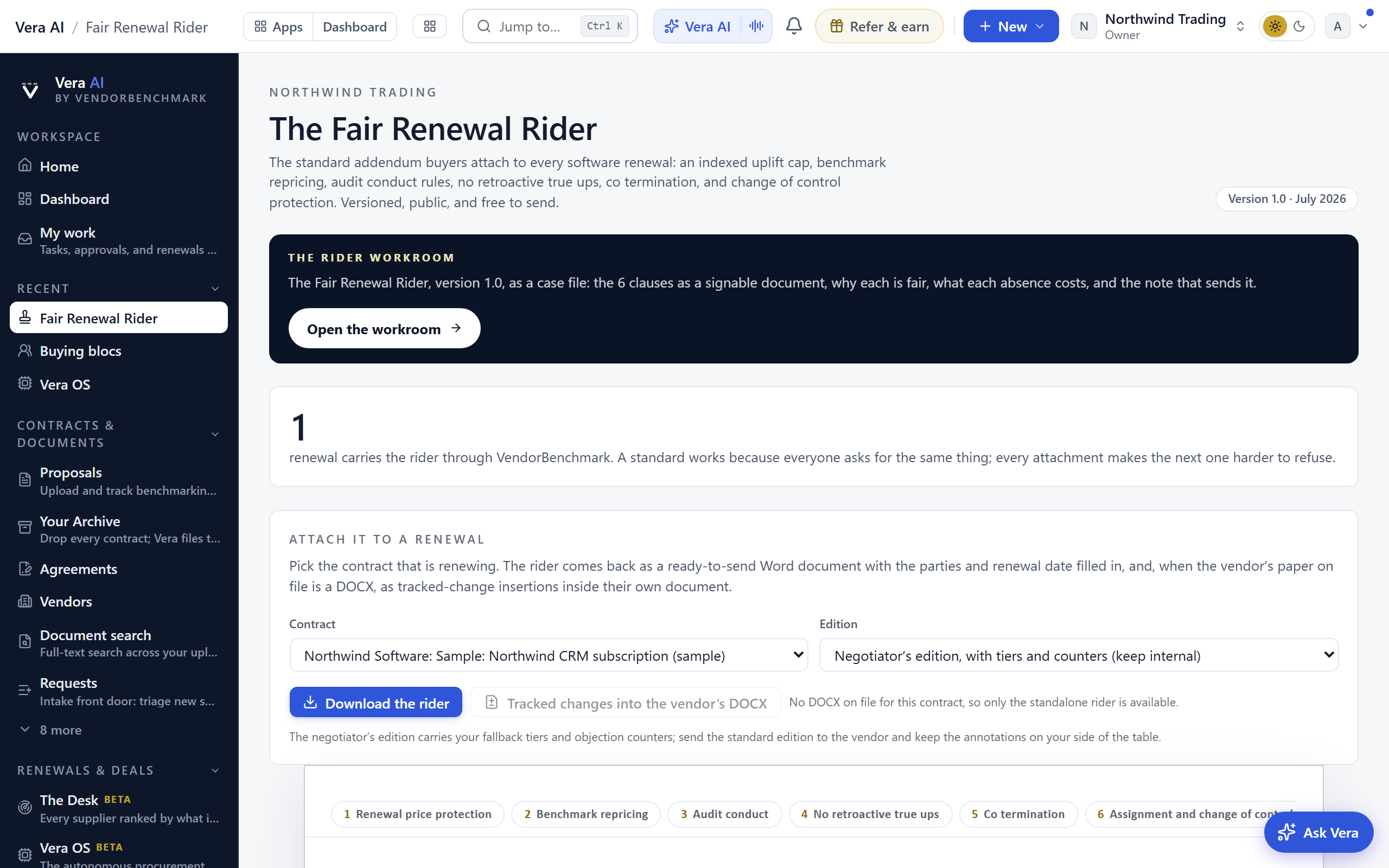
The work.
- The gap is caught by standard, not by vigilance. The Contract policy comparison flags the quote's silence on uplift against your recorded position and drafts your pre-approved language; the Coverage sweep would catch the same hole across the whole estate.
- The fix travels as one attachment. The Fair Renewal Rider generator produces the ready-to-send edition with the parties filled in, its indexed uplift cap doing the work the quote left undone, and the 30 day notice window argues for answering now rather than at the deadline.
- The negotiation is small and specific: the cap, the notice window widened, and the price checked once against the market (a quick instant benchmark is enough at this size).
- The outcome joins the year's story. The recorded result reconciles against the invoices that follow into the realized savings on the Savings statement, and at quarter end the verified set, this case included, goes to finance (the reporting recipe).
What it comes to. A deal that was "fine" on price and dangerous on structure, repaired for the cost of one attachment and one ask, and a savings ledger that ends the year answering for itself.
With your own vendor. Record your positions once, sweep the estate once, and let the standard catch what tired eyes miss. The rider goes on every renewal; the proof discipline goes on every outcome.
Related: Common workflows · Your first 30 days · Delivered reports
Next: Chapter 21 · The Vera handbook
Was this page helpful?
Thank you. Your note goes straight to the team that writes this manual.