See what every agent actually does, drawn as its pipeline
We rebuilt the Agent Center around a simple question buyers kept asking: what does this agent actually do before I trust it with my renewal? Now you can see the wire.
Here is a problem procurement teams recognise. You are handed a page of AI agents with confident names, and no clear account of what each one reads, what it changes, and what it leaves behind. You are asked to trust automation over renewals and invoices, which is to say over money and legal exposure, on the strength of a label. Most buyers respond the only sensible way, by turning the agents off and doing the work by hand. The PRODUCT UPDATE · FROM THE ANALYST DESK today is our answer to that. The Agent Center is now one page that explains itself visually. Every agent is drawn as its working wire: what it reads on the left, what it does in the middle, and the artifact it lands on the right.
The wire is the explanation
An agent is not a personality, it is a pipeline. It has inputs, a transform, and an output you can inspect. So we drew it that way. Open the Agent Center and each agent appears as a wire from source to artifact. The billing audit, Renewal Autopilot, and the benchmark white paper writer are drawn at full size because those are the three that move money, work deals, and produce deliverables you actually carry into a negotiation. Every other agent expands in place when you want the detail, so the page stays legible instead of drowning you in twenty open boxes at once.
The point of the wire is auditability before consent. You should be able to trace a claim to its source and an action to its artifact. When the billing audit says it caught a duplicate license charge, the wire shows the invoice line it read and the reconciliation record it landed. That is the same standard we hold our reports to, where a deliverable beats an answer precisely because you can check it.
The floor opens with proof, not promises
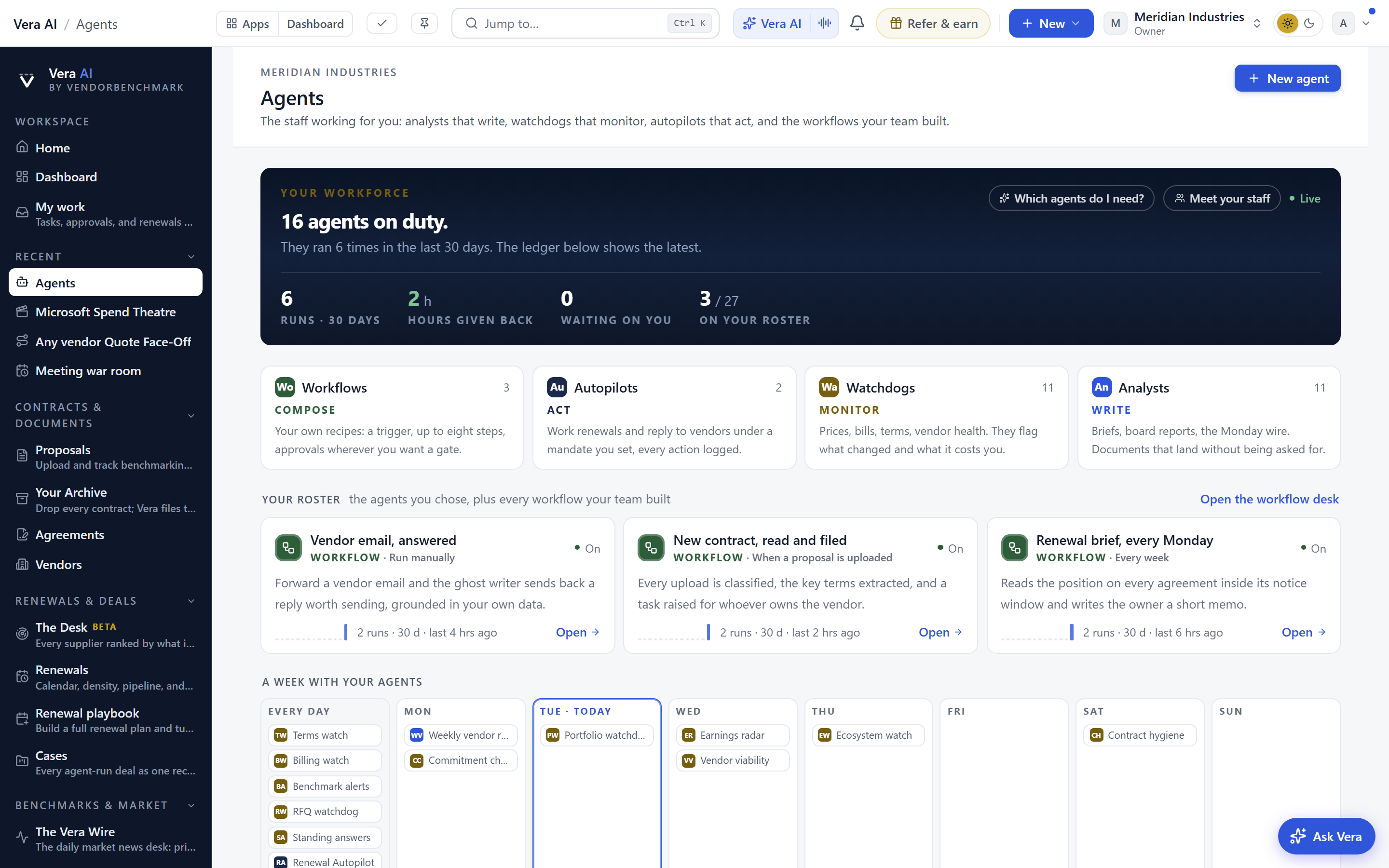
Below the wires, the floor opens with a shift board: thirty days of provable marks set beside the money ledger. Findings the agents raised, verified money they recovered, recorded runs you can replay, and the scheduled week ahead. This is the difference between an activity feed and an audit. An activity feed tells you something happened. The shift board tells you what was found, what was verified, and what is booked next, with the money ledger sitting right there so the claims and the recoveries live on the same page.
We deliberately put the scheduled week ahead on the same board as the past thirty days. Procurement runs on a calendar, and the renewals that hurt are the ones that slip past unwatched. If you have read our note on the auto-renewal clause, you know the window is everything. The shift board makes the window visible.
Three plain groups, not a class taxonomy
We retired the class taxonomy. Buyers do not think in agent classes, they think in outcomes. So the agents are now sorted into three plain groups: money they catch, deals they work, and documents they write. Money they catch is the billing audit and the anomaly watchdog, the ones that reconcile invoices and flag the leaks before the invoice does. Deals they work is the renewal and negotiation side, including Renewal Autopilot. Documents they write is the report and rider side, the benchmark white paper writer and the Fair Renewal Rider drafter.
Across the whole surface you have six specialist agents and thirteen inbox agents, backed by 99 background jobs. The grouping does not change that count, it changes how you find the one you need. When the CFO asks whether you are overpaying, you go to money they catch, not to a taxonomy tree you have to decode first. That maps to how we answer the overpayment question in one page.
The Watch, Draft, Act dial redraws before you grant it
The most important change sits on the Autopilot's wire. Automation over renewals is exactly where buyers are right to be nervous, so we made the consent explicit and visual. The Watch, Draft, Act dial redraws what lands at each setting before you grant it. At Watch, the wire ends in a finding and an alert, nothing leaves the building. At Draft, it ends in a prepared message or rider you review and send yourself. At Act, it ends in an action taken on your behalf, inside the boundaries you set.
You see the artifact each setting produces before you commit to it, not after. That is the whole design. Most teams will live at Draft for the deals that matter and reserve Act for the low-stakes, high-volume reconciliation work. Nobody is asked to hand over signature authority in the dark.
What changes for a procurement buyer
What this does not do
Three honest limits. First, the wire is only as good as the data feeding it. An agent that reads invoices needs those invoices connected, and if a billing export is missing, the artifact will be thin. The drawing shows you what it read, which is exactly how you spot the gap, but it cannot invent data you have not given it. Second, the Watch, Draft, Act dial governs what agents do, not what people around them do. If your sign-off chain approves a bad number, Act will execute it faithfully, so the approval discipline still lives with your team. Third, verified money on the shift board means money the audit could reconcile against a record. Savings that require a negotiation to land are shown as findings, not as booked recoveries, because we will not count a claim as cash until it is.
None of this replaces judgement. It gives judgement something to work with: a legible wire, a proof board, and a consent dial you can actually reason about. Open the Agent Center and read one wire end to end. If it does not tell you plainly what it reads, does, and lands, we have more work to do. We think it will.
Want to be updated when major licensing and pricing changes land? One analyst brief a week: the price rises, metric changes and audit campaigns that move software costs. Work email only.
Morten brings two decades of enterprise and software procurement, with stints across Oracle, IBM, SAP, and Salesforce shaping how he reads a deal. He has led sourcing through hundreds of renewals, from mid market order forms to nine figure global agreements, and learned that the buyers who win are the ones who walk in knowing the market. He built VendorBenchmark to make that pattern recognition repeatable.