A contract estate usually arrives as a folder tree, a register someone keeps in a spreadsheet and a shared drive nobody has opened in a year. The first question a CFO asks of it, what do we hold and what does it cost, has no quick answer while the paper sits there unread.
The Enterprise Uploader is how Vera AI by VendorBenchmark takes in a whole estate, and it is the first step of the Entitlement Agent. Here is what it does with 500 contracts between a morning upload and the end of the day, and what it leaves for a person.
The morning is one drop and a short transfer
An owner starts the run, because it writes thousands of records. The estate goes in however it lives today: a folder tree dragged onto the window, a ZIP archive, a connected SharePoint, Google Drive or Box library, a private email address or the intake API. Your contract register can ride in the same upload. It maps itself, and a dry run shows what it would create, update and reject before anything is written.
The transfer moves documents six at a time: about two minutes for a hundred documents of ordinary size on a decent connection, about twenty for a thousand. Every file is checked on the way in:
- Proven by its bytes. It must be a real PDF or Word document whatever it is called, checked on upload and again before reading.
- Caught as a duplicate by content. A byte identical copy is skipped and names the file it matched. Two order forms with the same name a week apart stay two.
- Named when refused. A file the read cannot take is listed with the reason, never dropped in silence.
Before anything is extracted, a first pass counts the files and pages, names the vendors and shows how long the read will take at the scope you chose. Eight standard questions are asked of every document, from the legal entity it is made out to and its uplift protection to audit and divestment rights, and you can add up to eight of your own. Nothing is extracted until you confirm.
The day belongs to the read, not to you
Once you confirm, reading starts with the first documents that land. Reckon on roughly a hundred documents an hour: nearer sixty for long master agreements, over two hundred for short order forms. Five hundred take most of a working day. The read runs on the server, several documents side by side, so it needs neither the tab nor you, and it carries on overnight.
Each document is filed under its vendor as its terms land. Folders follow the company, not the signing entity: paper signed with Salesforce UK Limited, salesforce.com inc and Salesforce files under one Salesforce. Each row fills in with its end date, its annual value and its total over the term.
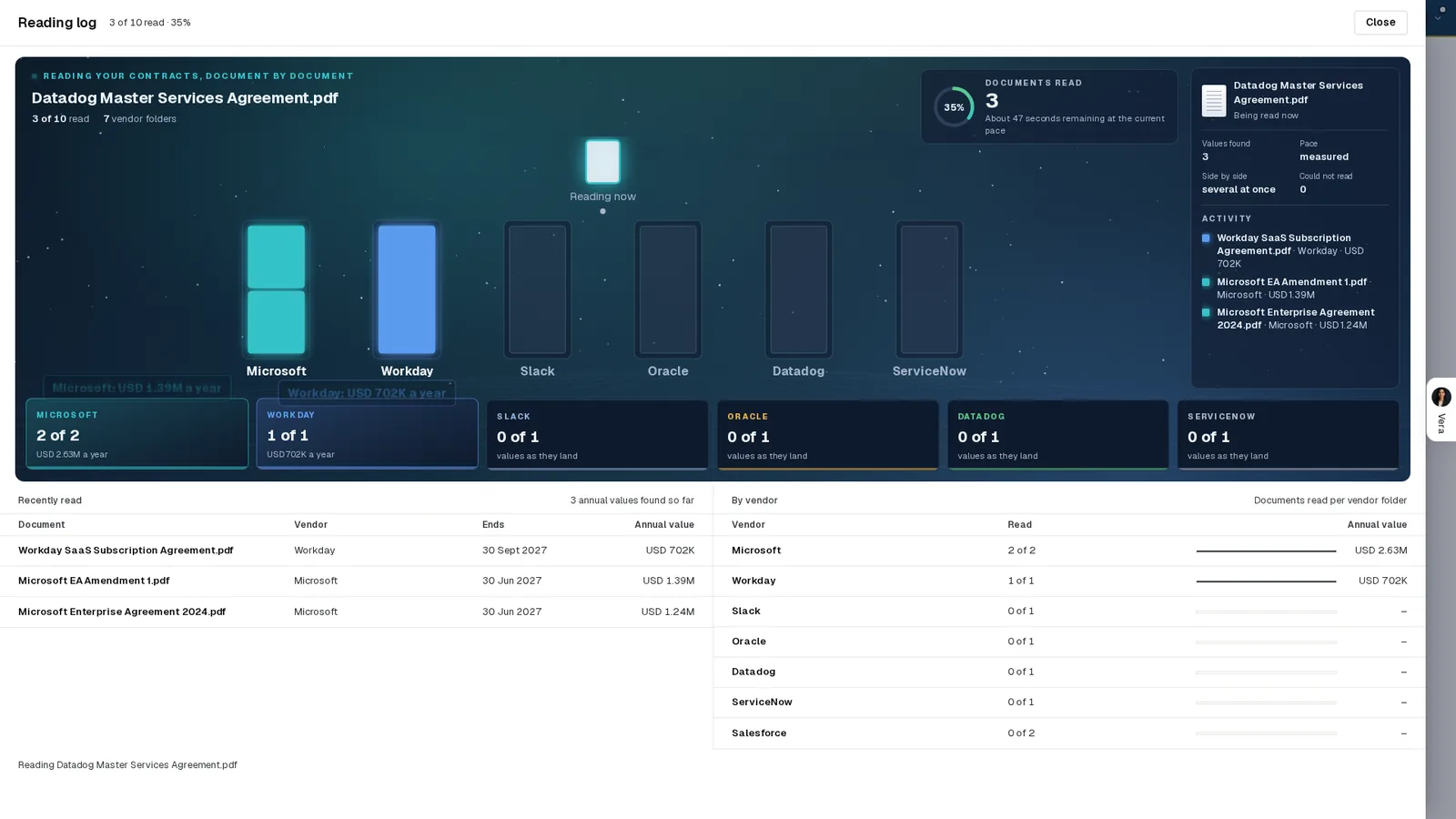
The reading log. The document being read at the top, one column per vendor folder filling as its documents land, and the time left at the pace the run is holding. Under it, each document read with its vendor, its term end and its annual value.
By evening the estate has a shape
When the read finishes, the run moves to review by itself and the routine work is already done. Byte identical duplicates are gone, a vendor's regional companies are folded onto the parent, and a master agreement and its amendments are bound into one contract, the newest document winning on each term separately. Every judgment sits on the Changes tab with its evidence.
What is left for a person is one board, grouped Blocking, Questions, Not blocking and Suggestions, with the money at stake first in each group. By the end of the day you know:
- What you hold. Every agreement by vendor, with its term end, annual value and total over the term.
- What each one grants. In the Entitlement Agent, every priced line with its quantity and its list and net price.
- What is missing. The agreements your documents name and the estate does not hold.
- How complete the record is. The scorecard, computed from the stored rows.
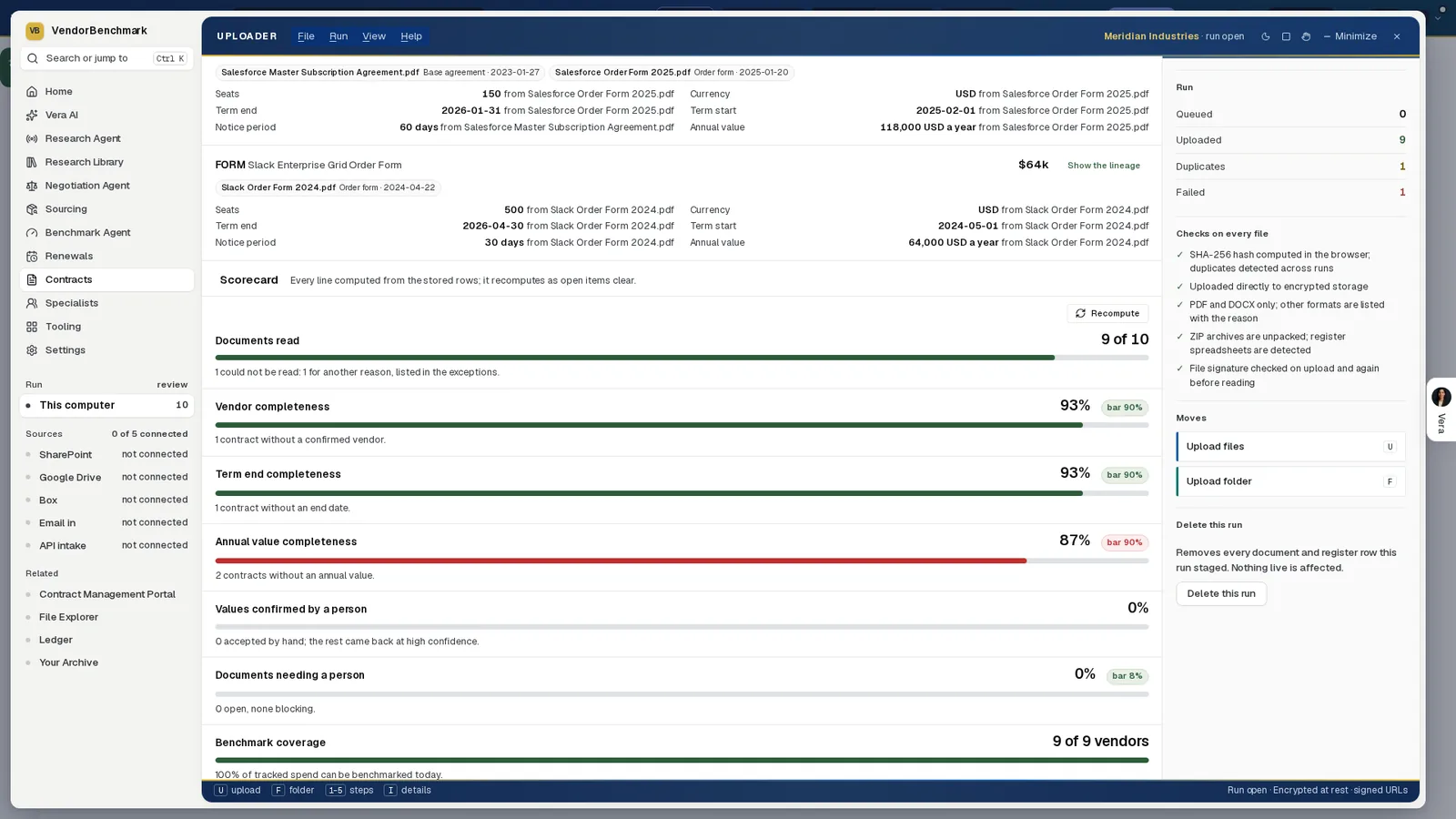
The scorecard. Documents read, then vendor, term end and annual value completeness against a bar, values confirmed by a person, documents needing a person and benchmark coverage. Every line is computed from the stored rows and recomputes as open items clear.
Nothing is live until an owner signs it off
Everything a run loads is held in staging: no renewal alert fires, no digest counts it and no other agent reads it. The estate becomes real in one transaction when an owner presses Go live, and the acceptance is written to the audit log with the scorecard attached.
Tick Benchmark on go live and Vera places every agreement against the market in the background, from Poor to Top of the market, with the gap over the term. Where a document cannot be placed, the verdict says so rather than inventing one.
Loading an estate is only loading an estate. Nothing fires until an owner presses Go live.
The run then prints an acceptance certificate with the scorecard as signed, verification coverage by spend tier and a signature block. For seven days a go live can be rolled back to staging in one transaction.
Where it sits among the contract agents
The day one read builds the record. The rest of the cluster works from it.
- The Entitlement Agent keeps the register of every priced line the read found.
- The Document Agent answers one question across every contract the run brought in.
- The Contract Agent reviews any one of them clause by clause.
For the app itself, see the Entitlement Agent page; for the whole cluster, read the contract intelligence guide.
What to do first
- Play the sample import. It runs the count, the estimate and the run on 10,000 sample files, so you see every stage before your own paper goes in.
- Bring the register. Put your contract spreadsheet in the same upload and read the dry run before anything is written.
- Upload in the morning. Keep the tab open for the transfer, then close it. The read runs on the server.
- Work the board, then go live. Clear the blocking items, read the scorecard, tick Benchmark on go live and press Go live. You have seven days to roll it back.
Questions buyers ask
How long does it take to read 500 contracts?
Most of a working day. Reading runs at roughly a hundred documents an hour, nearer sixty for long master agreements and over two hundred for short order forms, and it starts as the first documents land.
Will loading the estate email anyone?
No. Everything is held in staging, invisible to alerts, digests and other agents, until an owner presses Go live. Renewal alerts stay off until each person switches them on.
What if the same contract is uploaded twice?
Duplicates are caught by content, not by file name. A byte identical copy is skipped and names the file it matched; two order forms with the same name a week apart are kept as two.
Can we undo a go live?
Yes, for seven days. Roll back this go live returns the whole estate to staging in one transaction and reopens the run at sign off. Alerts already sent stay sent.