AI Managed is the agent in Vera AI, the platform from VendorBenchmark, that reads a renewal's contract, benchmarks its price and negotiates with the vendor by email inside limits you set, for buyers with more renewals than hours. Every first email and every offer comes back to a person, one at a time. This illustrative case study follows a single renewal through AI Managed from the hand over to the decision.
It is an illustrative case study, not a customer story. It is built on Northwind Trading, the sample company every Vera AI free trial opens with, and on the steps the product actually runs. The hours are illustrative.
PART ONE
The situation: a small renewal nobody has time for
Picture a procurement lead with about 150 software contracts. One of them is a collaboration tool for a few hundred users, renewing in three months. It is too small for a negotiation plan and too large to ignore. The contract renews on its own unless notice is given, a pattern we covered in the auto-renewal clause.
This is the renewal AI Managed is built for. Its own page names two cases: the long tail of small renewals that never get your time, and a busy quarter when every renewal is moving at once.
PART TWO
The time it saves on a renewal by email
A negotiation by email is slow in elapsed days and cheap in attention. The comparison below counts only the buyer's own time.
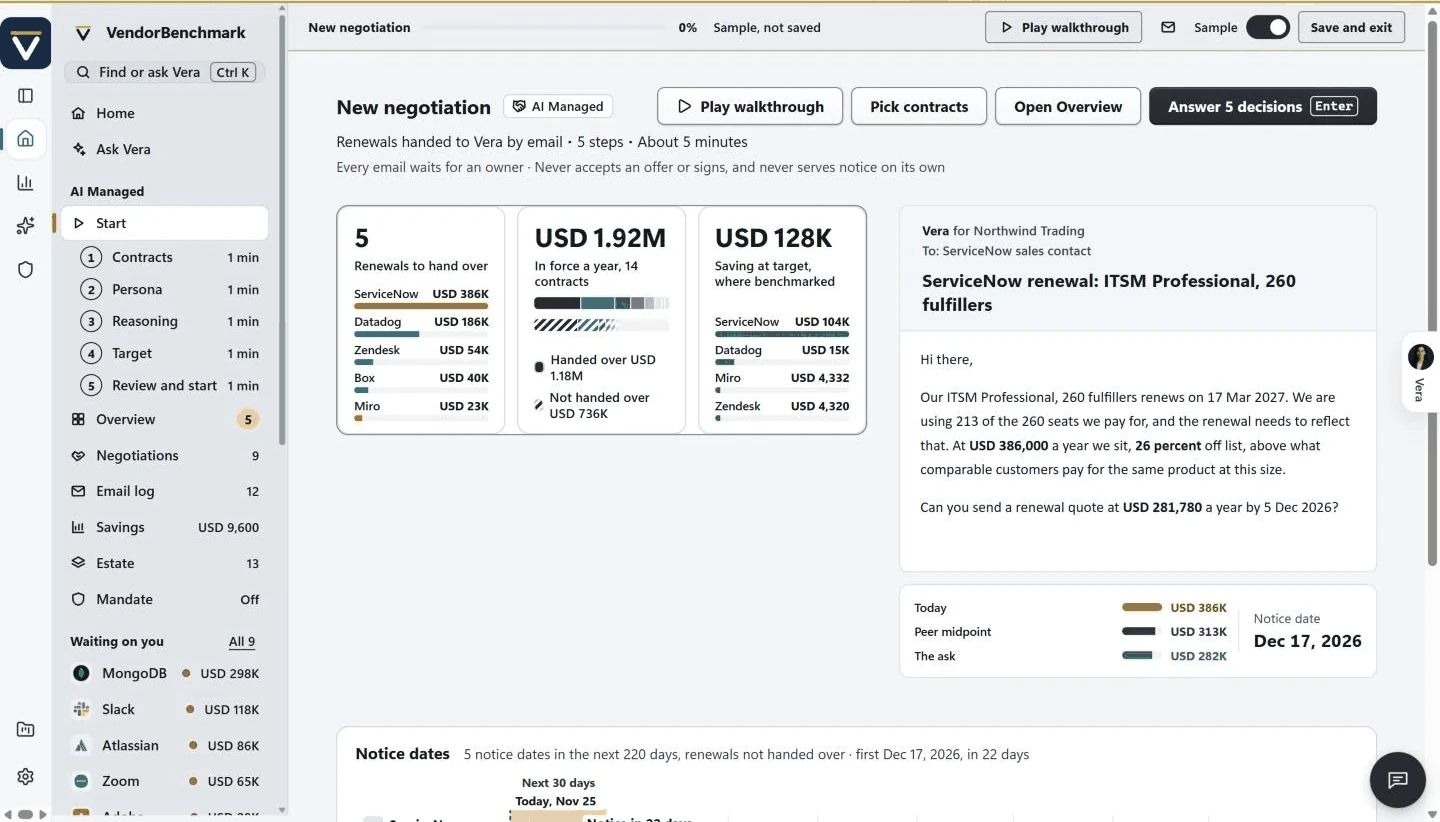
AI Managed on sample data: the renewals to hand over, beside a drafted renewal email with today's price, the peer midpoint and the ask.
THE SAME JOB, TWICE
TODAY, BY HAND
- Find the contract and read it for the renewal date, the notice deadline and the uplift
- Look for a market price, and usually go without one on a renewal this small
- Write to the vendor asking for a better price, then follow up twice when nobody answers
- Compare the offer with last year's invoice and decide, often days before the deadline
Roughly 3 hours for one small renewal, spread over several weeks, which is why most are never negotiated
WITH VERA
- Select the renewal in AI Managed, or drop the contract as a PDF or Word file
- Set the approach, the threshold and the justifications once for the estate
- Read the first email, with today's price, the peer midpoint and the ask, and approve it
- When the vendor replies, accept the offer, draft a counter or hold it for 7 days
About 5 minutes to hand over, then about 5 minutes on the first email and 5 on each offer
What changes: roughly 3 hours a renewal becomes about 15 minutes: 5 to hand over, 5 to approve the first email and 5 to decide the offer. For example, 10 small renewals handed over together is about 5 minutes plus about 10 minutes each, or about 105 minutes against roughly 30 hours by hand.
What the time depends on: how quickly the vendor answers, how many rounds the offer takes, whether the contract names a vendor contact, and whether an owner is free to approve. A vendor that goes quiet adds days, not minutes of yours, because the follow ups are scheduled.
PART THREE
How to hand a renewal to AI Managed, step by step
- Pick the renewal. Select it from the contracts on file, or drop a PDF or Word file. The vendor, the value and the renewal date are read off the contract.
- Choose the approach. Collaborative, balanced or aggressive. Balanced, for example, asks below the peer midpoint, follows up after 7 days of silence and names the alternatives once.
- Set the threshold. A value a year. Under it the AI emails the vendor. Over it a negotiator drafts a mandate for an owner to approve.
- Choose the justifications. You pick the arguments the AI may use, such as a limited budget. It uses one only when it is true for that contract.
- Read the first email and hand over. The first email is written before you commit. Read it, then hand the contract over.
- Approve the send. An owner approves the first email, adding the vendor's contact where the contract names none. It goes out with you copied.
Before that first email is written, the AI has done three things: read the renewal date and the notice deadline, written the plan with its dated moves, and benchmarked the price against comparable customers. The options are set once for the estate. A run keeps the approach it started with.
PART FOUR
The thread: the email, the silence, the offer
The email asks for a better price and gives a reason you allowed. It names itself as written by an AI. Then the usual thing happens, which is nothing. With a balanced approach the follow up is scheduled for 7 days of silence, and you can cancel it in the Email log if you would rather wait.
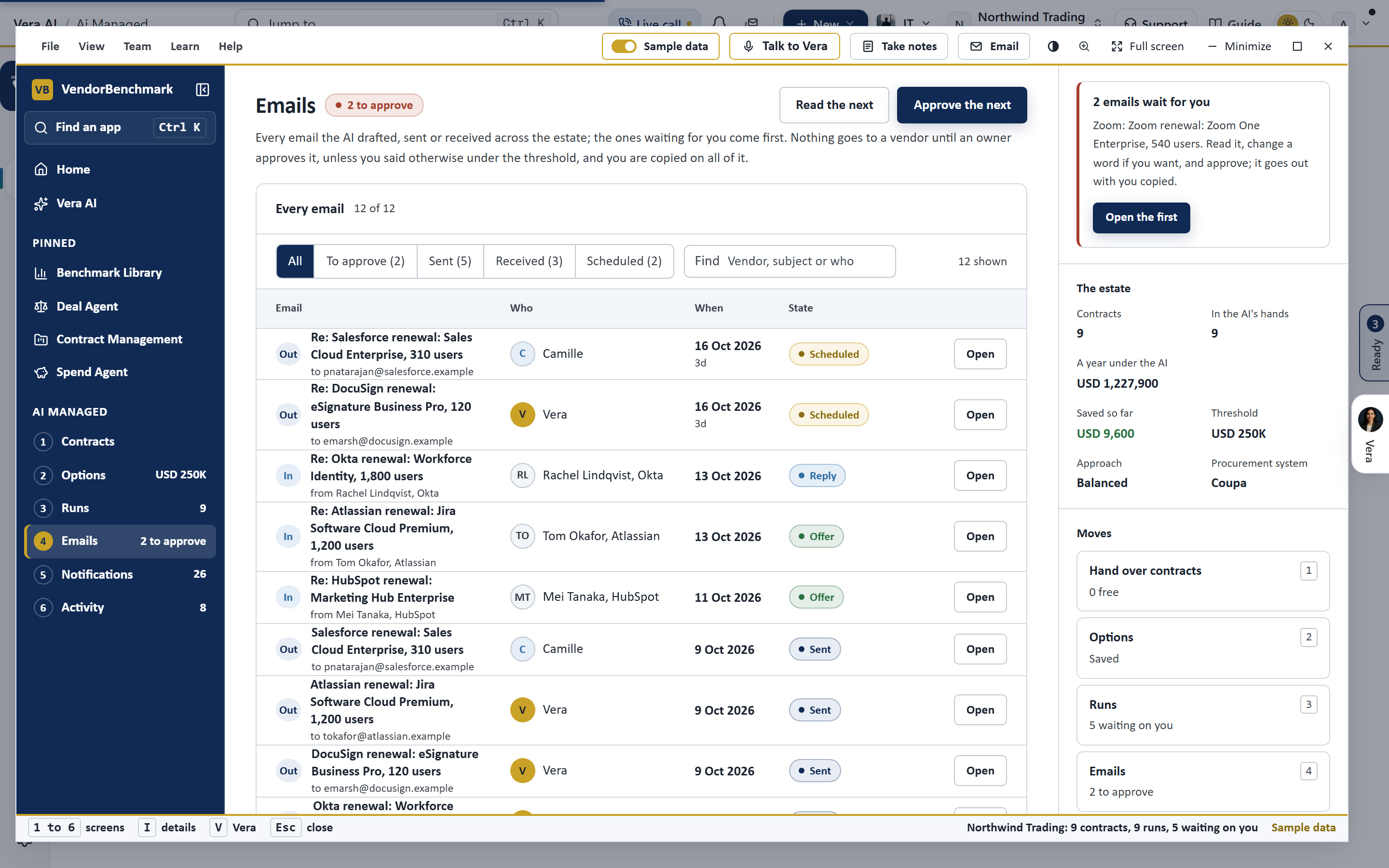
The Emails screen in AI Managed on sample data: the drafts waiting for approval first, then what was sent, received and scheduled.
When the vendor replies with an offer, the run pauses and the offer comes to you. There are three moves. Accept it. Move the counter to the figure you want and have the counter drafted, then approve that email. Or hold it for 7 days. Reject an offer with a steer and the AI counters again.
Throughout, the runs board shows where every renewal stands: waiting on you, the AI working, waiting on the vendor, or agreed and closed. How this fits with the other negotiating agents is covered in how AI agents negotiate for you.
The AI writes the emails. A person says yes to the price.
PART FIVE
What the AI does, and what stays with you
The AI reads the contract for the renewal date, the notice deadline and whether it renews itself. It researches the vendor: its fiscal window, how it behaves at renewal, what it tends to concede and the alternatives. It benchmarks the price: where the deal ranks and the range comparable customers land in. Then it drafts every email in the thread and reads each reply.
Each email to a vendor is checked against the deal's mandate on the exact words that will go. Only a clear result sends. A flagged email is held and shows the reason, so you edit the email or the mandate and try again.
What stays with you is every commitment. Nothing goes to a vendor unless your settings allow it or you approve it. The AI never accepts an offer, never signs and never serves notice. Your approvers sign off in the order your policy sets, and signers sign in DocuSign or Acrobat Sign, after Check before you sign has read the final paper.
PART SIX
Where it stops
- It does not decide the price. Every offer the vendor makes comes to a person. The AI can ask and counter. It cannot agree.
- It does not handle large renewals alone. Over your threshold, a negotiator drafts a mandate for an owner, and the plan for a large renewal comes back to you first.
- It does not hide what it is. It never writes to a vendor without naming itself as an AI.
- It can be stopped. Stop all sending pauses every vendor at once, and a single negotiation can be put on hold.
This example shows no saving, because an illustrative case study has no vendor on the other side. The Results screen reports what was saved renewal by renewal once real offers are accepted. The limits every agent works under are set out in what we will not let the AI do on your deals.
PART SEVEN
Common questions
- Which renewals suit AI Managed? The long tail of small renewals that never get your time, and a busy quarter when every renewal is moving at once.
- Does AI Managed send emails without asking? Nothing goes to a vendor unless your settings allow it or you approve it. Every first email comes back to a person.
- What happens when the vendor makes an offer? The run pauses and the offer comes to you. You accept it, send a counter or hold it. The AI never accepts on its own.
- Can I change the approach later? Yes. The approach, the threshold and the justifications are set once for the estate and can be changed any time. A run keeps the approach it started with.
- Who signs the renewal? Your approvers sign off in the order your policy sets, and signers sign in DocuSign or Acrobat Sign. Vera never signs.
To follow the same thread yourself, start a free trial, no card required. Open AI Managed and switch on Sample data. The sample company, Northwind Trading, has renewals at each stage, with drafts waiting, emails sent and offers received. Play walkthrough runs the whole job on the sample, and nothing is sent to anyone.