A vendor's account team knows what comparable customers pay for the same product at the same size. The buyer across the table usually does not, and negotiates the renewal anyway. A benchmark closes that gap only when it gives an answer a buyer can act on: a price, a range and a rank, in dollars.
This guide covers how Vera AI by VendorBenchmark benchmarks a software price: the three answers every benchmark gives, the three speeds you can have them at, and the tools that price what surrounds a deal, the alternatives to the incumbent and the competing proposals on the table. Each card below opens a full article.
Six articles, one method
Three of the articles cover how a price is benchmarked. Three cover the work around it: the alternatives, the proposals and the library underneath.
Instant, 10 minutes or 24 hours: how to choose a benchmark
The library, the AI benchmark and the analyst: what each needs and when each is right.
Read it → 2.2 · Benchmark LibraryThe order form prints no list price. Here is how to benchmark it.
Rate against rate on what the paper states, and what to ask the vendor to confirm in writing.
Read it → 2.3 · Is this a good deal?The three answers every software benchmark owes you
The cost, the peer range with its midpoint and the rank in plain words. Why a percentile is not one of them.
Read it → 2.4 · Competitive scenariosPricing the alternatives before you renew
Three to five credible alternatives priced over your term, with license, migration and transition cost.
Read it → 2.5 · Proposal comparisonTwo proposals, every change priced
Each pricing and term change marked improved, worse or unchanged, and competing quotes lined up.
Read it → 2.6 · Benchmark LibraryInside the Benchmark Library: how a software price is graded
How the library is built, graded and refreshed, and what you see when you search it.
Read it →Every benchmark gives three answers, in this order
A buyer holding a quote has three questions, and a benchmark should answer them before anything else. Ours do, in the same order and the same format, whichever speed produced them.
- What the deal costs, and how that compares. Where the paper prints a list price, the answer is your discount off list, with the list and the net it comes from. Where it prints none, the answer is your rate per user or per unit against what comparable customers pay for the same product at the same size.
- What comparable customers get. A plain range with its midpoint, for the same product at the same size, adjusted for region, industry and the period you sign in.
- Where the deal ranks. One of five words, Poor, Below market, At market, Good or Top of the market, with the gap in points and in money over the term.
Then comes the work: the supported target, the asks in order and the email to the vendor, drafted from the same figures. On a line priced as a rate, such as a percent of collections or a renewal increase, lower is better and every sentence turns with it.
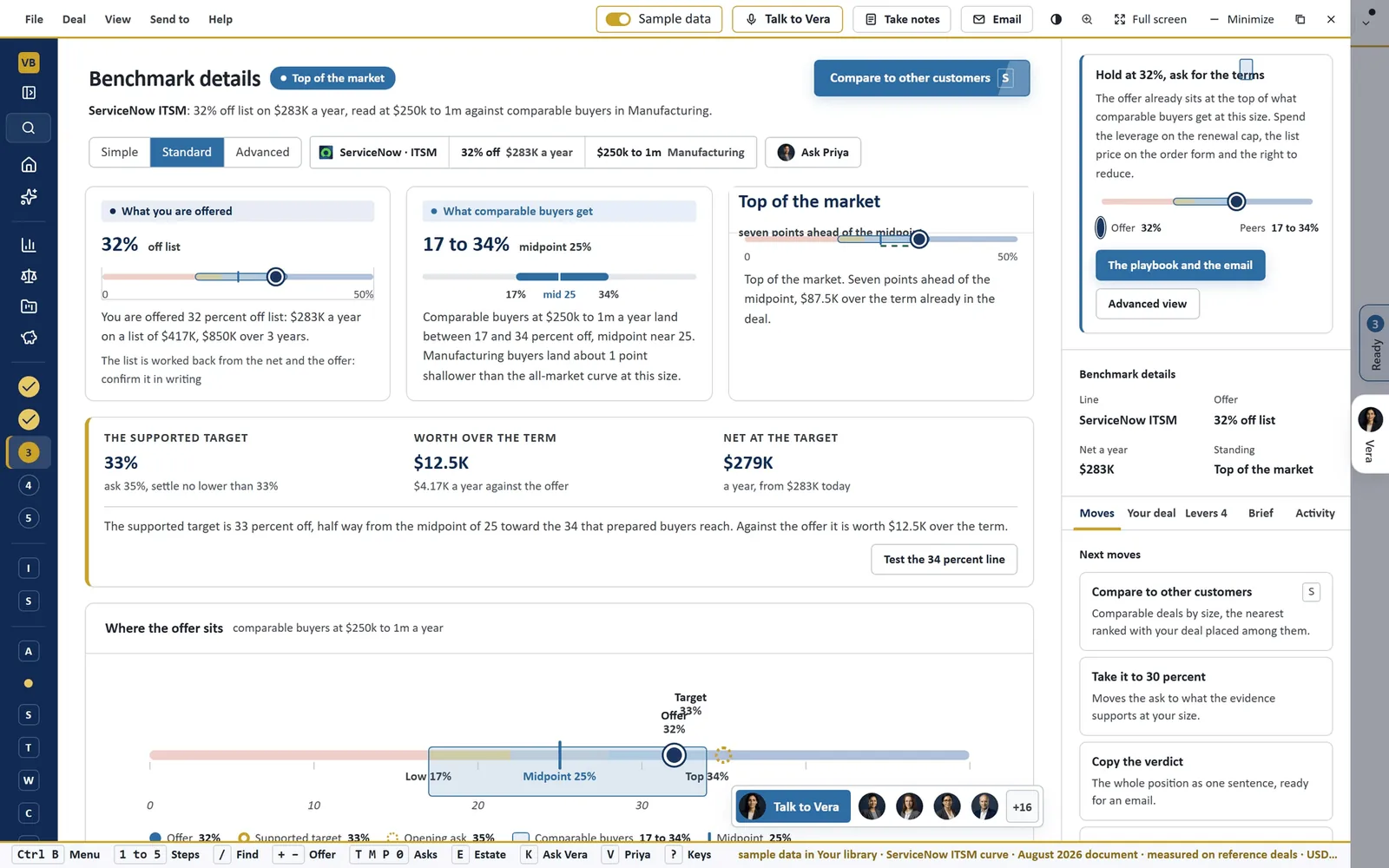
The three answers on one screen. The Benchmark Library on a sample ServiceNow ITSM offer: what you are offered, what comparable buyers get with the midpoint, and where it ranks, here Top of the market. Because the offer already sits at the top, the advice on the right is to hold the price and ask for the terms.
How a benchmark moves
The steps are the same at every speed. What changes is who reads the paper and how long it takes. You decide at both ends: what goes in, and what goes to the vendor.
You bring the deal
Type the vendor, the annual value and the discount, or drop the quote, order form or contract.
At the speed you chose
Seconds in the library, 5 to 10 minutes for the AI benchmark, within 24 hours from an analyst.
Read and placed
Prices and term off the paper, set against comparable customers for the same product at the same size.
The ask, drafted
The supported target, the asks in order and the email to the vendor, from the figures on screen.
You send it
From your own mail, when you are ready. Nothing sends from the platform.
Three speeds, one data set
All three run on the same data and return the same answers in the same format. Pick by what you hold and what is at stake.
| Speed | You bring | You get back | Right when |
|---|---|---|---|
| Benchmark Library, in seconds | The vendor, the annual value and the discount offered, or I don't know where the quote prints no list | The three answers, the supported target, the levers that move the price and a drafted email | A quote just landed and you want a first read before you reply |
| AI benchmark, 5 to 10 minutes | The quote, order form or contract, PDF or Word, up to 25 MB | A price benchmark, a terms benchmark and an options memo for management, plus the asks in order | You hold the paper and the terms matter as much as the price |
| Human benchmark, within 24 hours | The proposal, quote or contract, up to five files, with a note | A report written by an analyst, as Word and PDF, by email and in the window | The deal is big, unusual or headed for the board |
There is a fourth way when the question is the whole book rather than one deal. The estate benchmark in the Benchmark Agent places every contract in the workspace in one run: discount against the curve where a contract states a list, rate against rate where it does not, and a request for a rate card where it states neither. The report ranks where the money is and comes with a board deck and an Excel workbook that carries the formulas behind every figure.
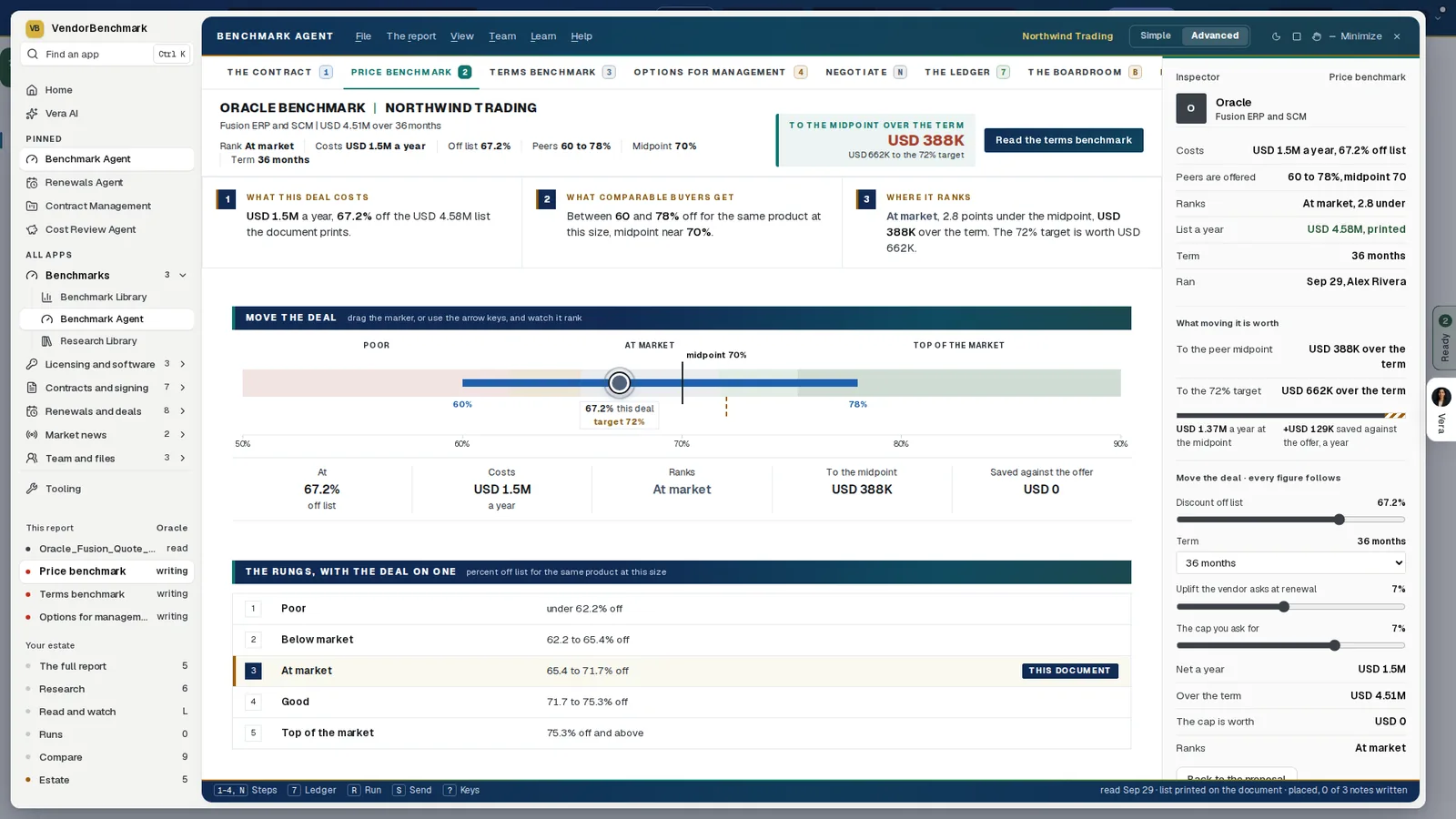
The AI benchmark, read from the paper. The Benchmark Agent's price benchmark on a sample Oracle Fusion ERP and SCM order: 67.2 percent off the list the document prints, comparable buyers between 60 and 78 percent with a midpoint near 70, ranked At market. The status bar records the basis: list printed on the document.
Why the answer has to be a rank and a dollar figure
A percentile says where a deal sits among other deals. It does not say whether to sign, what to ask for or what the gap is worth, and with a small peer set it moves a few points on noise. So a percentile appears in our work only late, as part of the basis, never as the finding. When too few comparable customers match a deal to rank it honestly, the page says so instead of printing one.
The same discipline applies to the list price. A percentage off a list you cannot find on your own paper reads like a measurement and is not one. Where the paper prints no list, we compare rate against rate and say so plainly, and the report names what to ask the vendor to confirm in writing. The same deal returns the same figures to everyone.
A benchmark should tell a buyer what to do next. A percentile does not.
A benchmark also has to be willing to say a deal is fine. When an offer already sits at the top of the market, the library says to hold the price and spend the leverage on the terms: the renewal cap, the list price on the order form and the right to reduce. When the rate case is closed, the brief says so, and the value left is in the structural terms.
When you want an analyst, or a negotiator
Some deals deserve a person. Human benchmark, in the Ask a human app, takes the proposal, quote or contract, up to five files, and a VendorBenchmark analyst writes the report by hand within 24 hours of submission. You follow the ticket through Received, Assigned, In progress and Delivered. The report arrives as Word and PDF, by email and in the window, and everyone you named on the request gets the same email. A report you want changed can be resubmitted, free of charge, twice per request.
Where you would rather hand the deal over, our negotiators can run it on top of the benchmark: the strategy, the calls with the vendor and the paper. You pay one fixed fee agreed up front, or 25 percent of the saving measured against the vendor's quote, with no fee when nothing is saved. The signature stays yours.
What to do first
- Check one quote in the library. Open the Benchmark Library, type the vendor, the annual value and the discount offered, and read the three answers. In the Is this a good deal? check, tick I don't know if the quote prints no list price.
- Upload the paper. Drop the order form on the Benchmark Agent and read the price benchmark first, then the terms benchmark.
- Send the big one to an analyst. Submit the renewal with the most at stake in Ask a human, with a note on what you need back.
- Run the estate. Once your contracts are loaded, run the estate benchmark and start with the gaps worth the most money.
Questions buyers ask
Which speed should I use?
Start from what you hold. With a vendor name and a number, the Benchmark Library answers in seconds. With the quote or order form, the AI benchmark reads it in 5 to 10 minutes. For a deal headed to the board, an analyst writes the report within 24 hours.
What if the quote prints no list price?
Then no discount off list is printed. The benchmark compares the rates the paper does state, per user or per unit, against what comparable customers pay for the same product at the same size, says so plainly and names what to ask the vendor to confirm in writing.
Do you show percentiles?
Not as the answer. The answer is the cost, the peer range with its midpoint and the rank in plain words. Where too few comparable customers match a deal to rank it honestly, the page says so instead of showing a noisy figure.
Can I benchmark every contract at once?
Yes. The estate benchmark in the Benchmark Agent places every contract in the workspace in one run and ranks where the money is, with a board deck and an Excel workbook beside the report.