The quote arrives with a date on it. The vendor wants an answer before its quarter closes, and someone in finance wants to know whether the price is fair before then. The right benchmark is the one that answers in time, with enough depth for what is at stake.
Vera AI by VendorBenchmark offers three speeds on one data set: the Benchmark Library in seconds, the AI benchmark in 5 to 10 minutes, and Human benchmark, in the Ask a human app, within 24 hours. Here is what each needs, what it gives back, and how to choose.
In seconds: the library, from three figures
The Benchmark Library needs no upload. On its Deal screen you type the vendor, the annual value and the discount offered, choose the term and press Benchmark it. The answer comes back in seconds: what you are offered, what comparable buyers get with the midpoint, where the deal ranks, and the supported target with what it is worth over the term.
Under the answer sit the six levers that move the price: the signing month, the competitive position, the term, the payment, growth and a customer reference, each with the points and the dollars it adds. Move one and every figure follows. When a quote prints no list price, the Is this a good deal? check takes a tick in I don't know, says what others get, and drafts an email that asks the vendor for the list price.
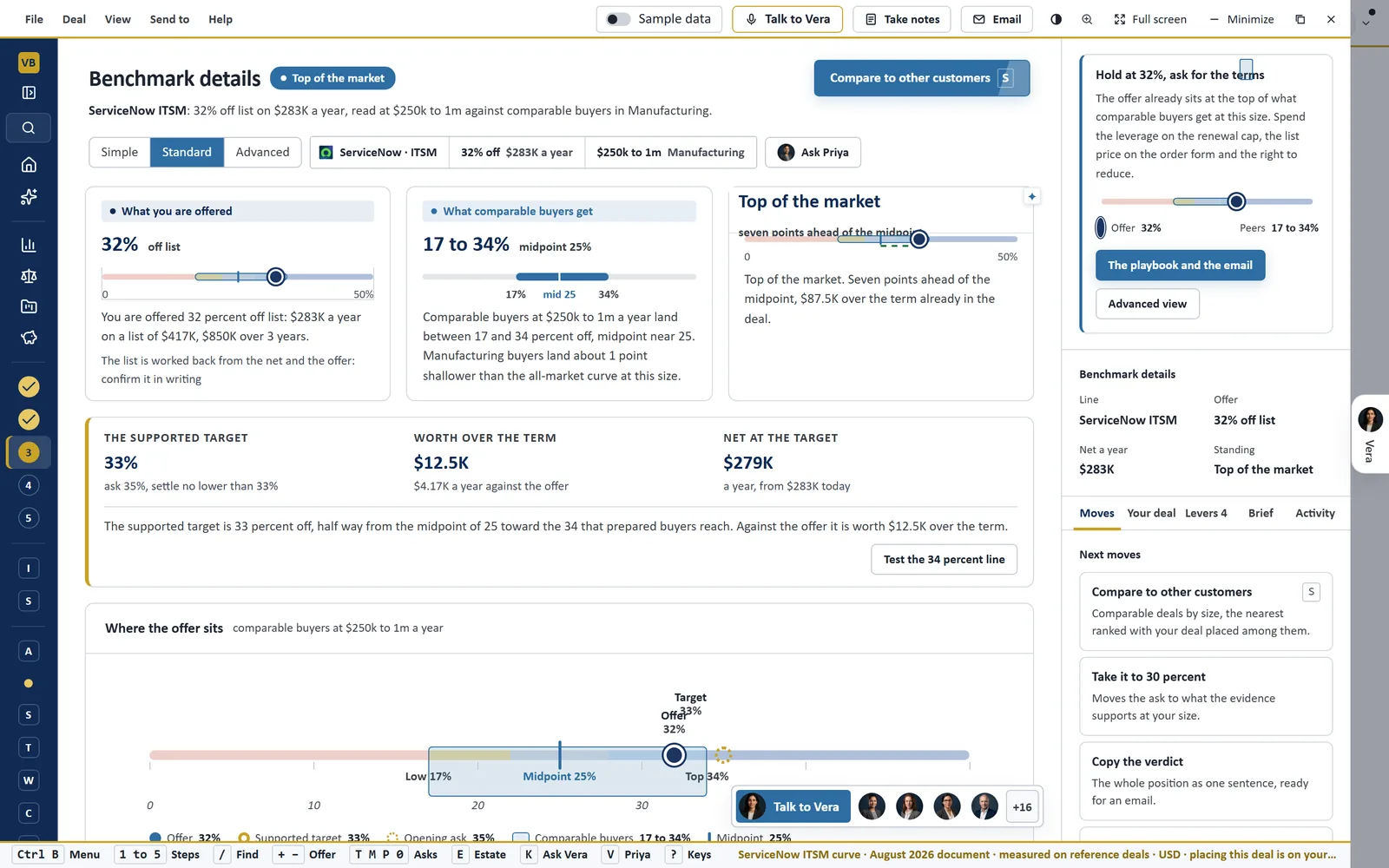
The library's answer. A ServiceNow ITSM offer read at $250k to 1m a year against comparable buyers in Manufacturing: 32 percent off, comparable buyers between 17 and 34 percent with a midpoint near 25, ranked Top of the market, with the supported target beneath.
Right when a quote has just landed and you want a first read before you reply, or want to test a later signing month or a longer term before the call.
In 5 to 10 minutes: the AI reads your paper
The Benchmark Agent, now part of the Benchmark Library, takes a quote, an order form or a renewal as PDF or Word, up to 25 MB, several at once. It checks the file signature rather than the extension, and nothing is spent until the read lands. It reads the document end to end, places the deal, and only then writes.
What comes back is three notes, four to five pages each, written from one benchmark:
- The price benchmark. Your discount or your rate, what comparable buyers get, where the deal ranks, and what to say in the room.
- The terms benchmark. Every commercial term against the market, with what each ask is worth.
- The options memo. Four ways to renew, costed, with the decision, written for management.
A fifth step, Negotiate, reads the report without writing anything new: the clock to the notice date, your leverage out of 100, the positions to open at, settle at and walk below, and the asks in the order to make them. A document that prints no list price is never refused. It is benchmarked on the rates it does state, and no percentage off an unseen list appears anywhere in it.
Right when you hold the paper and the terms matter as much as the price, or several quotes need reading at once.
Within 24 hours: an analyst on the paper
Human benchmark works as a ticket. In Ask a human you upload the proposal, quote or contract, PDF or Word, up to five files. You add a note if you like, name who else should get the report, and press Submit. You can ask for a benchmark, a negotiation strategy, talking points, research, a full analysis or a call.
The ticket moves through Received, Assigned, In progress and Delivered, with the time each stage was reached. The report arrives within 24 hours of submission, as Word and PDF, by email and in the window, and every person you named gets the same email. Each request carries its own chat with our team. You rate the report with a thumb, and a report you want changed can be resubmitted, free of charge, twice per request.
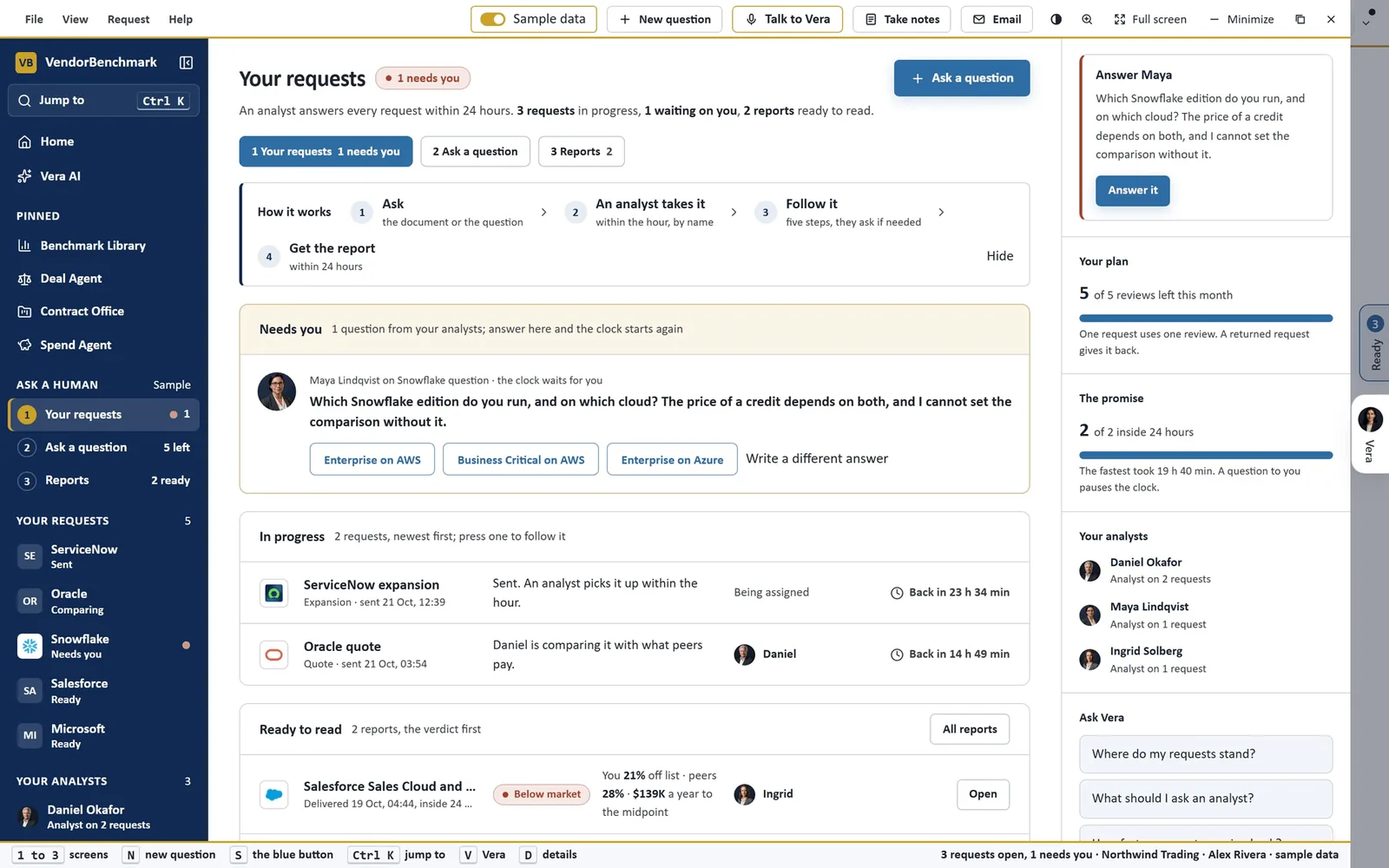
A ticket you can follow. Ask a human on sample data: the four steps from asking to the report within 24 hours, a question from an analyst waiting on the buyer, and each request in progress with the time left on its clock.
Right when the deal is big or unusual, or headed for the board. The app's own description puts it plainly: humans are still more accurate than AI.
The speed changes who reads the paper. The three answers stay the same.
How to choose
Start from what you hold and what is at stake, not from the tool.
| You have | Use | Because |
|---|---|---|
| A vendor name and a number, no document yet | The Benchmark Library | Three figures give the three answers in seconds |
| The quote or order form, and a call this week | The AI benchmark | It reads every line and term and puts the asks in order |
| A renewal headed for the board | Human benchmark | An analyst writes it by hand within 24 hours |
| A quote that prints no list price | Any of the three | Each compares rate against rate and says so |
The speeds are not exclusive. A deal typed in the library goes to an analyst from its Send to menu without retyping anything, and every report the Benchmark Agent writes carries Send to a human analyst. A sensible order is seconds first, the paper second, and a person when the number will carry weight in the room.
Where it sits
The rest of the guide covers what the answer contains and what to do with it.
- The three answers every benchmark owes you, and why a percentile is not one of them.
- How to benchmark an order form that prints no list price, rate against rate.
- How the Benchmark Library is built, graded and refreshed underneath all three speeds.
The full map is in the AI benchmarking guide, and the Ask a human app page covers the human ticket. An earlier post covers how each benchmark came to carry a person, an agent and the library together.
What to do first
- Type one deal. Open the Benchmark Library, enter the vendor, the annual value and the discount on your next renewal, and read the three answers.
- Upload the paper. Drop the order form on the Benchmark Agent and read the price benchmark, then the terms benchmark.
- Ticket the big one. In Ask a human, submit the renewal with the most at stake, with a note on what you need back.
- Keep the position. Save it in the library so it joins your estate, and get an alert when the market moves against it.
Questions buyers ask
Do the three speeds use different data?
No. All three run on one data set and return the same three answers in the same format. What changes is who reads the paper: you, the AI or an analyst.
What does the library need from me?
The vendor, the annual value and the discount offered, plus the term. If the quote prints no list price, tick I don't know in the Is this a good deal? check.
How does the human benchmark reach me?
Within 24 hours of submission, as Word and PDF, by email and in the Ask a human window. Everyone you named on the request gets the same email.
Can I move a deal from one speed to another?
Yes. Send to in the library takes the deal to a human analyst, and every report the Benchmark Agent writes carries Send to a human analyst.