A procurement lead takes a benchmark to the CFO. It says where the deal sits in its cohort, to the percentile. The CFO asks the three questions that matter: is the price good, what do others pay, and what is the gap worth. The benchmark should have answered those first.
Every benchmark Vera AI by VendorBenchmark produces, from the library, from the AI or from an analyst, answers those three questions in that order. This article walks through each answer with the worked example from our manual, explains the five ranks, and says where a percentile belongs.
First: what the deal costs, and how that compares
The first answer is the price in the terms the paper uses. Where the order form prints a list price, it is your discount off list, with the list and the net it comes from. Where the paper prints no list, it is your rate per user or per unit against what comparable customers pay for the same product at the same size. A percentage off a list the paper does not print never appears.
The worked example: a Salesforce Sales Cloud order form offers 1,200 Enterprise seats at 54 percent off the $175 list, $3,477,600 over 36 months. The first answer is exactly that, 54 percent off a printed list, on a deal in the band of $1 to 5 million a year.
Second: what comparable customers get
The second answer is a plain range with its midpoint, for the same product at the same size. In the example, comparable customers at $1 to 5 million a year land between 50 and 70 percent off, with a midpoint near 60. The range is adjusted for region, industry and the period you sign in, and the peer group can be narrowed to the same industry, the same country or both.
A range does work a single figure cannot. It shows how wide the market is, where its middle sits, and how far your deal would have to move to reach it.
Third: where it ranks, in five words
The third answer is a rank in plain words: Poor, Below market, At market, Good or Top of the market, with the gap stated in points and in money over the term. In the example the deal reads Below market. The gap to the midpoint is six points, worth about $454K over the term, and the supported target is 65 percent off.
On a line priced as a rate rather than a discount, such as a percent of collections or a renewal increase, lower is better and every sentence turns with it: the worst rate ranks Poor and the best ranks Top of the market. The quick check in the library puts the same finding in one line: Not a good deal yet, A fair deal or A good deal.
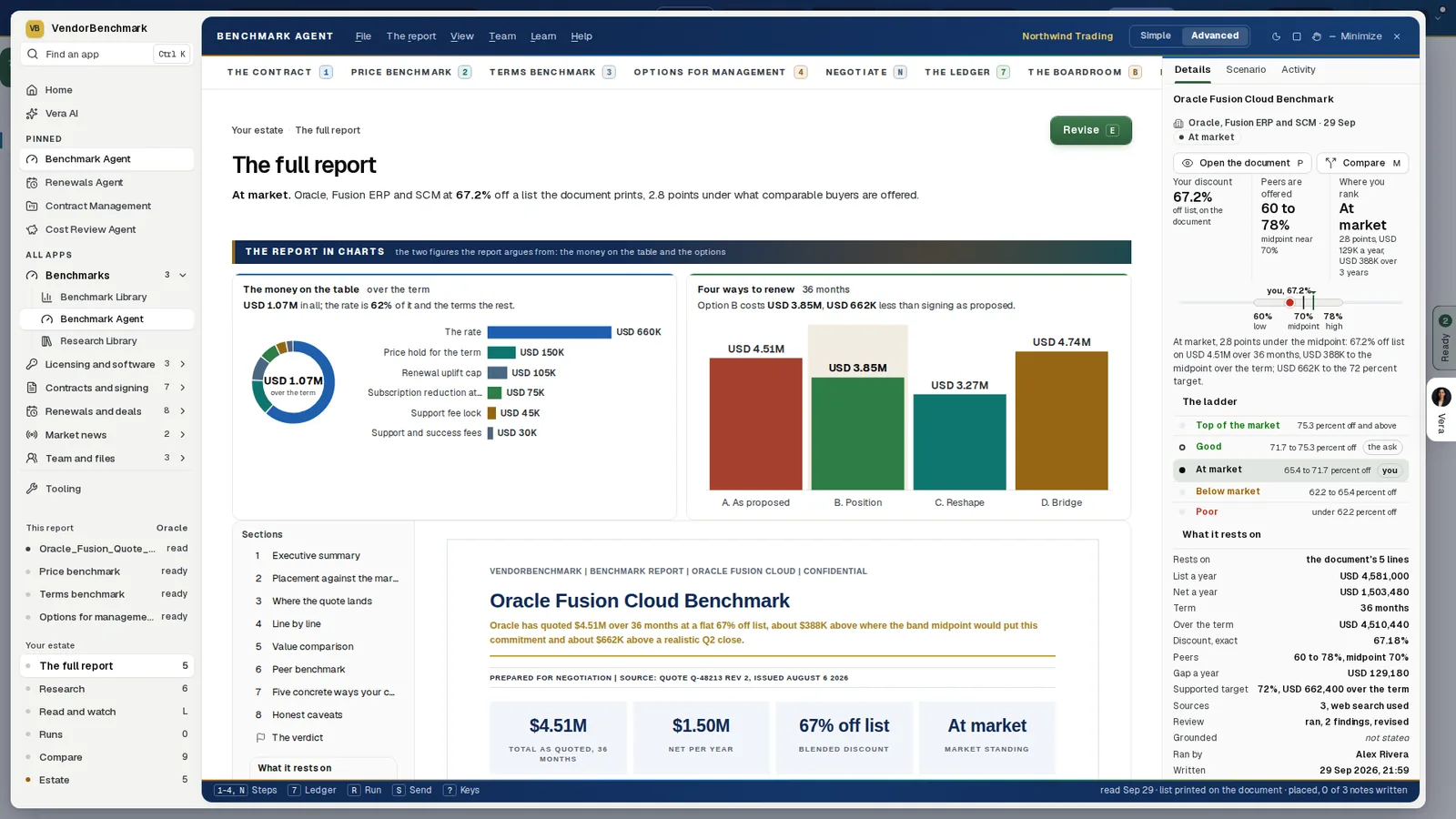
One sentence, then the evidence. The Benchmark Agent's full report on a sample Oracle Fusion ERP and SCM order opens At market: 67.2 percent off a list the document prints, 2.8 points under what comparable buyers are offered. The side panel carries the three answers and the five rung ladder with the deal on its rung.
A benchmark has to be able to say a deal is fine. Ours can.
That matters more than it sounds. When an offer already sits at the top of the market, the library advises holding the price and spending the leverage on the terms: the renewal cap, the list price on the order form and the right to reduce. When the rate case is closed, the brief says so, and the value left is in the structural terms.
Why a percentile is not an answer
A percentile says where a deal sits among other deals. It carries no money, no target and no direction. It does not say whether to sign or what to ask for, and with a small peer set it moves a few points on noise alone.
So percentiles stay in the basis. They appear late, in the case file's field atlas beside the range bars, for anyone who wants to check the working. When too few comparable customers match a deal to rank it honestly, the page says so instead of showing a noisy percentile. When the inputs cannot be right, such as a claimed edge larger than the commitment itself, the page says Check the inputs, names the suspect field, and the rank reads Unverified until the figures make sense.
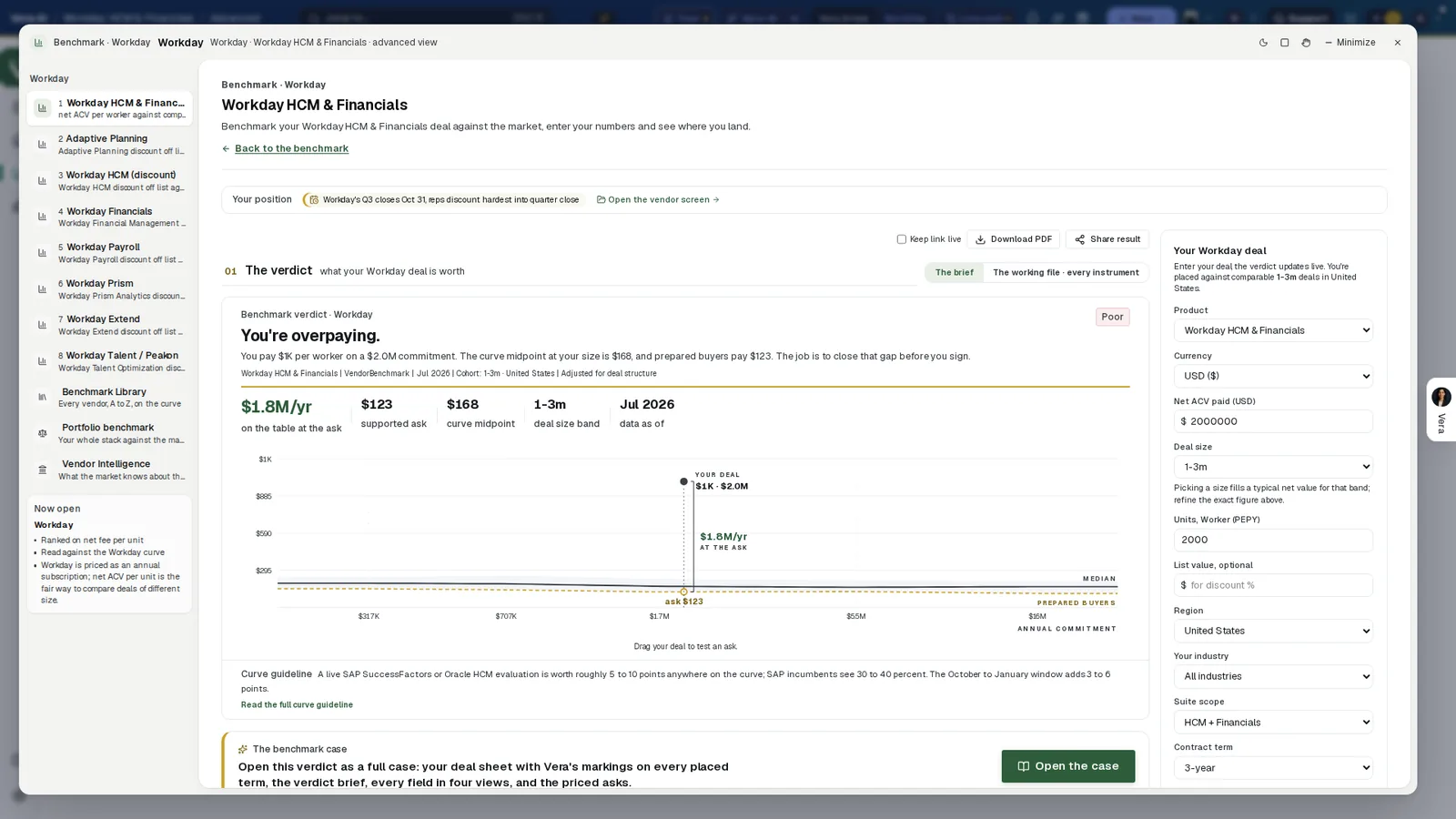
The verdict in plain words. A Workday HCM and Financials page, ranked on net fee per worker, the meter Workday bills. The headline is a sentence, the rank is Poor, and beside it sit the money at the ask, the supported ask and the curve midpoint per worker. The list value field is optional; a discount appears only when you supply one.
Where it sits
The three answers are the spine of every page in this guide.
- How the first answer works when the order form prints no list price.
- How the range is built, graded and refreshed.
- Which speed gets you the three answers in time.
The AI benchmarking guide covers the cluster, and the Is this a good deal? app page shows the quickest way to the three answers. Two older posts go further: one on what a percentile can and cannot tell you, and one on why the net unit price, not the headline discount, decides what you pay.
What to do first
- Ask for all three. Before you read any benchmark, find the cost, the peer range with its midpoint, and the rank. If one is missing, the benchmark is not finished.
- Check the basis. See whether the first answer is a discount off a printed list or a rate against rate, and that the page says which.
- Run the quick check. Open the Is this a good deal? check, type the vendor, what you pay a year and the discount offered, and read the answer in one line.
- Take the gap to the vendor. Press Ask for a better price to open the email the window writes from the figures on screen.
Questions buyers ask
What are the three answers?
What the deal costs and how that compares, what comparable customers get as a range with its midpoint, and where the deal ranks, from Poor to Top of the market, with the gap in points and in money over the term.
Why not lead with a percentile?
Because it carries no money, no target and no direction. Percentiles appear late, in the basis, for anyone checking the working.
What does Top of the market mean for my negotiation?
That the price already sits at the top of what comparable buyers get at your size. The advice is to hold the price and spend the leverage on the terms, such as the renewal cap and the right to reduce.
What if too few comparable customers match my deal?
The page says so instead of ranking you on thin data. Widen the region, or check the deal size.
Is a higher number always better?
On a discount, yes. On a line priced as a rate or a renewal increase, lower is better, and the ranks turn with it.