The renewal arrives as an order form: so many users at a price each, a subtotal, a total. Somebody asks what discount that is. The paper cannot say, because it never printed a list price, and any percentage put on it rests on a number nobody can find.
Vera AI by VendorBenchmark handles this case by design. Where the paper prints no list, the benchmark argues on the rates the paper does state, and says so plainly. Here is how that works, why we refuse to derive a list, and what to ask the vendor for.
We never derive a list price
To print a discount off list, something has to supply the list. Work one back from the net and an assumed discount and the result is a percentage that reads like a measurement and is not one. It rests on a list you cannot find on your own paper, and it cannot be checked by the person who has to defend it.
So the rule is simple. A discount off list appears only where the paper prints the list. Where it does not, no percentage is printed at all, and a missing list never stops the benchmark. The same deal returns the same figures to everyone who runs it.
A percentage off a list you cannot find on your own paper reads like a measurement. It is not one.
What rate against rate means
The benchmark takes the rates the paper does state, per user or per unit, per month or per year, and the totals, and sets them against what comparable customers pay for the same product at the same size. Where our Software Price Index covers the vendor, each line priced per user is placed against the middle half of what comparable customers pay at that size, with the median and a rank from Poor to Top of the market. Any money above the median is priced.
The three answers keep their order. What the deal costs is your rate, not a discount. What comparable customers get is their range at your size. Where it ranks is the same five words, with the gap in money. A report placed rate against rate draws no discount runway, because there is no discount to drag, and its note argues rate against rate from start to finish.
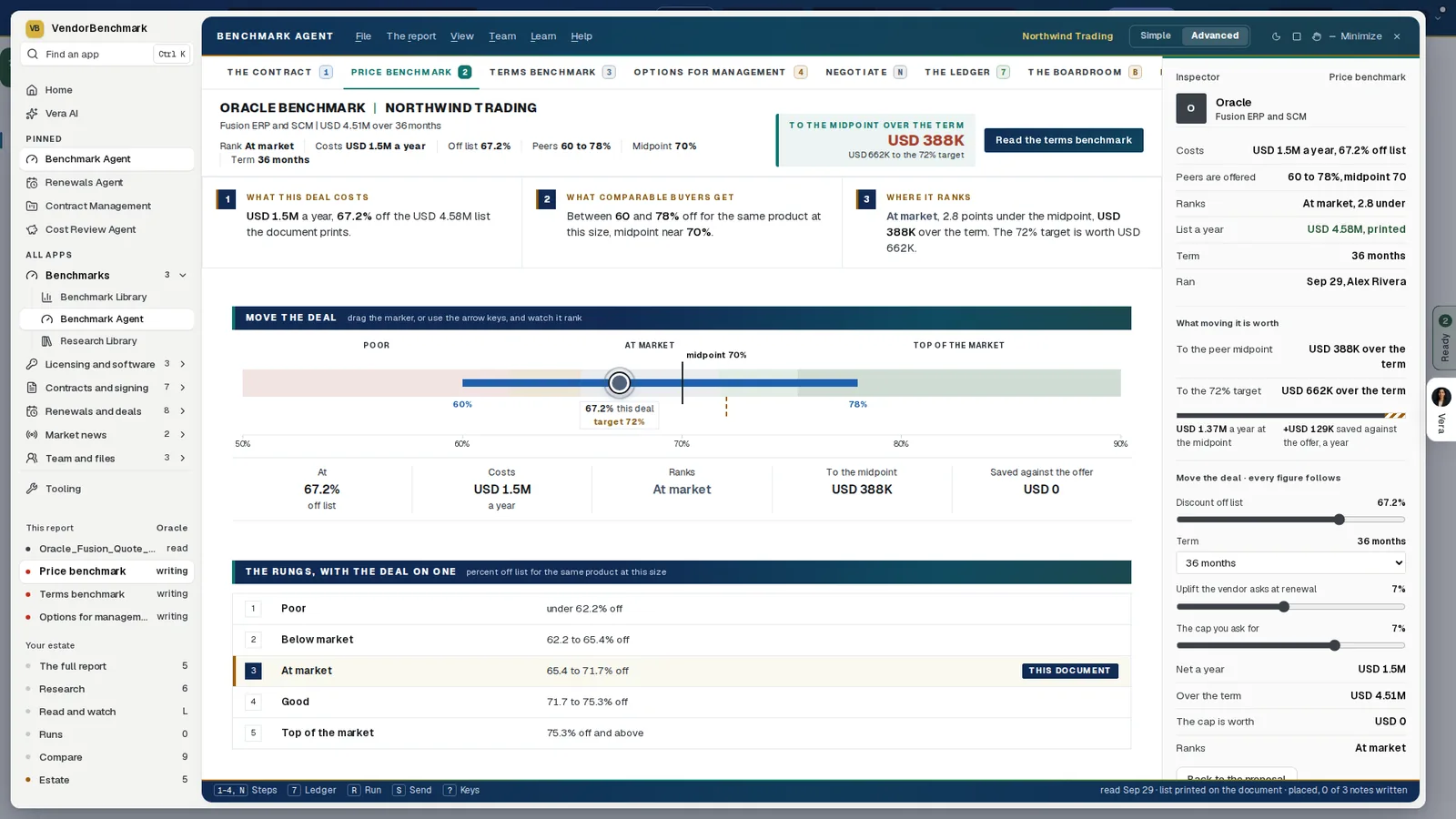
When the paper does print a list. The Benchmark Agent's price benchmark on a sample Oracle Fusion ERP and SCM order: 67.2 percent off the list the document prints, against comparable buyers between 60 and 78 percent. The status bar names the basis, list printed on the document. Without a printed list, neither the percentage nor the runway would appear.
Four kinds of paper, four readings
What the paper prints decides how the deal is placed, and the report says which case it is in.
| The paper prints | How the deal is placed | What the report says |
|---|---|---|
| A list price and a net | Discount off list, from the list and net on the paper | The list, the net and the discount they give |
| Its own discount, no list | On the stated percentage | That the discount is stated on the document and no list is printed |
| Rates and totals only | Rate against rate, at the same size | That the comparison is rate against rate, and what to confirm |
| Neither a rate nor a list | Listed as needing a rate card | What to ask the vendor for |
The same split runs through your estate. When the Benchmark Agent benchmarks every contract at once, a contract that states list prices is set against the discount curve for the same product at the same size, a contract that states no list is set rate against rate on the Software Price Index, and no list is ever derived.
What to ask the vendor to confirm in writing
A benchmark on rates is complete on its own terms, but the next renewal can start from better paper. Three asks follow from a missing list:
- The list price on the order form. With the list printed, the discount becomes a figure you can hold the vendor to next time. When a quote shows no list, the library's drafted email asks for it.
- The discount as a percentage of that list. The negotiation strategy puts the list stated and the discount as a percentage of it on the same order form ask.
- The line level price schedule. Where products are bundled under one price, the schedule turns the bundle into rates you can compare.
Where the offer already sits at the top of the market, the drafted email holds the price and asks for terms instead: the list price on the order form, renewal increases capped at 3 percent and the right to reduce quantities. And if you know the discount although the order form does not print it, enter it when you upload the offer. The offer is then placed on the range like any other, and Take the discount off returns it to the order form's own prices.
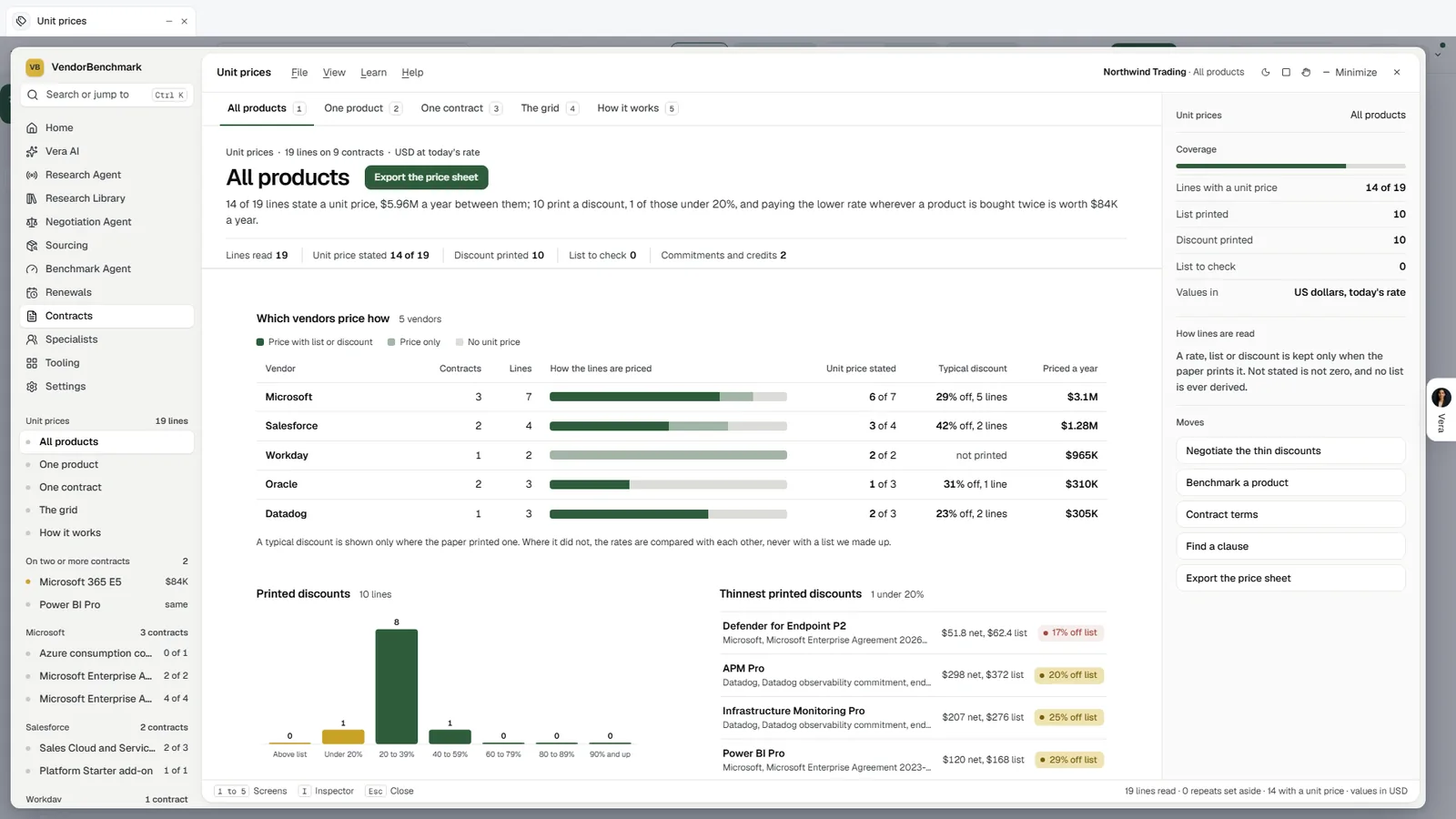
Rates compared with rates. Unit prices on a sample workspace: 14 of 19 lines state a unit price and 10 print a discount. Workday's lines print none, so its discount column reads not printed, and the note under the table states the rule: rates compared with each other, never with a list we made up.
Where it sits
A missing list is one case of a wider rule about what every benchmark owes you.
- The three answers every benchmark gives, in order, and why a percentile is not one of them.
- How the library grades a line, including which curves rest on a published list, a rate card or the vendor's opening quote.
- Which speed to use for the order form on your desk.
The AI benchmarking guide maps the cluster, and the Benchmark Library app page shows where to start.
What to do first
- Read what the paper prints. Check whether your order form shows a list price, a stated discount, rates only, or none of these.
- Benchmark it as it stands. Type the vendor and what you pay a year and tick I don't know, or upload the order form and let the AI place it.
- Open Unit prices. See which lines state a rate, which are not stated, and where you pay two different rates for the same product.
- Ask in writing. Send the drafted email asking for the list price on the order form and the line level price schedule.
Questions buyers ask
Can you benchmark an order form with no list price?
Yes. A missing list never stops the benchmark. The rates the paper states are compared with what comparable customers pay for the same product at the same size, and the report says the comparison is rate against rate.
Why not estimate the list price?
Because a percentage off a list you cannot find on your own paper reads like a measurement and is not one. We print a discount off list only where the paper prints the list.
What if the order form states its own discount?
Then the deal is placed on that stated percentage, and the status bar says the discount is stated on the document and no list is printed.
Does a rate benchmark still give a rank?
Yes. Where our price index covers the vendor, each line priced per user is ranked from Poor to Top of the market against what comparable customers pay at that size.
What should I ask the vendor for?
The list price on the order form, the discount as a percentage of it, and the line level price schedule where products are bundled under one price.