AI makes software procurement more efficient by taking the reading, the date chasing, the comparing and the first drafts off the buyer's desk, which is the work the AI agents in Vera AI, the platform from VendorBenchmark, are built to do. The decisions stay with people. It is worth being exact about which side of that line each task falls on.
This post goes through where a software buyer's hours go and which kind of agent takes each part. It uses no outside statistics, and any time figure below is an illustrative example, not a result. The agents are listed at AI agents and the apps at the platform.
PART ONE
Where a software buyer's hours actually go
Ask a procurement lead what the job is and the answer is negotiation. Look at the week and most of it is preparation for a negotiation that may get an hour. Four kinds of work fill it.
- Reading contracts. Order forms, renewals and master agreements, opened one by one to find the price, the term, the uplift cap and the notice period.
- Chasing dates. Renewal dates and notice windows, kept in a spreadsheet and a calendar, and the people who have to be reminded of them.
- Building comparisons. This year's quote against last year's, one vendor against another, and your price against whatever market evidence you can find.
- Drafting. The brief for the contract owner, the email to the vendor, the redline and the summary for finance.
The cost of that load is not only time. Most teams give real attention to their ten biggest contracts, and the rest renew at the price the vendor asked for. We described the staffing problem behind that in the one person procurement desk.
PART TWO
The time it saves on a quarter of renewals
Here is one quarter's renewals prepared both ways: the dates found, the comparison built, the brief and the first email drafted. The hours are illustrative.
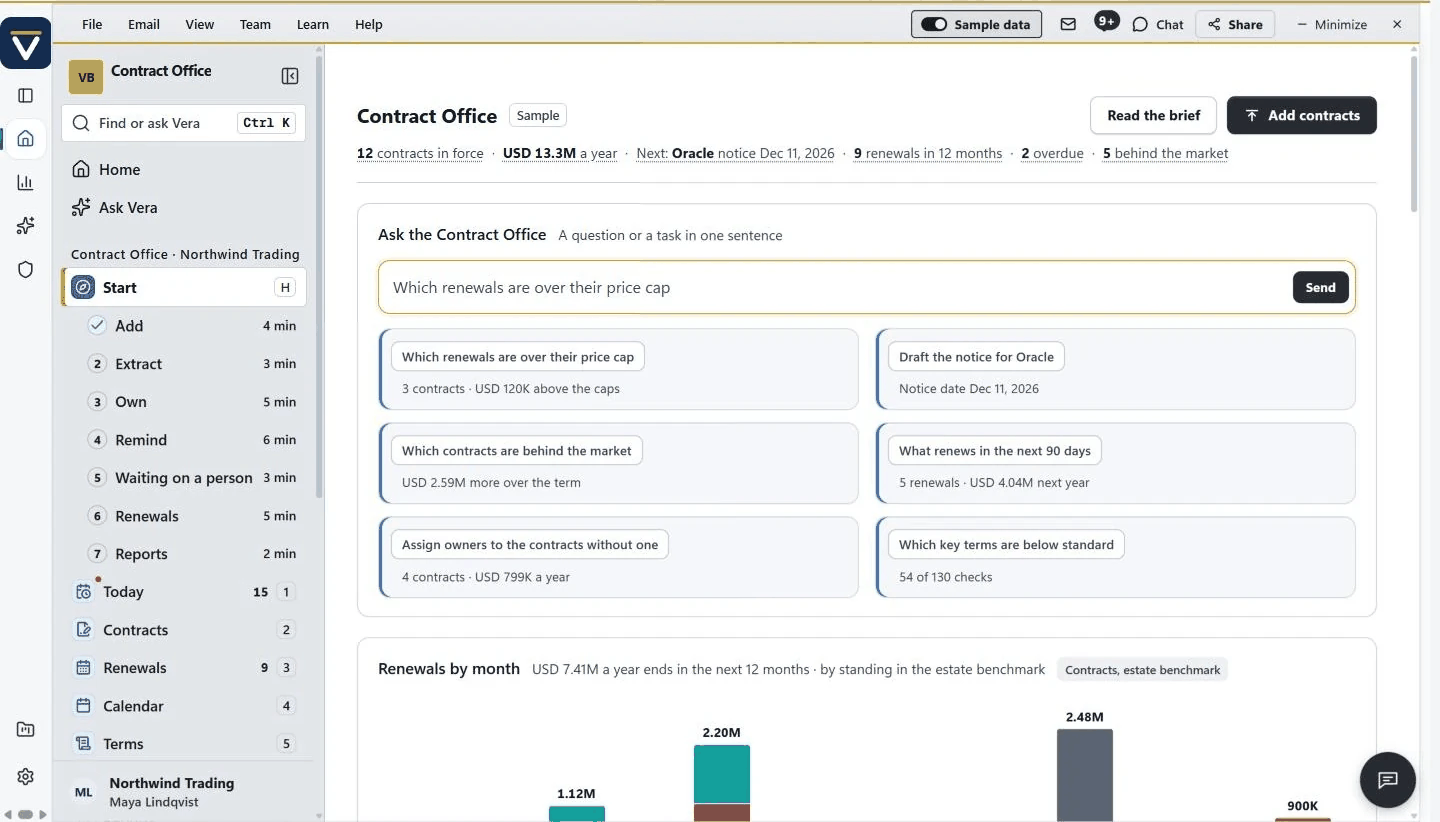
The Contract Office start screen on sample data: contracts in force, a box to ask about them and a chart of renewals by month.
THE SAME JOB, TWICE
TODAY, BY HAND
- Open each contract to find the renewal date, the notice period and the uplift cap
- Keep the dates in a spreadsheet and set calendar reminders for each one
- Build a price comparison for each renewal from old quotes and whatever market data turns up
- Draft the brief for each contract owner and the first email to each vendor
Roughly 4 hours per renewal, so about 40 hours for 10 renewals in a quarter
WITH VERA
- Upload the contracts once; each is read for vendor, products, price, term and dates
- Open the Contract Office to see what is due, with notice windows flagged a quarter ahead
- Read the benchmark for each renewal: what it costs, what comparable customers pay and where it ranks
- Edit the drafted brief and email, then decide: renew, renegotiate or cancel
About 30 minutes per renewal, so roughly 300 minutes for 10
What changes: roughly 40 hours of reading, tracking and drafting becomes about 300 minutes of checking and deciding. For example, 10 renewals at about 30 minutes each is 300 minutes, or 5 hours, against roughly 40 hours by hand.
What the time depends on: how many documents there are, how clean the paper is, how many people have to approve, and how much of the AI's work your team chooses to check line by line. Scanned contracts and missing order forms slow the reading. A long approval chain is not shortened by a faster draft.
PART THREE
How it works: which agent takes which part
- Reading goes to the reading agents. The Contract Agent opens a document as pages and reads every clause. The Document Agent reads every contract for the terms that decide a renewal and finds any clause you ask for. The Spend Agent takes the whole folder at once.
- Dates go to the Contract Office and the Deal Agent. The Contract Office flags notice windows a quarter ahead and briefs the owner. The Deal Agent counts down notice dates on a calendar and puts what needs you first.
- Comparisons go to the benchmarking agents. The AI benchmark places an offer against what comparable buyers pay, with the target and the gap. Compare sets two contracts side by side with every change marked. Vendor Radar prices a vendor's published change on your contracts.
- Drafts come with the analysis. The counter comes with the benchmark, the redline goes out as Word, the plan for management arrives as an email with the numbers, and Report Studio writes its report in Word, PowerPoint or Excel.
The date problem alone is bigger than it looks, as we set out in the renewal calendar problem. The comparison problem has its own post too: what the vendor quietly changed.
PART FOUR
What the AI does, and the decisions it leaves to people
In concrete terms, the AI reads documents into products, prices, terms and dates and keeps the page each fact came from. It compares those facts with what comparable customers pay and with your own records. It drafts the next document. Where it gives an answer it shows the clause and the page, so checking it takes seconds.
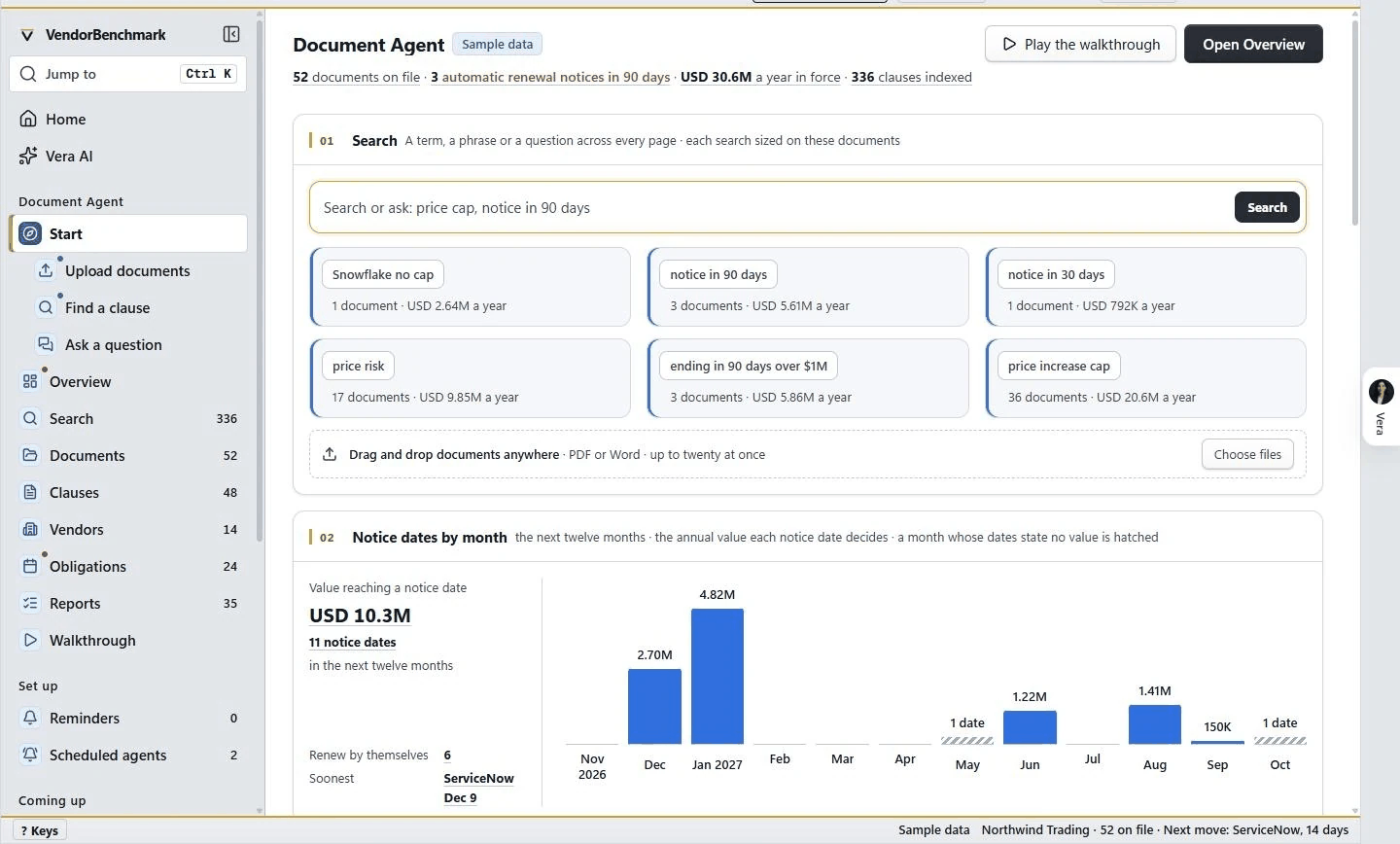
The Document Agent start screen on sample data: a search box with suggested clause searches over a chart of notice dates by month.
The decisions are not delegated. Each app says so in its own terms.
- Renew, renegotiate or cancel. Decided by a person in the Contract Office.
- What goes into the redline. A suggested change enters the redline only when you approve it.
- Every offer. Accept, counter with a steer or walk away. The Deal Agent brings every offer back to you.
- What to cut. Software Discovery flags the fixes, and a person decides what to cut at renewal.
- Who reads the report. Report Studio builds it. A person chooses the reader and sends it.
- The signature. Your people sign. The AI never signs.
The same holds for the hard lines. The AI never serves notice of non renewal, never agrees a price above your walk away and never writes to a vendor without naming itself as an AI. What an agent is, in general, is covered in what AI agents do in software procurement.
PART FIVE
Where the efficiency stops
Faster preparation is not a better outcome by itself. It buys attention for the contracts that used to get none, and what you do with that attention is still judgment.
The AI takes the preparation. The hour of judgment at the end is still yours, and now you have it.
The agents work from what is on file. A missing document is a missing fact, and a figure with no stored basis comes back empty rather than invented. The Entitlement Agent sends the answers it was not sure of to a person before they count.
The product is careful with its own time claims. On the agent floor, one labeled line values each completed workflow run at 20 minutes of manual work, printed with its arithmetic and named an estimate. Treat every time figure in this post the same way.
And some questions want a person. A human analyst answers within 24 hours through Human Benchmark.
PART SIX
Common questions
- How does AI make procurement more efficient? By doing the reading, the date tracking, the comparing and the first drafts, so a buyer's time goes to decisions.
- Which procurement tasks can AI agents take? Reading contracts, watching renewal and notice dates, benchmarking prices, comparing documents and drafting emails, redlines and reports.
- Which decisions stay with people? Whether to renew, renegotiate or cancel, what goes into a redline, whether to accept an offer, and every signature.
- How much time does AI save in procurement? It depends on the number of documents, how clean the paper is and how many approvers there are. The figures in this post are illustrative examples, not measured results.
- Does the AI invent missing facts? No. A fact that is not in your stored documents comes back empty, and answers the AI is unsure of go to a person.
The short version: efficiency here means the preparation is done before you sit down, every answer shows its page, and the calls are still yours to make.