03 · Tooling & playbooks
The Benchmark Library answers a few questions about one deal. The tools in this chapter go further: they read your own exports and documents, a usage report, a cost export, a signed contract, a photographed quote, and build a plan from your real numbers. The chapter closes with the vendor playbooks, full self-serve negotiation and migration engagements for ten major vendors.
The tools open from Benchmarks & market: the All tools wall, which opens as its own application window, and the Tool finder live at the foot of that panel (the rail carries six group icons, and the tool wall no longer holds one of its own). While a tool page is open, the tools panel appears beside it with the job categories; the calculator long tail lives on the wall and in the finder rather than as rail rows, and everything stays one Ctrl/⌘ K away.
Nearly every tool is free to explore with sample data on any plan; the few that only make sense on your own inputs, such as Quote Face-Off, say so on their pages instead of loading a sample. Uploading your own data, and running the AI over it, is included on every plan, and AI runs carry no monthly cap; Plans, allowances & limits defines the few allowances that do exist. Every contract-family document you hand an intake tool, the three decoders, Second opinion, the Vera Deal-Room, Proposal comparison, and the vendor playbook drop zones, is kept: it saves to your workspace as a contract, stored privately and visible only to your organization, and joins your benchmarking queue automatically. Benchmarking extracts only high level data points, the vendor, the price, the term, and the key commercial terms; the document itself never leaves your organization, every saved document can be deleted from its contract record at any time, and an owner can turn the saving off entirely under Settings, Security & compliance, Data controls. Three more tools now say plainly which side of that line each of their file types falls on, because they take more than one kind: the Time machine keeps both documents; Quote Face-Off keeps PDF quotes and never stores a photo capture; the Rate Card Benchmark keeps PDF and DOCX documents and never stores an XLSX rate card, because a spreadsheet of rates is a data file rather than a contract. The same owner switch under Settings, Security & compliance, Data controls governs all of them, and turning it off means those tools read in memory and keep nothing. Phone captures, invoices, audit letters, and spend exports keep the old rule, read in memory and never stored, and the browser-only calculators parse your export on the page so your usage data never leaves it.
Each tool section below carries a You get line: the artifact the tool produces and roughly how long a run takes, so you know what you are waiting for before you start. In the product, every tool page opens with the same strip under its title: when to use it ("Use this when …"), the typical finding it surfaces, its data-privacy posture, and, where the tool ships a sample, a "Runs on sample data before any upload" note, so you can judge a tool before you feed it anything. Every tool page also carries an All tools link at its top left, one click back to the tool menu from anywhere in this chapter.
Every chart enlarges, and so do the playbook cards. This is platform wide, not just in the tools: hover any chart on any screen and an Enlarge button appears in its corner; click it, or the chart itself, and the figure opens in a near full screen window with its title, its description, and a "How to read this" note. Hovering a bar, ribbon, dot, or segment, on the page or in the enlarged view, shows the exact figure behind it in a tooltip the moment the pointer touches it. In the playbooks the text windows enlarge too: click anywhere in a card or KPI tile that is not a button or a field and it opens in the same window with the text scaled up for reading; selecting text never triggers it. Press Esc or click outside to close the enlarged view. Charts and tiles that are themselves links, such as a dashboard tile, keep navigating on click.
Tools filed to another category do not appear here. A handful of tools only make sense on the software desk: Vera Licensing, the cloud cost optimizer, Microsoft 365 optimization, the Agentforce optimizer, VCF licensing and Commitment Studio, which sizes Claude, OpenAI, Copilot and Agentforce commitments. On the other seven spend categories they are absent from the rail, from All apps and tools, from the group pages and from the tool finder, so a search cannot surface a door the navigation has hidden. Everything else is on every desk. Information Technology and Software sees all of them.
All tools
The instrument wall, as its own application window: every upload-driven optimizer, decoder, calculator and renewal playbook, one room per job. Start here when you have your own data and want a plan built from it rather than a quick market check. It opens on its own over whatever you were doing, the way the Benchmark Library and the Contract Office do, and Close returns you to Home.
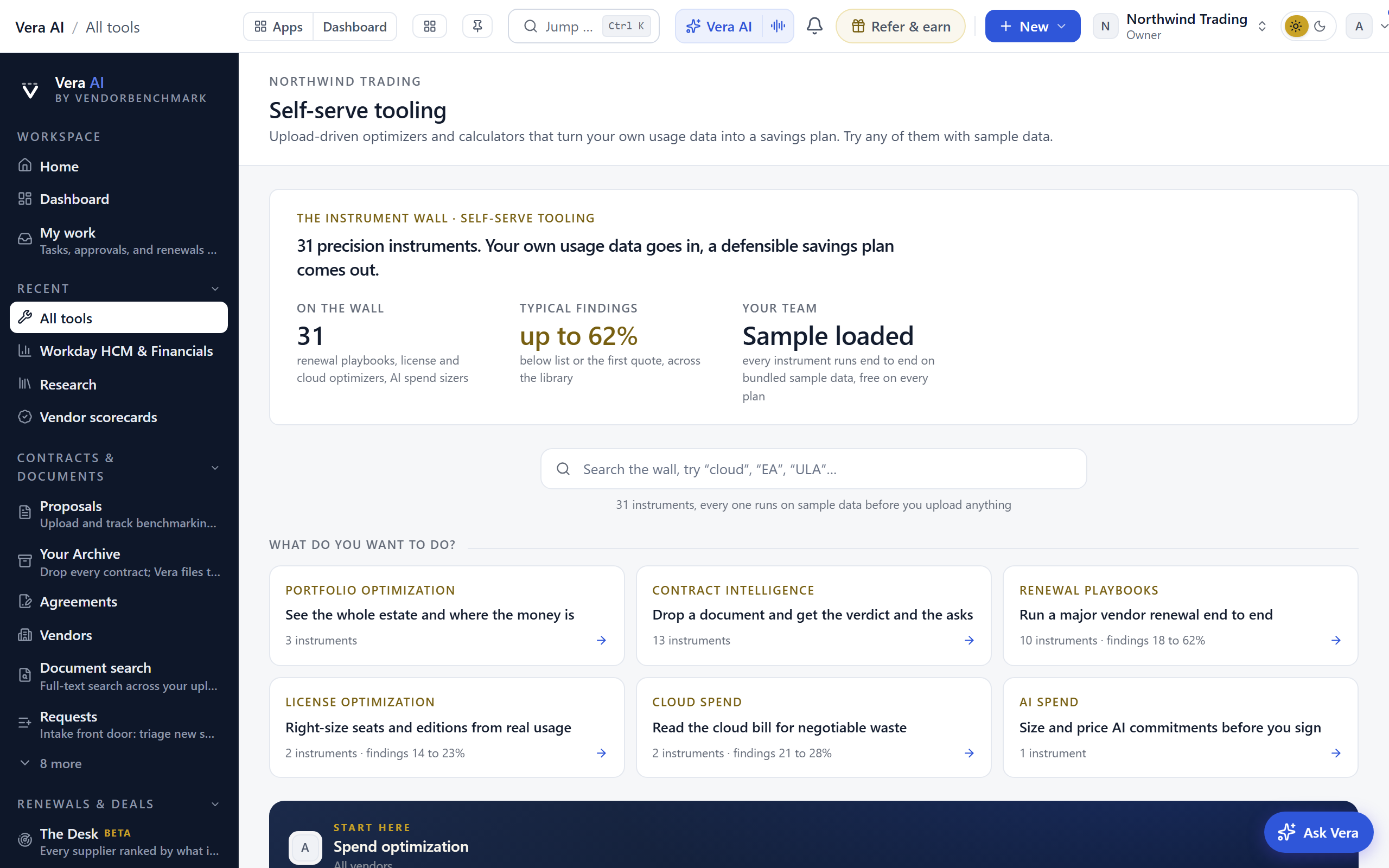
On the screen
- The title bar: the window name, the light or dark switch, and the window controls. Escape closes the window, the square maximizes it, and the minus puts it on the tab strip along the top of the screen to pick up later.
- The command bar: one search box that crosses every room at once, over vendor, title, description, group, typical finding and the Use this when line. Typing ULA finds the Oracle ULA certification playbook wherever it lives; the count beside the box says how many of the thirty match.
- The rooms rail: the wall itself, then one room per group: Portfolio optimization, Contract review, Deal pricing, Renewal playbooks, License optimization, Cloud spend, AI spend. The number beside a room is its keyboard shortcut, so 1 returns to the wall and 5 opens the renewal playbooks. The panel at the foot of the rail says what is in the room you are standing in.
- The stage: how many instruments are live, the typical finding across the wall as a percentage below list or the first quote, how many your team has taken down so far, and a gold bar per week of bench activity.
- Your team used recently: a chip row of the instruments your team opened most recently, with the open count, so yesterday's work is one click away.
- What do you want to do?: seven doors, one per job, each carrying its count and its finding range. Clicking a door opens that room.
- What this is worth on your spend: in each room, move the annual spend those instruments would cover and the room's own finding band prices it as a range with a midpoint. Both halves are stated plainly on the panel: your figure, and the band these instruments usually find. It is a size and not a quote.
- Instrument cards: one card per tool. Each carries a photograph of the work it does with its typical finding printed on the picture, then Use this when, the one line that separates it from its siblings, the pitch, and whether a sample is loaded or the instrument runs on your own inputs.
- Pointers between tools: overlapping instruments point at each other. The Vera Deal-Room carries a Most complete badge, the SOW Agent points at the Rate Card Benchmark, and each optimizer cross-links its vendor playbook. Follow the quiet line on a card when it fits your situation better.
- What next: at the foot of the wall, the three ways out when none of the thirty is the right instrument: the Benchmark Library, Ask Vera, and the Tool finder.
- Narrated AI reports: generating an AI report anywhere on the wall shows what the analyst engine is doing, step by step with a timer.
How to use it
- Start from the rooms: pick the job you came to do, from the rail or from the seven doors, and the wall narrows to the instruments that do it.
- Move the spend slider in that room to see what its instruments are usually worth on a number of your own.
- If you know the instrument you need, search for it from the command bar, or pick it from the recently-used chips.
- If you only have a document and are not sure which instrument fits, drop it anywhere on the window and pick from the chooser that opens, or drop it on the ask bar at the top of Home and simply ask about it.
- Try any instrument on sample data first to see the output before you bring your own.
Tool finder
Say what you are trying to do and the finder names the one tool to open. It opens as its own application window, and Close returns you to Home.
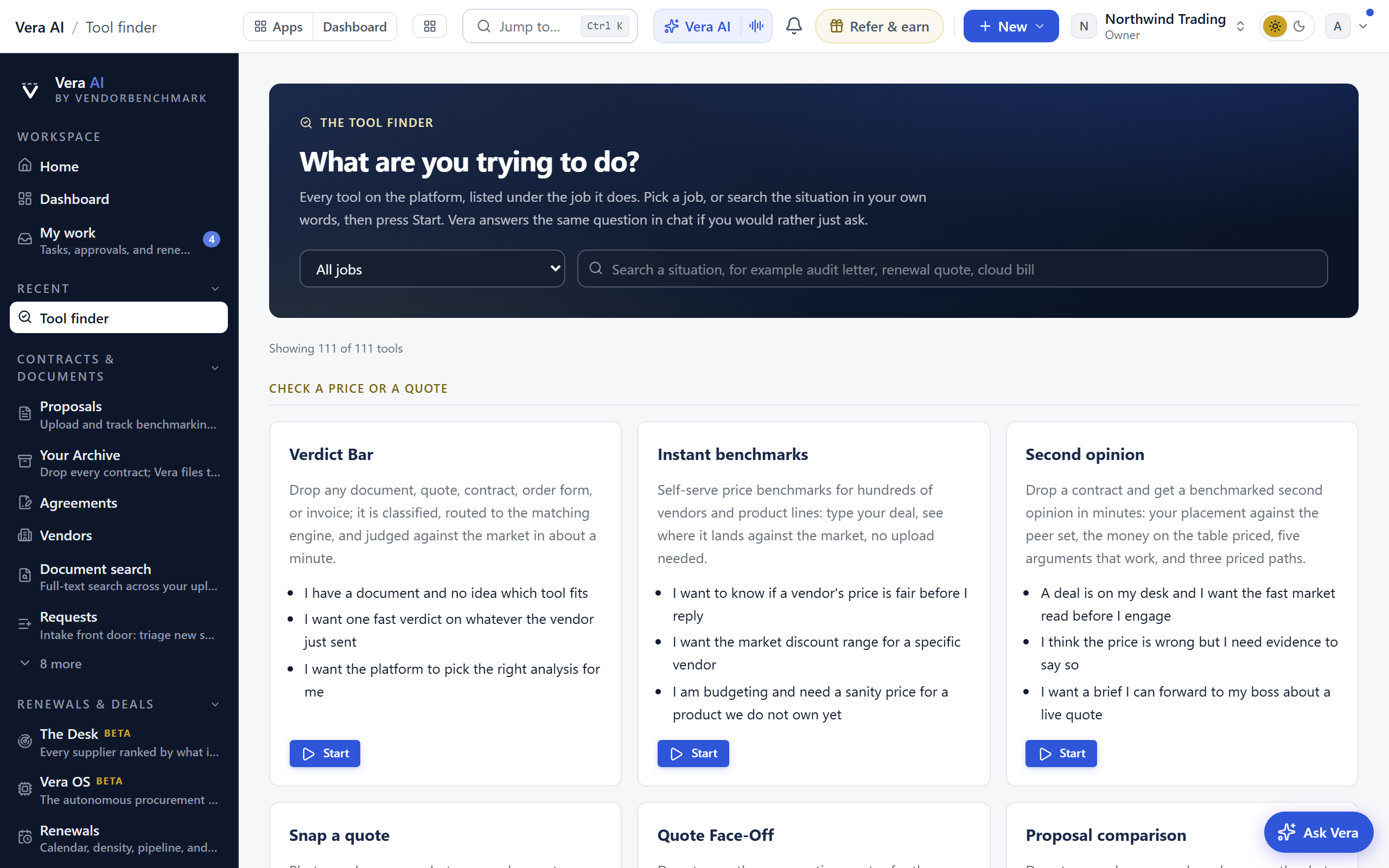
On the screen
- The ask — one field on the stage. Type the situation in your own words, for example "the vendor sent an audit letter" or "my renewal is in 60 days". Six common situations sit under it as chips, one press each.
- The verdict — the one tool to open, what it produces, and the reason: the sentence from our index that matched, quoted back at you. A Start button opens it.
- Also fits — up to three runners-up, each with the situation that made it a candidate, so you can see why it came second rather than first.
- The rooms rail — the fourteen jobs the platform does, from checking a price to handling an audit. The number beside a room is its shortcut. Picking a job narrows the list to that job's tools.
- The tool list — every tool under the job it does, each naming what it produces and the situation a buyer used to find it.
How to use it
- Say what you are doing, in a full sentence if you like: filler words are ignored, so a sentence narrows the list rather than matching everything.
- Read the verdict. If it fits, press Start.
- If it does not, the runners-up say why they were close, and the whole index is underneath by job.
- Still not sure how to phrase it? Ask Vera (Ctrl or Cmd J) instead; she reads the same index and names the same tool.
Tips
- The same index behind this screen also powers Vera's routing and Chapter 14, the printed "Which tool do I use?" reference, so all three always agree.
Budget draft
*In plain words: the software budget spreadsheet finance asks for, drafted from your own agreements instead of built by hand.*
When to reach for this
- Budget season opened and you need a defensible first number per vendor.
- Before committing next year's figure: see which renewals will move it and by how much.
- After the estate lands: the fastest way to see what the paper says next year costs.
The draft reads only your stored estate. Per vendor it states this year's annual cost, the steepest uplift cap on paper, when the deal reprices, the proposed number and one line of reasoning tied to those figures. Totals are summed from the lines, never written by the model, proposed numbers are clamped to a sane range of the current cost, and a vendor with no stored value is listed as unpriced rather than guessed. Draft it builds the draft; nothing regenerates while your figures are unchanged, so a second press costs nothing, and the page says when stored figures have moved since the draft was written.
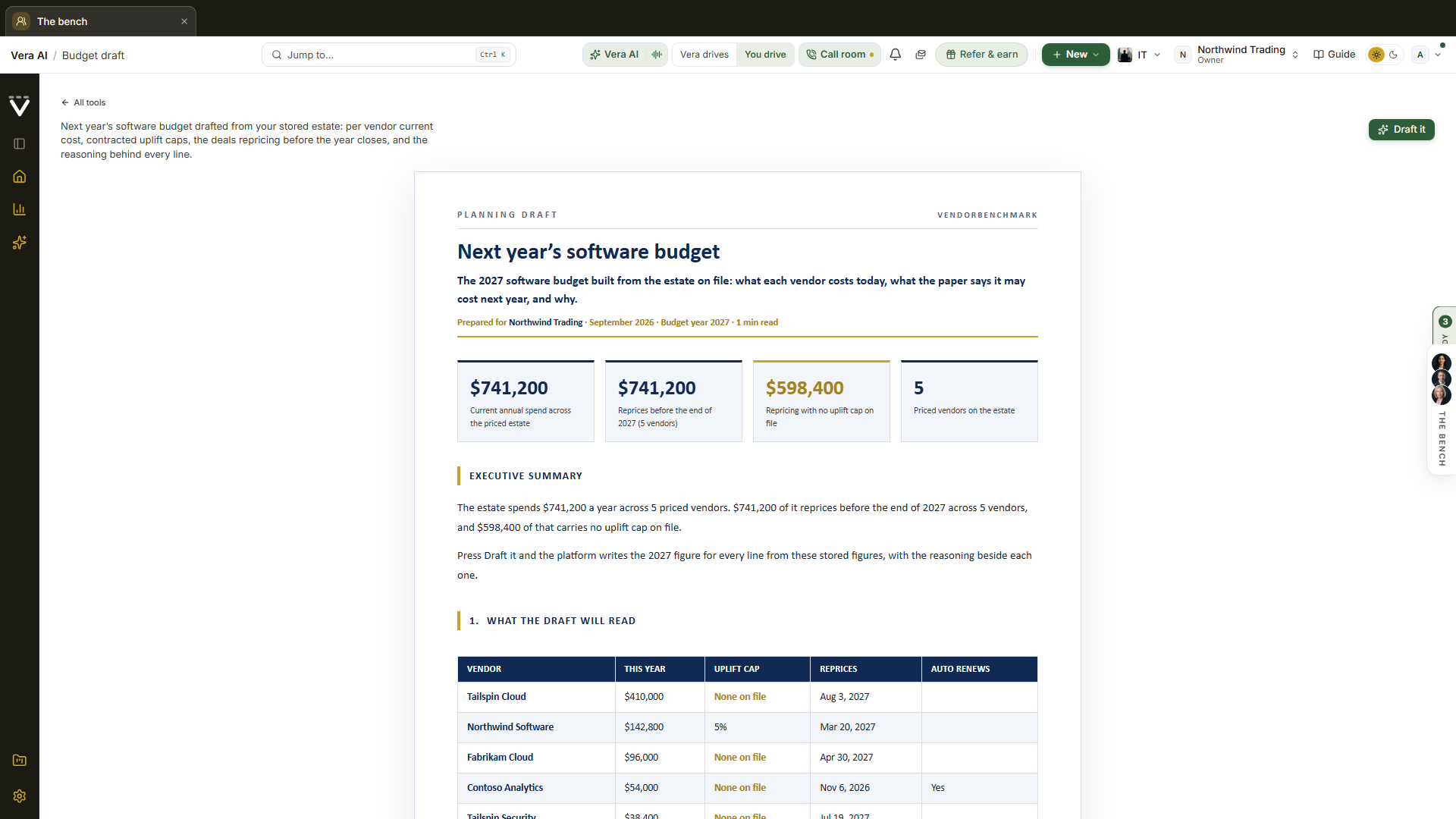
How to use it
- Open the tool; the deterministic scan renders your priced vendors and the unpriced list immediately.
- Press Draft it. The proposed numbers and reasoning arrive as one cached draft.
- Fix any unpriced vendor on its record (or apply a staged fix on Data health), then refresh the draft.
See also: Spend optimization · Data health
Spend optimization
*In plain words: the whole budget's savings plan, about twenty prioritized moves, from your own agreements.*
When to reach for this
- Budget season: the run-rate reduction plan, written and prioritized, before finance asks for one.
- After the estate lands: the first "where is the money" pass across every vendor at once.
- When single-vendor wins stop compounding: this is the portfolio view of the same work.
The plan's Theatre, Share, Forward, Word, and print controls sit in one toolbar row above the plan, alongside its version history; the generate card holds only Generate and Regenerate. Exporting or sharing a plan already on file keeps working even when AI generation is unavailable.
The savings plan for your whole software budget. Rank your top vendors by annual spend, see every renewal date on one calendar, and get an analyst-grade plan of about twenty prioritized moves to lower the run rate, written by Claude Opus 5 and checked against your own agreements. Once a plan is on file, the tool opens on stage: the plan presents itself as a full screen executive brief, and Escape steps down to the classic desk described below.
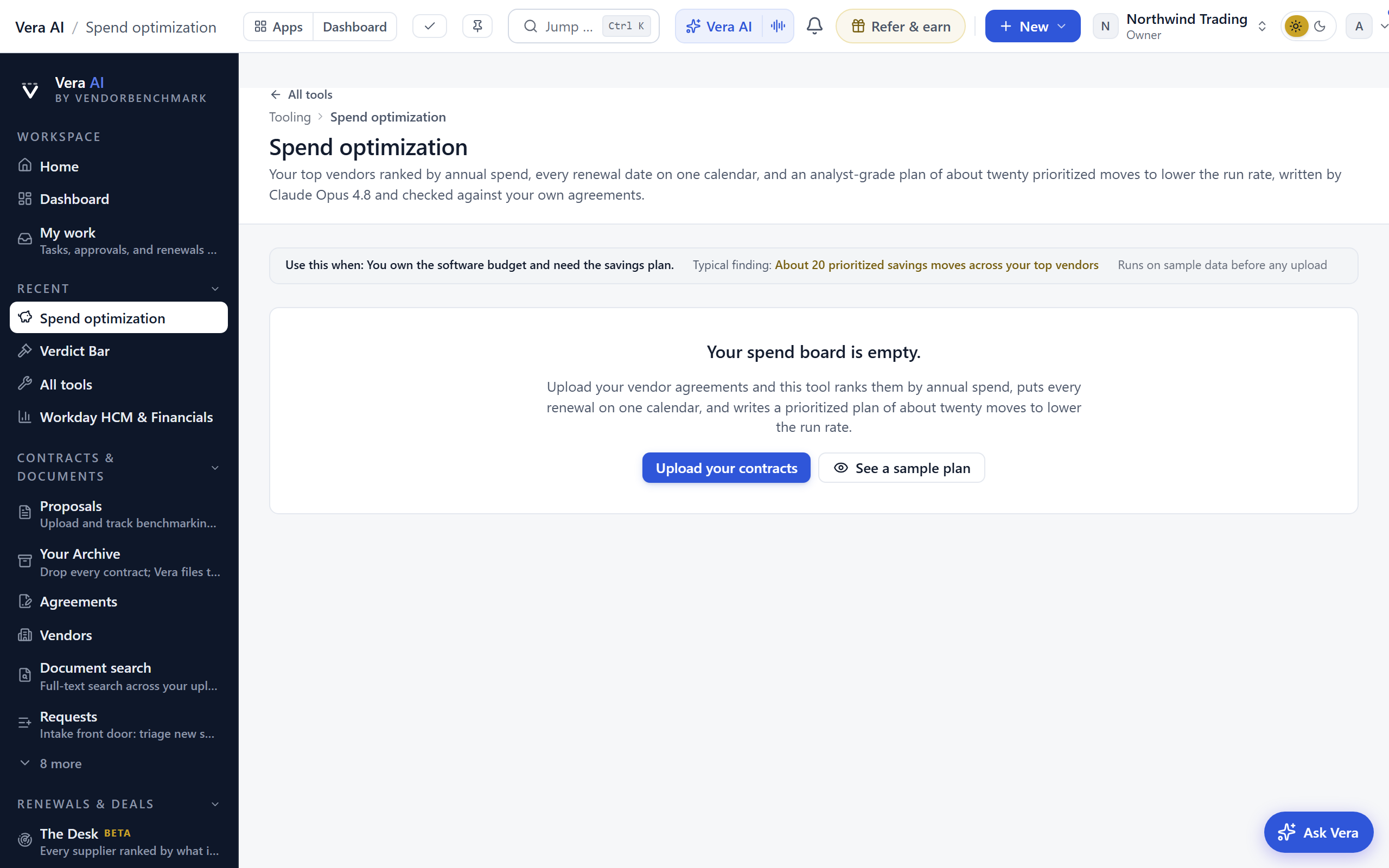
The brief on stage (the front door once a plan exists)
- Seven sections, walked like a briefing: the executive brief (a counted opening with the verdict, then a key findings page where every line is computed from your own agreements), the portfolio (the spend map with the five largest vendors beside it, the concentration pareto), the renewal calendar (the eighteen month horizon with flags on every vendor renewing blind, then a countdown in days to the next open window), the savings opportunity, the action plan (the move deck, the priority board, the 90 day sprint, the roadmap lanes), the decision (the targets, the bottom line beside the sequence), and execution (the what next cards and the project plan). Arrow keys walk the brief; G opens the overview grid.
- The agenda adapts to your data: when benchmarks have priced headroom, the savings section carries the run rate math with its per vendor table, the headroom board seating every analyzed vendor, and value in play with the vendor by vendor status; when they have not, one honest benchmark coverage screen shows where the signal stands per vendor and what opens the money up, and the header ticker tracks the spend renewing inside 12 months instead of zeros.
- The priority board: every move in one of three effort lanes (quick wins, standard plays, structural), the money first inside each lane, with its triage state on the card; click a move to open it in the deck.
- The spotlight: click any treemap tile, headroom bar, or target card and that vendor's dossier slides in: spend, share, renewal window, benchmark signal, the computed reasons it is worth a fight, and its moves with triage buttons.
- Triage from the stage: the deck shows one move at a time with accept, done, and dismiss; verdicts persist to the plan and the header ticker reprices headroom in play live, with delta chips on every change.
- The workspace on stage: Share mints the 30 day read only link, Forward emails the plan with the verdict figures, Word downloads the export, the envelope has Vera draft the follow up email, and the leave behind prints exactly the screens you walked, all without leaving the stage.
- Autoplay: press A or the header pill and the show walks itself one screen at a time; press again to take the wheel back.
- Presenter kit: presenter notes (N), gold ink over any screen (I), fullscreen (F), and light or dark stage lighting, remembered per user.
On the screen (the desk, under the theatre)
- Vendor picker: take your top 10, 25, 50, or 100 vendors by annual spend, or choose them yourself.
- The board: spend per vendor, every renewal on one eighteen month calendar, and the market position wherever the data defends one.
- The portfolio scan: generating opens a full screen scan: your analyzed spend as a board of vendor blocks coloring in by renewal urgency, an honest progress figure over the two to four minute composition, and a live ticker narrating each vendor's spend, agreements, and renewal date. When the plan lands, an executive readout counts up the verdict: spend analyzed, benchmark headroom, renewals inside 12 months, and the opening moves. Close it any time; the plan still lands on the page.
- The plan: a five to ten page optimization plan of about twenty recommendations across right-sizing, renegotiation, consolidation, terms, and timing, each anchored to a renewal date. When benchmarks place headroom, page one leads with the savings waterfall from analyzed spend down to the optimized run rate.
- The treemap: the vendor board opens as tiles: size is annual spend, color is renewal urgency. In the pick-vendors scope, clicking a tile toggles that vendor in or out of the analysis.
- The briefing case: the finished plan splits into five documents drawn as first-page miniatures: the C-level brief on where the money is, the vendor targeting memo with the evidence per target, the full move list, the renewal calendar, and the phased roadmap. Click one and it zooms open into a reading room with a document rail, arrow-key paging, read state, and gold chips that jump to the evidence behind a figure.
- Move triage: every move in the walkthrough takes a verdict: accept, mark done, or dismiss. Verdicts save to the plan itself, so the whole team sees them and they survive reloads; press a verdict again to clear it.
- The tracker: a live band above the plan recomputes as you triage: headroom in play, headroom engaged (an accepted or done move on the vendor), and headroom dropped (every move on the vendor dismissed). Every dollar is the vendor's benchmark headroom from your own deals.
- Open the workroom: a navy band above the tracker opens the plan as a six document workroom on a dark stage: the cover sheet, the spend ledger as the exhibit, the optimization brief, every move priced by family in the action atlas, the sequenced plan sheet with a first step per move, and the What now sheet. Under the document list sit a search over your own uploaded documents and your shelf of recent workrooms. Two panels dock on the right: ⚡ What now drafts the note to the budget owner (analyzed spend, identified headroom, where the savings sit, and the first three moves with their deadlines, figures included) and the opener to the lead vendor (the entitlement, the usage, and a line by line renewal quote, stating plainly that pricing is under review and never quoting your headroom), copies a chat ready summary, the one line plan and the first moves, and opens the renewal calendar, the Deal Room, your two highest priority vendor rooms, and the analyst booking. ✦ Ask Vera answers from this plan alone: the ledger, the measured headroom, the renewal clock, and the moves in plan order. The sample plan carries the same band, so the room is visible before you upload anything.
- Groundedness: every figure is checked against your stored agreements before the plan is shown.
- Share and Forward: Share mints a 30 day read only link that always shows the current plan (copy it, or revoke every link in one click). Forward sends the plan to a colleague as an executive brief email with the verdict figures, the opening moves, and the same kind of link. No account needed on their side.
How to use it
- Pick your vendor set by spend, or hand-pick it (the treemap tiles toggle vendors in the pick-vendors scope).
- Generate the plan and watch the portfolio scan while Opus composes it. This takes two to four minutes.
- Return with a plan on file and the brief opens by itself: walk the sections with the arrow keys, put vendors under the spotlight, and triage moves from the deck. Escape lands on the desk; the Theatre button raises the stage again and offers to resume where you left off.
- On the desk, walk the plan move by move and give each a verdict: accept, mark done, or dismiss. The tracker above the plan shows the value in play as you work.
- Press Open the workroom and work the What now panel: draft the note to the budget owner, open the lead renegotiation, and put the renewal dates on the calendar.
- Take any move deeper with Vera, or book the analyst walkthrough; a dot on the renewal calendar jumps to that vendor's move.
- Share or forward the plan to the budget owner, or export it to Word or PDF, from the stage or the desk.
Related: Portfolio benchmark · Portfolio
Spend Intelligence
*In plain words: your raw spend export, classified, checked for duplicates and price creep, and forecast.*
When to reach for this
- The AP export exists and nobody has ever read it as a whole.
- Duplicate payments and quiet unit-price steps hide in exactly this data.
- Finance wants a six month forward view with buying windows marked.
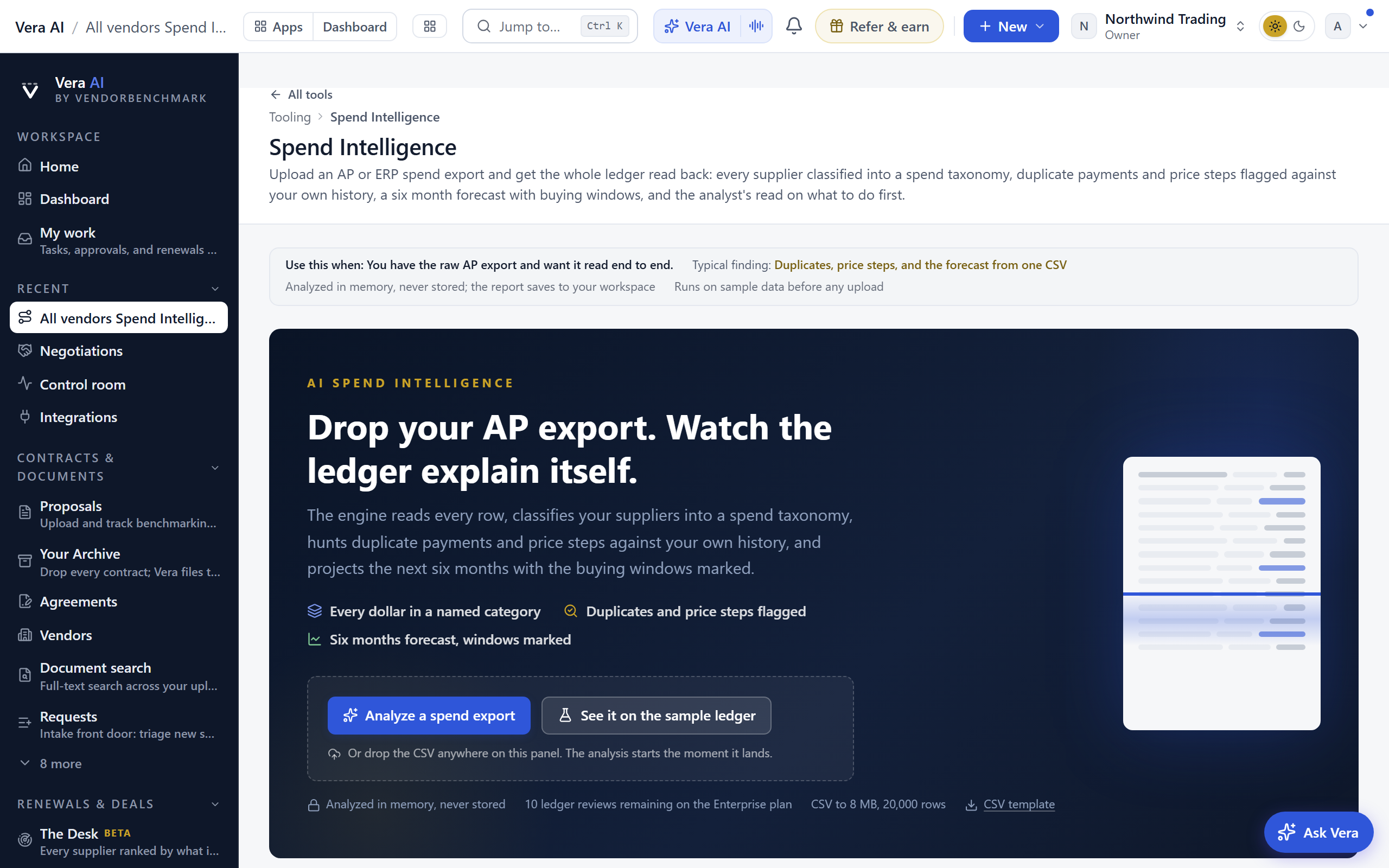
Upload a raw AP or ERP spend export (CSV) and get the whole ledger read back. Every supplier lands in a 20 category spend taxonomy, two deterministic detectors work your own invoice history for duplicate payments and unit price steps, the monthly trend and seasonality project the next six months with buying windows marked, and the analyst narrative says what to chase first. The file is analyzed in memory and never stored; the report saves to your workspace.
On the screen
- Upload stage — drop the CSV or browse for it. Vendor, amount, and date columns are required (common column names map automatically); invoice references, memos, GL accounts, SKUs, and unit prices sharpen the detectors when present. Up to 8 MB and 20,000 rows.
- Sample ledger — the See it on the sample ledger button renders the full report instantly on a fictional 18 month, 41 vendor ledger, no upload and no allowance used. The CSV template link downloads a miniature export in the same format, with a planted duplicate pair and a planted price step, so you can watch the detectors fire on it.
- The ledger scan — running an analysis raises a full screen scan with an honest progress figure and a live board: the moment the rapid first pass lands, its real numbers stream in (rows read, spend totaled, categories forming, findings ticking) while the deep pass finishes behind it. Close it any time; the report still lands in your workspace.
- Verdict band — the flagged dollars, the spend analyzed with its row and month counts, the projected next quarter against the last three months, and the classified share as a ring. A note confirms every headline figure was recomputed from the ledger.
- Where the money goes — the category composition as a dense bar list: spend, share, vendor count, each category's own yearly trend, and its top vendors inline.
- The findings ledger — duplicate invoice suspects (identical amounts inside 45 day windows, re-keyed references) and price variance outliers (unit price steps above 15% of your own trailing median, months beyond 2.5 sigma of a vendor's norm), each with severity, the amount at stake, and the evidence rows (reference, date, amount). Mark each finding Worth chasing or Dismiss; dismissals leave the flagged total live and your triage saves to the run.
- The next six months — actual monthly spend as a solid line, the projection dashed with a one standard deviation band, values printed at the data, and deterministic buying window notes per category beneath it.
- The analyst read — the narrative over the computed numbers: where the money concentrates, which findings to chase first, and three to five prioritized moves with the stake quantified.
- Classifications worth a human glance — suppliers the model placed below 60% confidence, with the guessed category and the reason it was unsure.
- Your ledger reviews — every run saved to the workspace as a shelf or a dense table with the flagged total, finding count, and status; reopen any run, rerun on a fresh export, or delete it.
- Open the workroom: a navy band above a saved review opens the analysis as a case file on a dark stage: the cover sheet, the analyst brief, the category composition, the findings ledger with every evidence table and your triage state, the six month forecast with its buying windows, and the What now sheet. The ⚡ dock beside the paper carries the moves: the hold list for the payment run (the duplicate suspects with their evidence, figures included), the statement request to the flagged vendor (your own postings only, never the analysis behind the flags), the finance readout, chat ready copies of the verdict, the findings, and the composition, and handoffs into invoice intelligence and the renewal calendar. ✦ Ask Vera answers from this ledger alone: the flagged total with your triage applied, the composition, the projection, and the analyst moves. The rail searches your uploaded documents and keeps your shelf.
How to use it
- Press See it on the sample ledger first if you want to see the output shape before exporting anything.
- Export the ledger from your AP or ERP system as CSV (vendor, amount, and date at minimum) and drop it on the stage.
- Watch the scan or leave the page; the analysis takes two to four minutes and saves either way.
- Triage the findings: mark the real ones Worth chasing and dismiss the rest; the flagged total follows your verdicts.
- Take the top category into the spend optimizer, reconcile flagged invoices in invoice intelligence, or put a buying window on the renewal calendar from the What next panel.
Tips
- Negative rows (credits) count toward totals but are never flagged as duplicates.
- Mixed currency exports are summed as printed and the report says so; filter to one currency for exact totals.
Related: Spend optimization · Invoices
Contract Reader
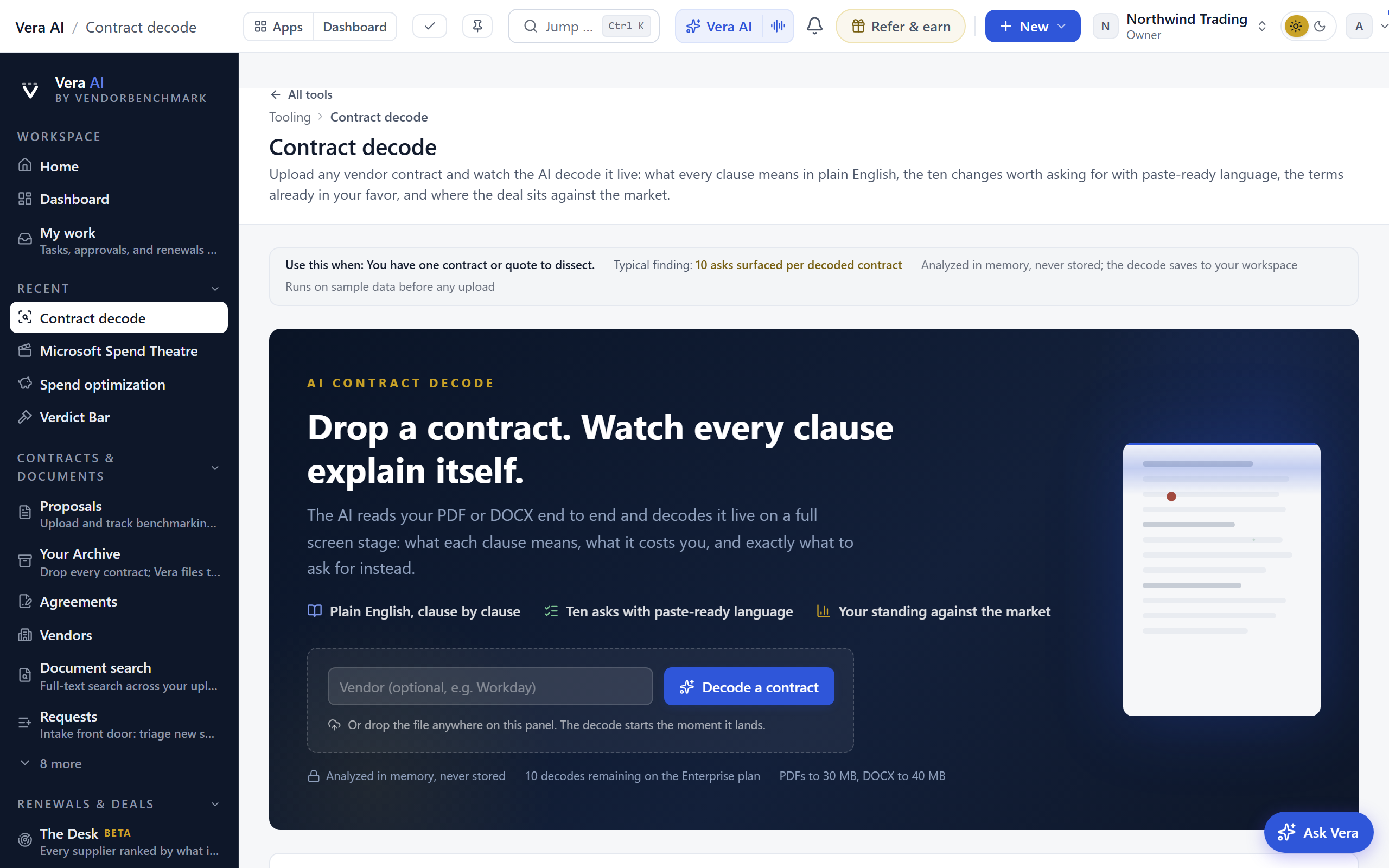
One contract, read properly, in one window. Since August 2026 pressing Contract Reader opens the agent's own window directly, with nothing loading behind it: the titlebar names the paper you are working, carries the sun and moon for light or dark, the desk inside holds the drop lane and every contract you hold, and closing the window returns you to Home. Give it a paper and the reader opens on top as a second window, with the page on the left, Vera's read, your marks and the redline beside it, and, on the tab row, the contract, MSA and SOW Agents, Compare against a second paper, the comment ledger, a conversation with Vera about the paper, the document's thread, and search across every document you hold, and the agent room itself.
The agent room, key a. Inside the window, the Agent tab is where the paper gets worked to a job rather than read. Say what you need out of the document in one sentence, or take one of the four standing assignments (prepare me for the renewal conversation, what we are exposed to if we sign this as it stands, where the money is and what it is committed to, what to change before signing and in what order). The agent plans the work first: the three to six things it has to settle to answer you, each one named with the question it puts to the document. It then works them one at a time against the text, filing each finding with the verbatim passages it rests on; pressing a passage opens it on the page beside you. When the steps are in it writes the close: what the paper means for you, the moves in the order they are worth doing, and what the document leaves open. Copy hands you the whole run as plain text, and three doors carry it on into marking the paper up, decoding the clauses, or writing the brief.
Continue a previous run, or start a new one. Runs are kept against your account, not just this browser. Opening the room with no run in hand offers Earlier on this paper, a list of your last five runs on this document with what each one was for and how far it got; pick one and Continue brings it back exactly as you left it. A run that was interrupted, by a pause, a closed window or a lost connection, carries on from the step it reached rather than starting again, and New run sets the current one aside into that same list rather than throwing it away. Every step reads this document and nothing else, so a figure the paper does not carry never appears in a finding.
It remembers the paper. Opening the agent with work in progress lands on the contract you had open, no question asked. File, Continue where you were lists your last five sessions, and Start a new one in the same menu sets the current session aside rather than throwing it away; saved reports and records are never touched.
Every open is saved. The moment a paper is in hand the agent remembers it, in this browser at once and against your account behind that, so the offer to carry on follows you to another machine. There is nothing to press to save and nothing to lose by closing the window.
Three ways to start a new one. Drop a contract anywhere on the window, press Browse for a contract and pick a PDF or Word file up to 40 MB, or choose one you already hold from the searchable list underneath. A dropped file is filed into your workspace first, through the same checks and the same read as any upload, so what the agent works on is a real contract in your estate rather than a file that vanishes with the page.
While a paper is open the window names it, with Open the reader to go back in, The record for its contract page, and Work another contract on the titlebar to set it aside and pick the next. Under the working paper, What next carries the three moves the paper makes worth doing: ask Vera about it, book the analyst walkthrough, or open the whole estate in the Contract Management Portal.
Contract Agent
*In plain words: one window for the contract, the master agreement and the statement of work, where the paper is the stage and the redline is the product.*
When to reach for this
- Before signing anything: what does this paper say, and what would a buyer change?
- Before a redline round: the changes drafted in paste ready language, struck on the page, ready to send back under your own name.
- When legal is a bottleneck: the MSA read is the legal review that decides whether counsel needs to look at all.
- When a consultancy sends the statement of work: the SOW read finds where the scope leaks and sets the rate card against the market.
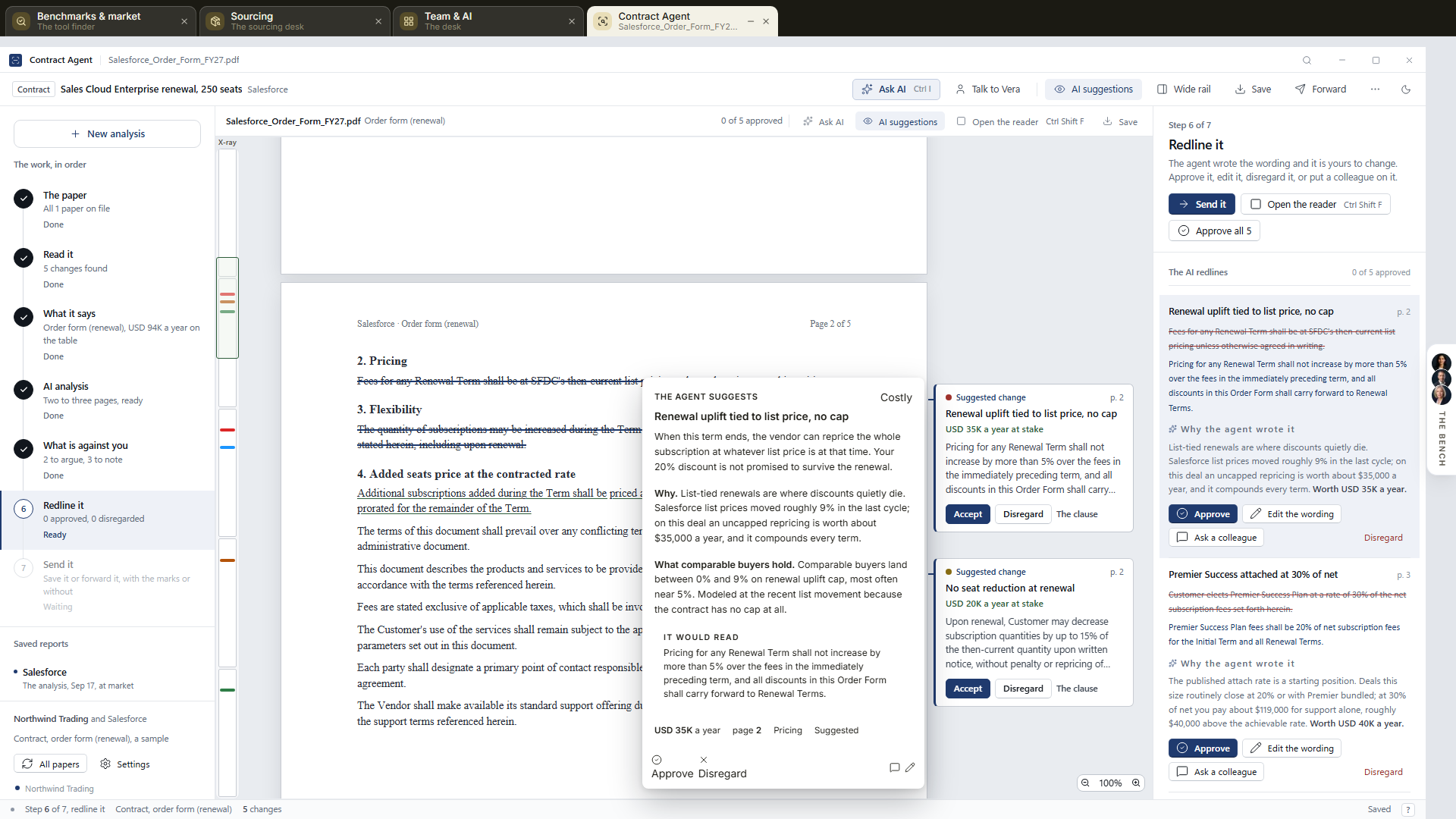
Since Contract Agent 5.0 (15 September 2026) the window is three columns and one path. Down the left are the seven steps of the work in order: The paper, Read it, What it says, AI analysis, What is against you, Redline it, Send it. Each step says whether it is waiting, ready, running or done, and what the paper in hand gives it: how many papers are on file, how many changes the read found, how many are approved, how many are ready to send. The paper takes the middle of the window on a light mat, the way a page sits in a reader, and stays there through every step; everything the agent finds is marked on it. The right column is the step's own work. The bar over the columns carries the kind of paper, its title and vendor, Ask AI, the AI suggestions switch, Wide rail, Save, Forward, the menus behind one button, and the theme. Full screen (F11, the button in the caption, or the button on the analysis bar) puts the whole window on the whole screen, browser and all; F11 or Esc comes back. New analysis sits above the seven steps, in the same place on every one of them: it clears the desk and opens step one for the next paper. Nothing is deleted, the paper you had stays under Your uploads with its analysis under Saved reports, and a read already running keeps running. Everything you decide applies as it changes; there is no Save button for your decisions.
On the screen
- 1. The paper: a drop strip (or Choose a file, Ctrl O, which asks the kind of paper and the counterparty), then every paper the organization has read as rows: the title, the vendor, where it stands (reading now, suggested changes, in the redline, with the vendor, returned, signed off, did not finish), the date, the kind and the money a year on the table. Press a row and the paper opens in the middle; a filter box appears above the rows once there are more than six. A fresh estate offers the seven samples of three kinds, which open without an upload and spend nothing: three contracts, two statements of work (one uncapped time and materials, one fixed price) and two master agreements (one SaaS licence, one managed services). The pairs are deliberate, because the money sits somewhere different in each shape. Right click a row for its menu (send, export, copy a link, delete). The foot of the left column names whose paper is open, what the approved changes are worth a year, how many colleagues have commented, All papers and Settings, and the estate you are in (your own, or the labelled sample estate).
- 2. Read it: while the agent reads, the beats in order (received, the first pass, the deep read, on the pages), never a spinner; the page in the middle shows the paper as a stack of pages with a beam reading it line by line and the part being read named under it, with a bar that moves, the minutes elapsed and the usual time left (the first changes inside a minute, the whole read in three to five); Back to the papers opens every paper on file while this one keeps reading, and it lands on the ledger by itself. The Contract Agent name in the caption and the kind pill on the bar do the same from anywhere, and All papers on the analysis bar closes a report and goes back to the list. A read cut short by its time limit lands what it had found, says so, and offers Read it again. Once it lands, what was read and the verdict in one paragraph, with Read it again on your own papers.
- 3. What it says: the paper in facts, each value on the right (the vendor, what it is, the changes, the money on the table, the standing against comparable buyers in words, and every term the read set against the market with the peer range under it), the read in one paragraph and point by point, Already in your favor (every clause the read left alone on purpose and every term on your side of the market, or a plain sentence that nothing beats the market), What the paper does not say, and three doors under More on this paper: Against the market (every term with the change that moves it, the rate card as a ladder on a statement of work with a cap lever, the staffing mix, the must have check and the research library's door), The team on this paper (who is on it now, who is invited, the thread, Send to a colleague, Invite, Copy a share link) and Versions and the trail (the round, what moved since the previous read of the same contract, the trail). Back to what it says returns.
- 4. AI analysis: the full analysis of the paper, written by the agent from the whole document with a web search of the vendor's current published terms, in the shape of a negotiation brief: what this document does (with a table of every commercial mechanism and its assessment), the drafting defects to resolve first, the seven to ten commercial terms to change (each with its section and the precise ask), the ten clauses to look at ranked by consequence, what is genuinely negotiable, what you will have to trade for and what the vendor will not move on, and how to run the negotiation, with the sources consulted at the foot. It is written by itself once a read lands, in about six minutes, with a bar on this step that says how long. Before it writes, a reader opens the vendor's own current pages (what they charge and how they package it now, their stated uplift and renewal policy, the definitions that decide what you owe, their audit practice and their fiscal year end) and what it read goes in front of the writer, so the analysis argues against the vendor's terms as they stand today. The sources at the foot are those pages, and only those: each one on the vendor's own site, in its primary edition rather than a regional or translated one, and dated inside the last three years. Where the reader could not run, or nothing it found met that test, the analysis says the current published terms were not checked and cites nothing. Where the read has used the time its own run had, the analysis is queued and starts in a run of its own, which the step says; it still lands here by itself. A paper read before today shows Write the full analysis instead. The desk's own numbers (the money, what to do in order, the bottom line) follow it.
Read it (Ctrl Shift A) opens it over the pages as a document: four figures across the top before any prose (what is at stake a year across the changes on the desk, how the paper reads against comparable ones, its headline term against the middle of the market, and the largest single change), then body copy at reading size, the points as lists, a page a centimetre wider each side, and every figure grounded in the stored read. Its own bar carries Ask AI (the agent beside the page, reading the analysis on your screen and the contract behind it, with the passage each answer rests on), Talk to Vera and Ask Vera, Edit (every paragraph becomes a text box in place; what you type saves with the read and travels with the shared link, the forward and Vera's reading; Restore the original brings the composed words back), Full screen (the whole window on the whole screen with the analysis at a larger size), Share a link (a read only link that opens the analysis itself, without a seat, for thirty days), Copy a link (for a colleague with a seat), Open as PDF (the analysis is printed once as it lands and kept beside the read, so what you forward is the document rather than whatever your browser produced; it opens in the same reader the research library uses, with the pages as designed, a contents list read from the document's own headings, thumbnails, zoom, find and Save, and it says plainly when the analysis on screen has moved since the file was printed), Word, and Forward (to a colleague by email under your name). The rail carries the same doors under Talk about it and Send it on.
- Saved reports (under the steps, on the left): the last five papers you read, by vendor and date. Press one and the paper opens on step four with its analysis in the rail, exactly as if you had opened the paper and walked to it. Read it on step four opens the analysis over the pages as a document, with the other saved reports on a shelf beside it. Everything else you decided on the paper is saved the moment you decided it.
- Talk to Vera (on the bar, on the analysis, and in the Ask AI pane) puts Vera on the line with the paper, the written analysis and what is on your screen in hand: the step you are on, the change you have selected, the report she can quote from. Ask her what the analysis says to do first, or what the selected clause means, and she reads it back. A microphone is never required; type in the dock and she still answers out loud. Ask Vera opens the written conversation on the same screen. Talk about this paper on the View menu is the older door: the vendor's own negotiator, or Vera where none fits, with the paper alone.
- 5. What is against you: every adverse term the read found, however many there are, ranked by what it costs a year, each with a word for its weight (Argue, Worth it, Note), the clause it rests on quoted, what it means, and the money. Every quote is checked against the paper's own text and placed on the page where the words sit; one the read could not find in the paper says quote unverified beside it, so you read the clause before you argue it. Press one and the page opens on the clause; rest on one and the card that explains it opens beside it. With a finding selected, The market position says what comparable papers carry, with Ask AI about this clause.
- 6. Redline it: the same changes as redlines, each with the words struck, the wording written under them, and Why the agent wrote it with what it is worth a year. Approve puts the change in the redline (press again to reopen), Edit the wording opens the replacement in a box and what you save is what the paper then carries, Ask a colleague lists the people in your organization and hands the change to the one you press, with the thread on that change and a composer under it, and Disregard takes it out, with Undo on the toast. Approve all takes every open suggestion after a confirmation, and Open the reader puts the paper on the whole window with this rail beside it. Your own lines (drag over words on the page and press Redline, or Write a line of your own, W) are listed under the agent's with Edit the wording and Remove. The tally under the list says what is approved, disregarded and worth a year.
- 7. Send it: the pack, each file marked Safe to send or Yours only: the paper with the redlines (the Word original with the accepted changes as tracked changes, or the PDF with the changes struck and the language beside each page, under your own name), the AI analysis, the brief as Word or PDF, the change log as a CSV, a colleague (the read as an email with a link that lasts thirty days) and an invitation onto the paper. Forward the paper emails the redlined paper under your name with a message drafted from your changes; Save the paper downloads it. Under the pack, what the vendor gets and what is kept back, and the round: our redline, sent, returned, signed off, with Import the vendor's return and Sign off.
- Ask AI (on the bar, on the paper's own bar, Ctrl I): the agent in the right column. The questions worth pressing are read off this paper (what the selected clause means, which single change to hold out for, what is good in the paper, what the vendor will push back on), the conversation stays with the paper, and a box at the foot takes a question in your own words. Your own paper is answered as a whole from its stored read, with the passage each answer rests on and a plain line when the paper is silent; a sample is answered from the clause you have selected. Talk about it out loud puts the vendor's own negotiator, or Vera where none fits, on the line with the paper in hand.
- The paper in the middle: the pages with every suggested change struck in the read's colour and its balloon in the margin, the way Word draws a redline; a term already in your favor is underlined green, your own changes are struck green, a note of yours is a yellow mark. Press a balloon and the redline of step six opens on it. Drag over words and a toolbar floats over them: Redline (D) strikes them at once, AI line has the AI write the line for those words, Comment leaves a note for your team, Copy takes the words. The bar over the pages counts what is approved and carries Ask AI, AI suggestions, Open the reader and Save. The reader (Open the reader on the bar over the pages, on any step, or on step six, or Ctrl Shift F) is the paper as its own window, on the whole frame, with one rail beside it that has two faces: Redline, which is the step's own work, so you approve a change, edit its wording, disregard it or put a colleague on it with the clause in front of you, and Comments. It opens on the redline, and pressing Redline stands the reader on step six. Press a face again to put the rail away and read the pages on the whole window. Esc comes back to the desk.
- The menus (the button on the bar, F10): File, Edit, View, Redline, Paper, Team and Help, the same registry the older menu bar printed, so every verb is still here: the markups, the positions on a change, the vendor's round, the drafts, the second read, the must have check, the share links, the trail, the keys. Ctrl K goes anywhere; ? lists every key; the digits 1 to 7 walk the steps; Ctrl B collapses the steps to their numbers.
- Settings (Ctrl ,): open in the middle column. Display (density, text size, the wide rail), Redline (the markup the paper opens in, the suggestions on the page, the organization's redline author), Keyboard, Must have terms, Clause library, and doors to the platform's notifications, sharing, retention and members pages.
How to use it
- Open a sample first, or drop a paper on the window. It opens in the middle as the agent reads it, and the rail moves from Read it to What it says when the read lands.
- Read steps three and four: the facts, the verdict and the analysis, then step five for what is against you, ranked by what it costs.
- On step six press Approve on the redlines you want, Edit the wording where you would say it differently, Ask a colleague on the ones that are theirs, and Disregard the rest. Press Open the reader to do all of it with the paper on the whole window.
- On step seven press Forward the paper to email the redlined paper under your name, or Save the paper to download it; the analysis, the brief and the change log are yours only.
- When the vendor's version comes back, Import the vendor's return on step seven: every change says agreed, countered or declined; take their wording or hold our line on each counter on step six; then Sign off.
Related: Vera Deal-Room · Rate Card Benchmark · Clause library
Second opinion
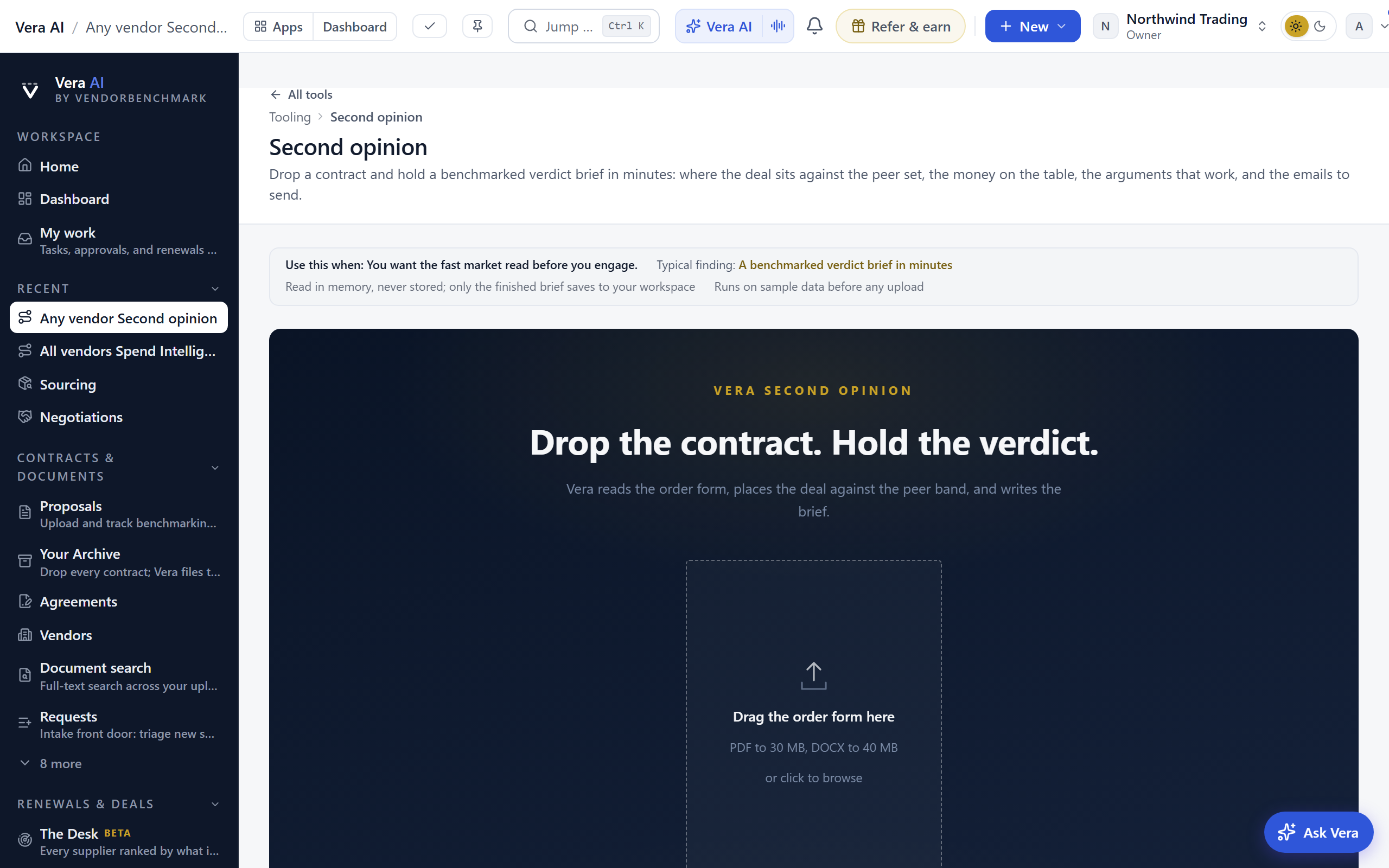
Drop a software contract and Vera returns a benchmarked second opinion in minutes. Where Contract Agent reads every clause, Second opinion answers the first question: where does this deal sit against the market, what is it worth to fix, and what do I say. Use it when a renewal quote or a fresh contract lands and you need the market read before you engage.
*In plain words: is this deal fine, what is it worth to fix, and what do I say.*
When to reach for this
- The agreed deal is drafted and one hour of checking is still cheap (the pre-signature recipe).
- A stakeholder wants independent reassurance before they countersign.
- You suspect a deal is fine and want that confirmed in writing rather than assumed.
Second opinion opens as the immersive application window from every entry point, the same window as the three decoders: a rail click, a launcher tile, a typed address, and a link someone sent you all land in the dark titlebar frame with Jump to and Ask Vera, floating over the page you were on. Close the window and you are back where you were, with nothing lost.
On the screen
- The drop zone: drop the contract as PDF or DOCX, or browse for it. The document is read for the terms that price the deal. When you handed a tool a document in the last few hours, a second door stands beside the drop zone: Continue with that paper, one press, no new upload, because the workspace already holds it, and any older papers from the same desk wait in one quiet line under it. The desks pass their working deal's paper the same way.
- The reading: a full screen stage in the platform's own light that shows the extracted terms live as the read runs: vendor, product, price, seats, and term land as they are found, so you see what the brief will be built on before it is written. Beside the document, a progress tracker states the phase in words (parsing the order form, extracting commercial terms, placing the deal in the cohort), the percentage in figures, how many terms have been extracted so far, and the elapsed clock. The bar reaches 100% only when the run is finished, never before. Press Skip to the brief and the same percentage and clock follow you onto the page, so a run you leave and come back to still says where it is.
- The masthead: a finished opinion opens in the platform's studio light, filling the window. The verdict is the headline in display type, with the one line under it and the deal's meta (vendor, product, event, file, date). Under it, four colour tiles state the figures every benchmark on the platform leads with: the discount this paper offers as a percentage off list, what comparable customers get at the same size as a range with its midpoint, the money on the table over the term, and where the deal ranks in one of five words (Poor, Below market, At market, Good, Top of the market), each with one line of reading under the figure. The masthead also carries the opinion's actions (replay the reveal, email a copy, download the PDF, start another opinion, delete) and the numbered view pills that run the whole opinion. The number keys 1 to 6 switch views, and each view keeps its own link, so a forwarded URL lands on the exact view you were reading.
- Verdict (view 1): the executive read on one screen: the summary, the bottom line, the deal ledger (population, net ACV, discount, uplift, payment, flex), and where you sit in the band drawn as a meter, with the peer figures under it. When the vendor is covered by the discount curve library, the view leads with the curve itself: the documented peer range by deal size drawn as a band, your offer placed on it as the gold dot, the ask as the diamond, and the distance between them priced in money over the term. Three levers move the drawing, all from the curve document: the curve line (for example the line with competitive alternatives quoted), the deal size band, and the ask, bounded to the documented range. The levers keep their position when you close the window and come back, and Reset to the reading returns to the midpoint. Vendors outside the curve library keep the view exactly as before.
- The brief (view 2): the four page paper in the executive brief format: the same three figures across the masthead, your placement against the peer set on a scatter, the money on the table priced, the arguments, the talking points, and the three priced paths. Under the peer figures the brief reads the position back to you in its own words: what the placement means for this contract, what the gap is and is not evidence of, and what it changes about how you negotiate. Alongside it sit the deal snapshot, every negotiable dimension with what the vendor proposed against the position the evidence supports, the market evidence naming where the band came from, and the sequencing that says which lever opens and which one closes. Where the vendor paper prints no list price, and most enterprise cloud quotes do not, the brief benchmarks against the vendor's latest known list rate instead of stopping: the discount is stated as the working baseline with its source named, a working baseline callout says why the figure is credible and how to verify it against the vendor's own paper, a sensitivity table prices what changes if the real rate differs, and having the vendor confirm the current list rate in writing becomes one of the asks. The same paper lands on the same baseline every time, for everyone. The discount is always taken on the whole deal, total list against total net over the term, never line by line and never per unit. When no peer cohort in the reference data sits close enough to this contract to price the gap, the brief says so plainly and still gives you a read: where the paper sits judged from its own terms, the uplift, the commitment shape and the flex rights it carries, marked as an analyst's read rather than a placement against our data, and the one input that would turn it into one. The docked verdict bar rides with the paper, and Download PDF prints this document.
- Arguments (view 3): the arguments and the talking points as one working view; every talking point carries a Draft this email that lands on that draft, open. A talking point whose draft did not come through is still shown, without the button, rather than disappearing from the list.
- Draft emails (view 4): the five ready drafts: read the full body in place, then copy the draft or open it in your own mail app. Nothing sends from the platform.
- Negotiation (view 5): the brief for the table. The three priced paths stand as the high level strategy ladder with the note on how to choose, followed by the tactical plays written from your own verdict figures (cap the uplift before price, ask for the band you are in, take the flex band, park the signature against the vendor's fiscal year end), how to open the conversation, and a budget posture line. Beside them sits the desk's curated view of the vendor at the table, covering the eight major publishers: fiscal year end and quarter closes, the best signing window, what the vendor's sellers are paid to attach right now, the main competitors worth naming with one line on when each is credible, and the table notes a buyer should know before the first call. Vendors without a curated desk keep the strategy and plays, with a pointer into the Vera Deal-Room for live intel.
- Next moves (view 6): the saved contract note, the door into the opinion workroom, and the handoffs.
- The opinion workroom: Open the workroom, on the masthead from any view, puts the brief on one dark stage with the five drafts, the copy moves, and the handoffs docked beside the paper (the dock opens on the moves), Ask Vera grounded on the whole verdict, and your past opinions, document search, and shelf on the rail.
- The handoffs: take the same contract deeper in one click: Contract Agent for the clause by clause read, the Vera Deal-Room for the full negotiation package, or Proposal comparison when a revision comes back.
- Email a copy: send the brief to yourself or a colleague; enter the address and the brief arrives as an executive brief email.
- The sample: a sample Workday renewal shows the full application instantly, no upload and no AI allowance used, so you can judge the output before you bring your own paper. Trial plans use the sample to see exactly what the tool produces; upgrade to a paid plan to run a second opinion on your own contract.
- Saved to your workspace: a note on Next moves says where the contract went: it was filed under Contracts, private to your organization, and joined your benchmarking queue. The note links to the contract record and carries a delete that removes the stored document on the spot. Owners can turn document saving off under Data controls.
How to use it
- Drop the contract, or press Use the sample Workday renewal first.
- Watch the reading extract the terms, then land on the Verdict view: the summary, the bottom line, and your standing on one screen.
- Walk the band with the number keys: the full paper on 2, the arguments on 3, the drafts on 4, the negotiation brief on 5.
- Open the draft that fits, copy it into your own inbox, or email a copy of the brief to a colleague.
- When the fast read earns a deeper one, follow Next moves into Contract Agent or the Vera Deal-Room.
Related: Contract Agent · Vera Deal-Room
Benchmark Agent
The door that reads a dropped quote or contract and comes back with the benchmark. Since 15 September 2026 the window is four steps and nothing else: a white rail with the deal card, The contract, Price benchmark, Terms benchmark and Options for management, the saved reports under them, one head, and the work for the open step. There is no menubar, command bar or details pane on that path. Drop a quote or a contract and it is read and benchmarked at once, with nothing to fill in; the report is written by an analyst persona with 25 years inside that vendor's own deal desk: it reads the paper, checks it against the platform's discount curve research for that vendor and product, researches the live market with web search, and writes the report. The moment it lands, the three notes are written from the paper itself, attached as the document with a search over its wording and the calculators beside the web and the platform's vendor material, and saved with it; Write it again takes a paragraph of your own and revises the last note rather than starting over. Where Second opinion returns a four page verdict brief with drafts and paths, the Benchmark Agent returns the documents you forward.
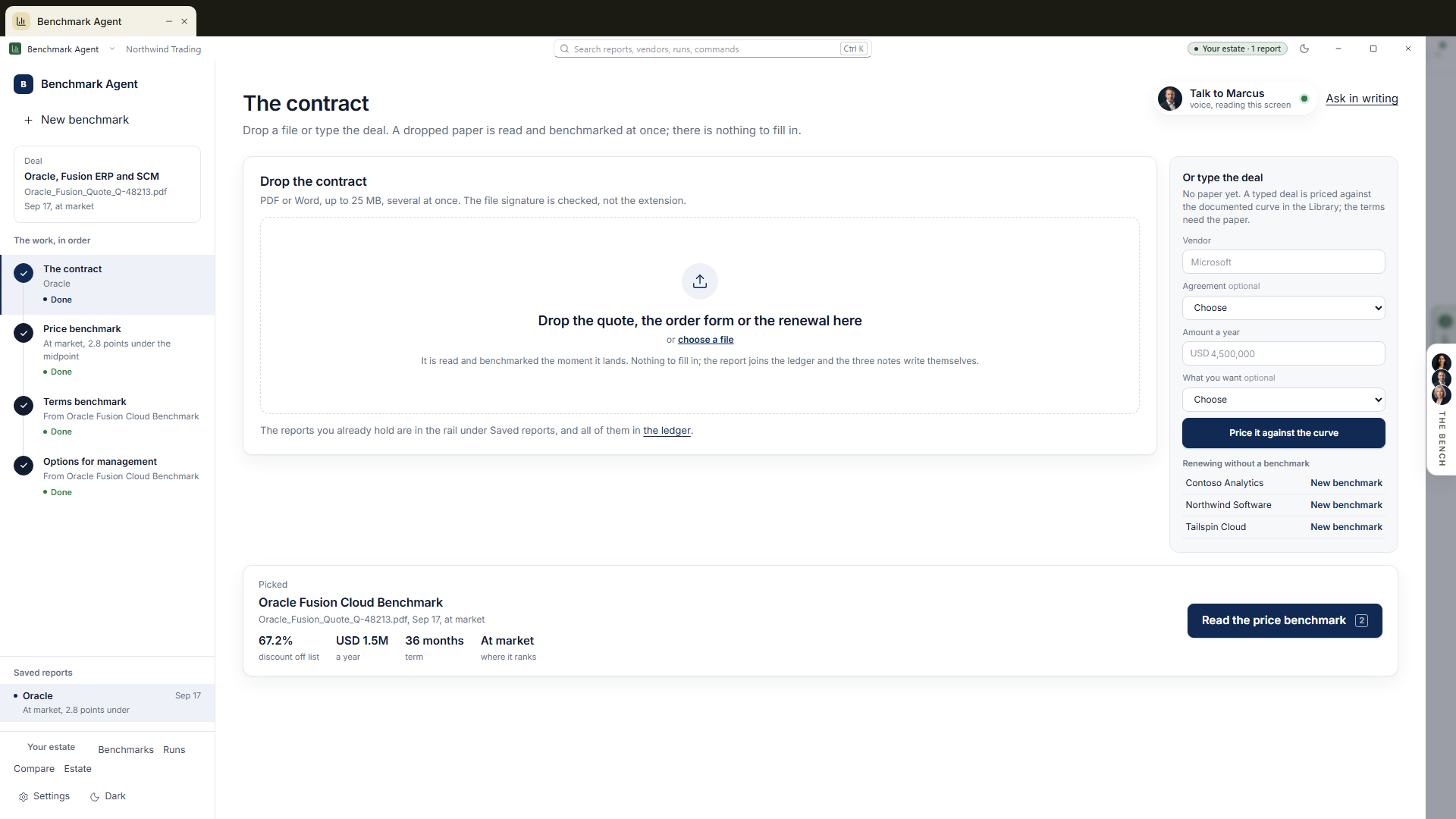
On the screen
- The caption: the top row of the window: the app mark, the title, your organization's name, the search box in the middle (typing into it opens the palette with your text carried over, and Ctrl K does the same), the estate chip (Your estate, or Sample estate in amber while the labelled sample is on screen), the sun and moon for the theme, and the three window buttons: minimize to the taskbar, maximize (F11) and close.
- The rail: New benchmark first, under the brand and in the same place on every step. It clears the desk and starts the next deal at step 1: the report that was picked is set aside, a paper staged but never run comes off the list (nothing has been spent on it), and everything you hold stays saved, under Saved reports and in the ledger. A benchmark already running keeps running and lands where it always did. Then the deal card: the vendor the read found, the paper's own file name on one line under it, and the date and rank once it has one, so a long file name never carries the card. A paper you drop is named there from the first byte, with the percentage of it that has reached us, and it becomes the deal at once: the card, the four steps and the card at the foot of step 1 are about the paper you just dropped, and the report that was picked is set aside rather than deleted (it stays under Saved reports and in the ledger). While a paper is being benchmarked, Running now lists the run under the deal card with its station and the time remaining, wherever you have gone in the meantime; press it and you are watching it again. Then the four steps as one ladder, the same one the Contract Agent and the Negotiation Agent draw: The contract (1), Price benchmark (2), Terms benchmark (3) and Options for management (4), joined by a hairline down the numbers, a finished step filling its ring and taking a tick, and the open step carried on a bar at the left edge. Each says where it stands, Waiting on step 1, Ready, Running or Done, and once your estate has something to say it says that instead of its standing line: the vendor whose paper is in hand, the station a run is at, the placement the benchmark produced. A step that cannot be entered yet says so rather than offering a press that does nothing. Under the four, Saved reports lists the five most recent by vendor, date and rank, so you can go back to any of them with one press, and All reports opens the ledger. Then Your estate: Benchmarks (7), Runs (8), Compare (9) and Estate (0), and at the foot Settings (Ctrl ,) and the theme.
- The head: the open step's name, one line of what it does, and at the right the agent with a face: the portrait and name of the specialist who knows the vendor in hand, pressed for the voice line (T), which opens already reading what is on the screen (the papers staged, the report picked, the run in flight, or the note itself), with Ask in writing (A) under it, then The contract to go back to the start on a note, then the step's one action: Run now on step 1 when a read paper is waiting, Revise the report on a landed note. Once a written note is on the screen the specialist moves into the Share card beside it rather than standing in both places, and the T and A keys work from wherever you are.
- The work: what the open step needs and nothing else, described step by step below. The window runs edge to edge with no margin.
- The rooms beyond the steps: the full report, the library, the runs, Compare and Estate keep the office shell, and every one of them carries Back to the benchmark at the head of the room (or press 1), so a report never dead ends.
The four steps
The contract (1) is where you land: the drop zone across the page, with the typed route in the narrower column beside it. Drop the contract: drop a PDF or a Word document on the strip, or anywhere on the window, or press choose a file. From the first byte the page becomes the scene of the run: the paper rising onto the desk with the percentage of it that has actually reached us, then the read, then the benchmark, with every paper named on the rail under it and how long the run will take. The read fills in the facts and the benchmark runs by itself the moment the read lands. There is no fact sheet to answer on this path; to correct a read before running, use the Benchmarks room behind the steps. The reports you already hold are in the rail under Saved reports and all of them in the ledger; picking one opens its three notes. Or type the deal, the quieter second way in beside the strip at half its width: the vendor, the agreement type, the amount a year and what you want; a typed deal is priced against the documented curve in the Library, because the engine needs the paper to benchmark the terms. A run in progress and a stopped run sit above the drop zone with Watch and Retry from the stored sheet, and while a dropped paper runs it is the deal in hand: the card names it, step 2 shows its stations, and steps 3 and 4 wait for it. Once a report is picked, a card at the foot states its discount, its annual figure, its term and its rank, with Read the price benchmark beside it.
Price benchmark (2) is the benchmark as a document, written by the platform as the most experienced buyer side negotiator for that vendor, from the paper itself, the saved benchmark with its sources, the platform's own figures and market positions, and everything the platform holds on the vendor, with web research. Four to six pages in the advisory note format: a kicker, the title, one sentence that states the finding, the written from line, the key takeaways first, then the numbered sections. What you are being offered, with the lines on the paper; what comparable buyers are offered, drawn as the peer band with this proposal and the supported ask on it; where this deal ranks, drawn as the ladder of five standings; the levers and what each is worth, drawn as the price walk; the asks in order; what to say in the room, as sentences with the reason each works; a sensitivity table; the calendar; the bottom line. The charts are the platform's own, drawn from the saved benchmark inside the note where the writer placed them. The report closes on the firm block, the same one the notes carry: Vendor Benchmark LLC and the address, the buyer side stance, the standing notice, and the file the report was written from.
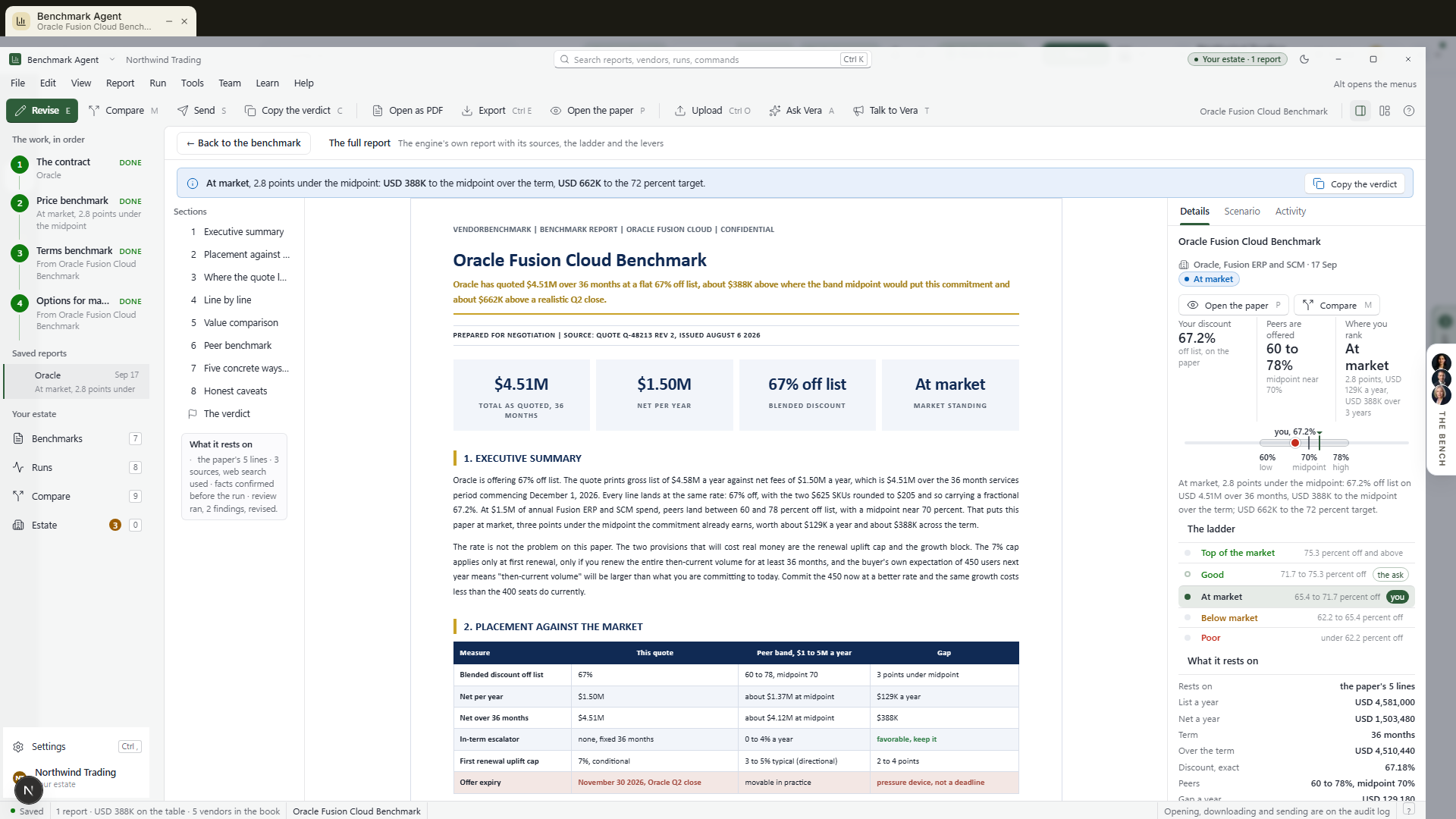
Terms benchmark (3) is read from the paper itself. Every commercial term the paper states is quoted with its section or clause (the term and its dates, the payment schedule, price hold or repricing, the renewal uplift, auto renewal and the notice window, reductions and true ups, overage, swap rights, support and its fee, service levels, audit, termination and exit, data return, order of precedence and any special conditions), then placed against what comparable buyers get on that vendor: the verdict, the ask and what the ask is worth over the term on the paper's own annual figure, with the assumption stated. The terms map places each one from risk to favorable. Then the terms that cost money argued one by one, the protections worth asking for, which asks go in which round, only what is genuinely silent on the paper to confirm, and the letter to the account team as sentences ready to send.
Options for management (4) is a decision memo addressed to the executive team, written by the same specialist: four ways to renew, each costed on the same figures. Renew as offered, renegotiate to the market midpoint, push to the supported target and restructure the commitment, or hold, shorten or re-source. For each, what it means, the money a year and over the term, the pros and cons, the risk and who has to do what by when; the options chart shows the cost over the term with the saving printed at each bar; a comparison table adds the risk, the effort and the time to decide; then the recommendation with the date the decision must be taken by, the exact decisions management is asked to approve, what would change the recommendation, and the bottom line. Forward it as it stands.
How the report is written. From the moment the engine starts writing, step 2 shows the report arriving in its own dress, refreshed every few seconds with the word count on the clock, and keeps it on screen while the engine reads it back. Before that, the stage shows the read and the placing of the deal.
How a note is written. The moment step 2 opens on a placed report, all three notes start writing at once, so the terms benchmark and the options memo are there by the time the price benchmark is read. The step shows the writer's stage: the clock and the order it works in (reading the paper, researching the vendor, writing, reading it back), then the note itself streaming onto the sheet word by word with the word count on the clock, the way an answer arrives on claude.ai. The writer reads the paper first and the paper wins: where the benchmark's read disagrees with a line on the paper, the note follows the paper without comment. Since 15 September 2026 two specialists read the paper before the writer starts and leave their notes, one for the clauses and one for the money; the writer has the platform's bench at hand as it writes (the benchmark library for the vendor, the price catalog, the market briefing, your deal history, a sandbox for the sums) and your record with the vendor in the room; and when the note is written a second pass reads it against the paper and the writer revises once if the read finds something, the revision standing only if it reads cleaner and is no shorter. A note usually takes four to ten minutes and lands under the report the moment it finishes, so leaving mid sentence loses nothing and it is there to go back to from any browser. Beside a written note, Write it again writes it once more with anything you add to the brief, and the earlier version stays saved. If the writer stops, the step says why and the platform's derived note (the same figures, without the writer's reading of the paper) stands in until you press Write it again. A paper the engine could not place (no peer band) still gets its three notes: the writer places the deal from its own knowledge of the vendor and says the band is its own. The same holds when a paper prints no list price and the placement rests on a derived one: the notes work from the paper's own money rather than from a percentage you cannot find on your document. On a workspace without AI the derived note is what you see. The labelled sample estate carries all three notes written out in full, hand curated on its Oracle Fusion quote, so you can read exactly what each step produces before you spend a run; the sample cannot be written again, because it is the platform's own.
Beside every note. The specialist's face sits at the foot of this card while a note is open, which is the one place it appears on that screen. Forward sends it to a colleague with a note, and a review task lands on their desk; the whole benchmark rides on the message as a PDF, so whoever they pass it to reads it without signing in. Where the file is behind the benchmark (a note written since it was printed), the mail carries the link only and the sheet is reprinted for next time. Share a link copies an address that opens that note on that report after sign in, not just the report. Open as PDF opens the whole benchmark as the file it is, in the reader (below). Download as Word hands over the full report in the house document dress with its charts. Print prints what is on the screen through the browser. Ask Vera (A) opens the assistant on the note on your screen: its takeaways, its sections and its figures are what she reads, so the conversation is about the page in front of you. Talk to Vera (T) opens the voice line with the seat who knows that vendor, already reading the same note. Under them, What next carries the next step, or Forward the memo on the last one, and The full report (5). It offers to write the next document while it is still unwritten and to read it once it exists, so the press always says what it will actually do.
The benchmark as one PDF. Every benchmark is printed once and kept: the report, then the price benchmark, the terms benchmark and the options memo, bound in that order into a single document with the charts and peer bands exactly as they are on screen. Open as PDF sits on the bar of every step and in the Share card beside each note.
- What opens. The reader the research library uses: the pages as designed, a contents list read from the document's own headings, page thumbnails, zoom and fit, find across the whole document, full screen, and Save. Escape puts the step back where it was.
- What you forward. The same file you are reading, which is the point of printing it rather than printing your screen. Every save is written to the audit log as a copy leaving the building, separately from a read.
- While it is being printed. The file takes about a minute after a benchmark lands. Until then the reader says so in one line and you read the benchmark itself, which is the same document; Download as Word is ready throughout.
- After a note is written. A note written later is printed into the file on its own. Open it before that has finished and the reader says plainly that a note written since is not in this file yet, rather than handing you a document that quietly omits it.
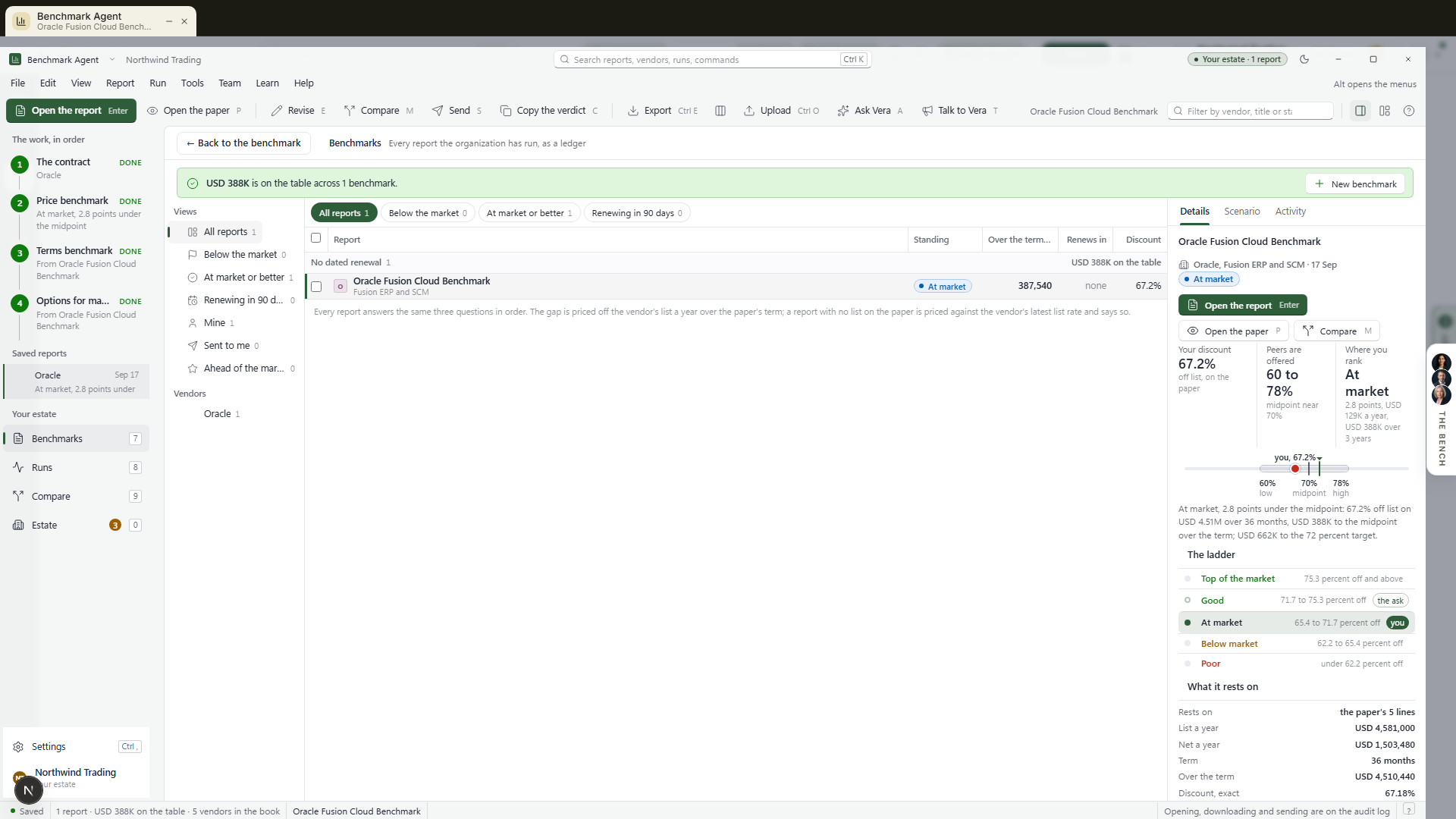
The rooms behind the steps. The full report (5) is the engine's own report as a room: the section rail, the paper with its four figures pinned, the sources, the ladder and the levers. The pane beside the paper answers the three questions on any placed report, including one written from a paper that states rates and prints no list; there the discount reads as the rate the paper states, and the price at your ask is left out rather than worked back from a list you have never seen. Research (6) is the Benchmark Library open inside the window: price any vendor against the documented discount curve without an upload. Benchmarks (7) is every report as a ledger grouped by consequence, Runs (8) every run on its four stations, Compare (9) two reports side by side with what moved, and Estate (0) every vendor you hold paper with. These rooms draw the application frame with its menus, its command bar and its details pane; a step key brings you back to the path.
How to use it
- Open the Benchmark Agent from Your apps on Home. Drop the quote or contract on the strip (PDF or Word, up to 25 MB), or press choose a file and pick several at once; each uploads, is read and runs by itself, and the paper you drop becomes the deal on the screen at once, whatever was open before it.
- Watch step 2 print the run's stations while the engine works, or leave; the run continues and the note is written the moment the report lands. A paper with no printed list prices is benchmarked on the rates it does state rather than on a percentage off a list it never shows, and the note says so.
- If a read needs correcting before the run, open Benchmarks (7) behind the steps; the fact sheet lives there.
- Read the Price benchmark (2): the takeaways, the band, the ladder, the price walk, the sensitivity, what to say and what to ask for. Move the levers beside it to test a position.
- Press Benchmark the terms, or 3: read the terms map, the table and what each ask is worth, and note which asks go in the first counter.
- Press Write the options memo, or 4: read the four options, the recommendation and the decision. Press Forward the memo to put it on the executive sponsor's desk, or Share a link.
- Press A on any note and ask Vera what is actually wrong with the offer, how hard to push, or how to explain option B to the board; press T to talk it through out loud.
- Press Open as PDF to read and save the whole benchmark as one file: the report and all three notes, in the reader, ready to forward to your CFO.
- Come back any time: the report is saved the moment it lands, the last five sit under the steps, and Benchmarks (7) holds them all. When the vendor's next quote arrives, open the earlier report in Benchmarks, press M, and benchmark the new paper against it; the Compare room prices what moved.
The keys
- The steps and the rooms: 1 to 4 open the steps, 5 the full report, 6 the library, 7 to 0 your estate; Ctrl , opens Settings over the room and a room key closes it.
- The window: Ctrl K the palette; F11 maximize; Esc closes what is open; ? shows the keys sheet, which prints only the keys that are bound. In the rooms behind the steps, Ctrl B collapses the navigation and Ctrl I the details pane.
- The selection, in the ledger and the rooms behind the steps: j and k or the arrows walk the rows; Enter opens the report; Alt Enter properties; P the paper; E revise; S send; C copy the verdict; M compare against this; A ask Vera about it; W watch the run; Delete deletes, unless the report is locked.
- Papers and files: Ctrl N new benchmark; Ctrl O add papers; R run a read paper that is waiting; Ctrl E export; Ctrl P print; Ctrl L copy a link; Ctrl Z undo; Ctrl A select all.
- Undo: every press answers at once and can be taken back for eight seconds from the toast, or with Ctrl Z, forty deep.
Settings (Ctrl ,)
Settings is a view over the room: a page list on the left, the page on the right, every row a label, a line under it and the control at the right. Everything applies as you change it. You: Display, Notifications, Keyboard. Your organization, changed by an owner and read by everyone, each change on the trail with Undo: Defaults, Sharing, Branding, Retention and The team.
What is remembered
- On this browser, per organization: the step you were in, the levers and the text size; in the rooms behind the steps, the pane widths, the collapsed navigation, every room's columns, sorts, filter text and view.
- On your account, on any browser: the papers you staged, the fact sheet as you corrected it, the notes you typed, a half written send note or comment, and the display you chose under Settings. Every report and its three notes are saved with the organization the moment the run lands.
- Dark mode follows the platform's theme; a note is light in both, because a printed note is.
Tips
- Read the first read under the fact sheet before you press Run: if the house curve covers the product you already know the peer range and the supported ask.
- The report argues in USD at today's rate when the paper prices in another currency, and says so.
- A paper with no printed list prices is never refused: it is benchmarked on the rates it does state, per user or per unit and the totals, against what comparable customers pay, and the note says once that your paper prints no list. No percentage off an unseen list appears anywhere in it, and the deal card carries the money rather than a rank.
- The terms benchmark says, term by term, whether the report states the position or you have to confirm it on the paper. Strike any ask the paper already grants before the first counter.
- Opening, downloading, sending and sharing a report are on the audit log.
Related: Second opinion · Quote Face-Off · Human benchmark · Benchmark Library
Human benchmark
The door to a person rather than a model, an application window over Home titled Ask a human. Drop the contract, the quote or the order form, answer ten short questions about the deal, choose what you want back, and a VendorBenchmark analyst benchmarks it by hand. Seven rooms in the navigation on the left, the brief on the right exactly as the analyst reads it, and a standing line at the top naming the next move. Every question is optional, every answer sharpens the number, and everything you typed is kept when the window closes.
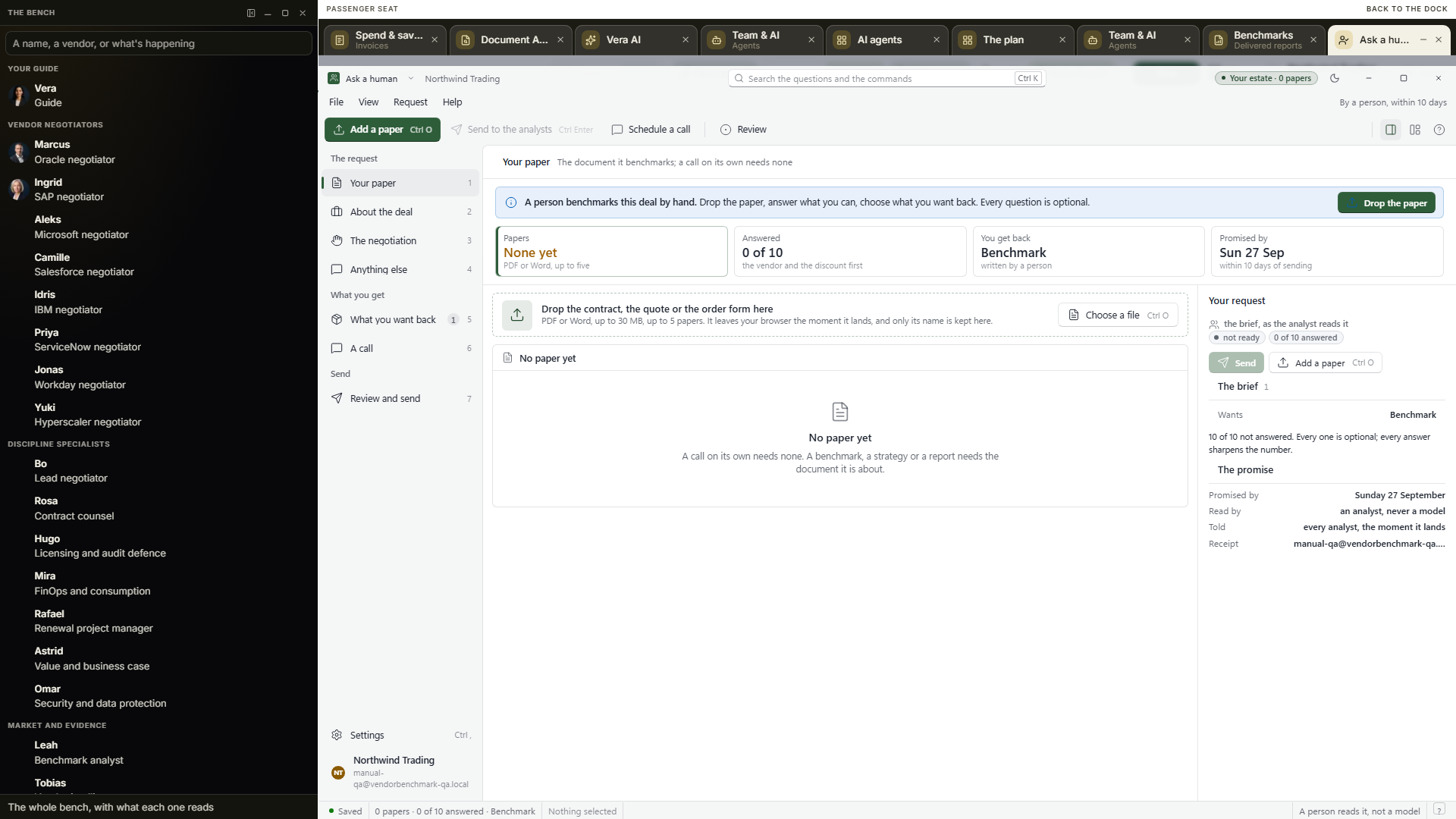
On the screen
- The title bar and the menus — Ask a human and your organization, the search box (Ctrl K) over the questions and the commands, the estate chip counting staged papers, the light or dark switch, Minimize to the tab strip, Maximize and Close. File (Add a paper, Send to the analysts, Start a new request, Close), View (the seven rooms, the brief, the navigation, dark mode), Request (Schedule a call, Open the contract record, Where the answer lands) and Help (the keys, this manual, About). F10 or Alt opens the menus; every command prints its key beside it.
- The command bar — one primary: Add a paper (Ctrl O) until the request is ready, then Send to the analysts (Ctrl Enter). Beside it Schedule a call, a toggle, and Review; on the right the brief press (Ctrl I), the layout press and help.
- The navigation — seven rooms in three groups, keys 1 to 7. *The request:* Your paper, About the deal, The negotiation, Anything else. *What you get:* What you want back, A call. *Send:* Review and send. A room's badge counts its answers (the deal room reads 3 when three of its four questions are answered). Settings at the foot (Ctrl ,) opens where the answer lands, your notification settings, since the window has no settings of its own.
- The standing line and the four figures — the bar under the room's title says what the window needs next (drop the paper, answer what you can, send) and carries the one press that does it; it turns green when the request is ready and amber when a benchmark is wanted without a paper. Under it four figures: papers staged, questions answered, what you get back, and the promised day. Press a figure to jump to its room.
- Your paper — drop a PDF or a Word document on the strip, or anywhere on the window, or press Choose a file. Up to five papers, up to 30 MB each. A paper leaves your browser the moment it lands, so closing the window never loses it; staged papers list under the strip with their size and a Remove press, and an upload shows its progress. A call on its own needs no paper.
- The ten questions — numbered rows across three rooms. *About the deal:* what kind of paper, the vendor, what is on the table per year, the term. *The negotiation:* where you are, when you need to sign, the discount offered today, your leverage, what matters most. *Anything else:* a free line for history, a target or a promise made. Press a chip to answer, press it again to clear; the number on the row becomes a green tick when it is answered.
- What you want back — three switches: Benchmark (the discount you are offered, what peers at your size are offered, and where the deal ranks in points and in money), Negotiation strategy (the levers in order, the talking points, the counter to send), and Research report (the vendor's pricing model, the market evidence, what changed this year). Any or all.
- Arriving from a benchmark — press Ask an analyst to check this on a benchmark sheet and this window opens with the questions the sheet can answer already answered: the vendor, what is on the table a year, the term, the discount offered today, and the sheet’s own finding written into the last question, so the analyst reads the machine’s placement before their own. A line at the top says how many of the ten filled themselves in. Nothing you have typed is ever overwritten, and the three the sheet cannot know, where you are, when you sign and your leverage, are the three left to answer.
- A call — a switch, on its own or on top of the deliverables. When it is on, say this week, next week or whenever suits, mornings or afternoons, and how to reach you. The analyst fixes the time by email. The Home band's second press, Schedule a call, opens the window with the switch already on.
- Review and send — one row that sums the request (the vendor, what you want back, the promised day) and carries Send, then the brief laid out as the analyst reads it. Send is lit once a paper is staged and something is wanted, or a call is asked for on its own; otherwise the standing line says what is missing.
- The brief — the pane on the right names the vendor, says whether the request is ready, carries Send and Add a paper, lists the brief line by line as you answer, and states the promise: the day, who reads it (a VendorBenchmark analyst, never a model), who is told (every analyst, the moment it lands) and where the receipt goes. Ctrl I folds it away and brings it back.
- The receipt — after sending, the window shows Received with the promised day, a timeline from the day it landed to the promised day, the request number, and what lands where: the answer by email to your inbox, the call if you asked for one, and the record. Send another deal starts a fresh request; the last one stays under Recent requests on the title bar. When the paper became a contract, Open the contract record sits on the command bar.
- The status bar — Saved, the papers staged, the answered count, what you asked for, and that a person reads it, not a model.
How to use it
- On Home, press Ask a human, not a model on the band under the bench (or Schedule a call for the same window with the call already on).
- Drop the paper on the strip or anywhere on the window, or press Add a paper. Wait for the row to say staged: the upload finished.
- Press 2 and 3 for the deal and the negotiation and answer what you can. The vendor and the discount you are offered today are the two the analyst reads first, and the badges count you along.
- Press 5 for what you want back, and 6 to switch on a call if you want one.
- Press Send to the analysts (Ctrl Enter). The receipt names the day you hear back, and a copy reaches your inbox.
Tips
- The standing line always names the next move and carries the press that makes it, so there is never a hunt for what is missing.
- Nothing typed is lost: a reload, Minimize and the comeback from the tab strip, or tomorrow's visit all find the request where it stood. Start a new request shelves the current one rather than clearing it; Recent requests on the title bar brings it back.
- What happens on our side: the paper becomes a contract in the analyst review queue (it appears under Contracts with your answers on the record as customer notes), every VendorBenchmark analyst is told the moment it lands, and a research report also opens a request on the research desk.
- The benchmark counts against your plan's analyst benchmark allowance, exactly as an upload under Contracts does. When the allowance for the period is used up the receipt says so; the analysts still hold the paper and the brief, and the contract record offers the credit path.
- A call on its own needs no paper. A benchmark, a strategy or a report does.
- Your answers are the brief. A blank request is still worked, but "peers at this size" is only as sharp as the size you gave.
Related: Benchmark Agent · Analyst benchmark (upload a proposal) · Advisory sessions
Proposal comparison
Drop two vendor proposals and Vera shows exactly what changed. Where Second opinion reads one contract against the market, Proposal comparison reads one proposal against another and answers a different question: what moved, did it move your way, and what is the movement worth. It handles both situations. A same vendor revision, the original against the revised proposal, tells you whether the vendor's new draft actually helped. Two competing vendors, side by side, tells you which bid is stronger. Use it when a vendor sends back a revised proposal, or when you are choosing between two.
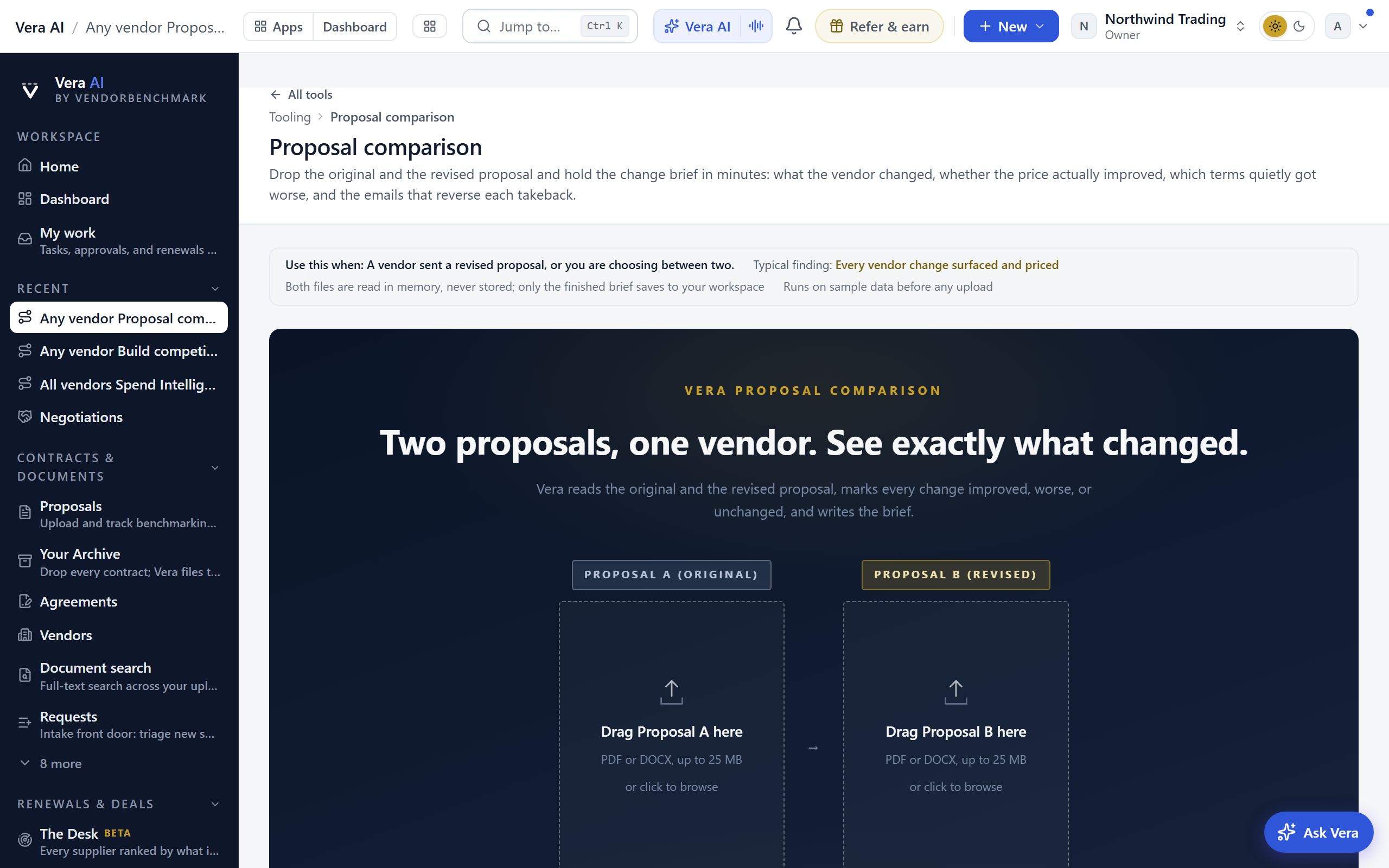
On the screen
- The two drop slots: Proposal A original and Proposal B revised, each dropped as PDF or DOCX or browsed for. Slot A is the baseline and slot B is what changed against it, whether that is the same vendor's revised paper or a competing bid. Each proposal uploads to private staging the moment it lands, so one staged proposal survives leaving the page, closing the window, and coming back tomorrow; a staged slot shows its file name with Click to replace and Remove. When the second slot lands the read starts on its own; a pair restored from an earlier visit waits for the Run the comparison button instead, so reopening a session never spends a run unasked.
- Continue where you were: opening the tool with a proposal staged earlier puts it back on the desk, no question asked. Your last five sessions wait under File, Continue where you were, and Start new in the same menu sets the current session aside, never deletes it; saved comparisons are never touched.
- The reading: the dark stage that shows the changes as they are found: the terms extracted from both proposals and the differences between them land live, so you see what the brief will be built on before it is written.
- The change ledger: every change grouped into pricing changes and term changes, each one marked improved worse or unchanged against the baseline, so the movement in the deal reads at a glance.
- Pricing changes: the price lines that moved, old value against new, with the difference priced, so a lower unit price, a higher uplift cap, or a shifted payment term each shows what it is worth.
- Term changes: the contract terms that moved, from renewal notice and price protection to liability and termination, each read in plain English and marked whether the change helps or hurts your side.
- Open the case: a finished comparison shows a navy band above the brief that opens it as a seven document case file: both proposals as exhibits, a delta atlas over every compared term, the ask sheet that reverses the takebacks and banks the wins, and a What now sheet with the vendor reply and the internal note drafted from your own numbers. The case now carries the workroom dock: press ⚡ and the same moves work beside whichever paper is open; press ✦ and Ask Vera opens in the split, grounded on the whole comparison, with one chip per document that jumps the stage. The rail lists your past comparisons, a keyword and semantic search over your uploaded documents, and your shelf of recent and starred comparisons. The sample opens the same case, marked Sample.
- Email drafts: five ready drafts behind buttons: edit the subject and body in place, then copy the email or open it in your own mail app. Nothing sends from the platform.
- The handoffs: take either proposal deeper in one click: Contract Agent for the clause by clause read, or Second opinion for the benchmarked market read on a single proposal.
- Email a copy: send the brief to yourself or a colleague; enter the address and the brief arrives as an executive brief email.
- The sample: a sample revision shows the full comparison instantly, no upload and no AI allowance used, so you can judge the output before you bring your own paper. Trial plans use the sample to see exactly what the tool produces; upgrade to a paid plan to compare your own proposals.
- Saved to your workspace: a note under the brief says where both proposals went: each was filed under Contracts as a vendor proposal, private to your organization, and joined your benchmarking queue. The note links to both records and carries a delete for each. Owners can turn document saving off under Data controls.
How to use it
- Drop the original in slot A and the revised or competing proposal in slot B, or press Try the sample revision first.
- Watch the reading extract the terms and surface the changes, then read the change ledger and the brief.
- Check each pricing and term change against improved worse or unchanged to see whether the deal moved your way.
- Open the email drafts, edit the one that fits, and copy it into your own inbox, or email a copy of the brief to a colleague.
- When a single proposal earns a deeper read, follow the handoff into Contract Agent or Second opinion.
Related: Second opinion · Contract Agent · Vera Deal-Room
Build competitive scenarios
Name the product you are renewing and Vera researches the credible alternatives, prices three to five cost scenarios against the renewal over your term, and writes a competitive options review you can put in front of the vendor. Where Second opinion reads one contract against the market, this tool answers a different question: what are my alternatives actually worth, and what does a credible option on the table give me. Each scenario carries the license, migration, and transition cost, so renewing as proposed, repricing to market, and switching to each alternative are priced side by side. Use it when you want a believable alternative in the room before you renew, so the vendor knows you are looking.
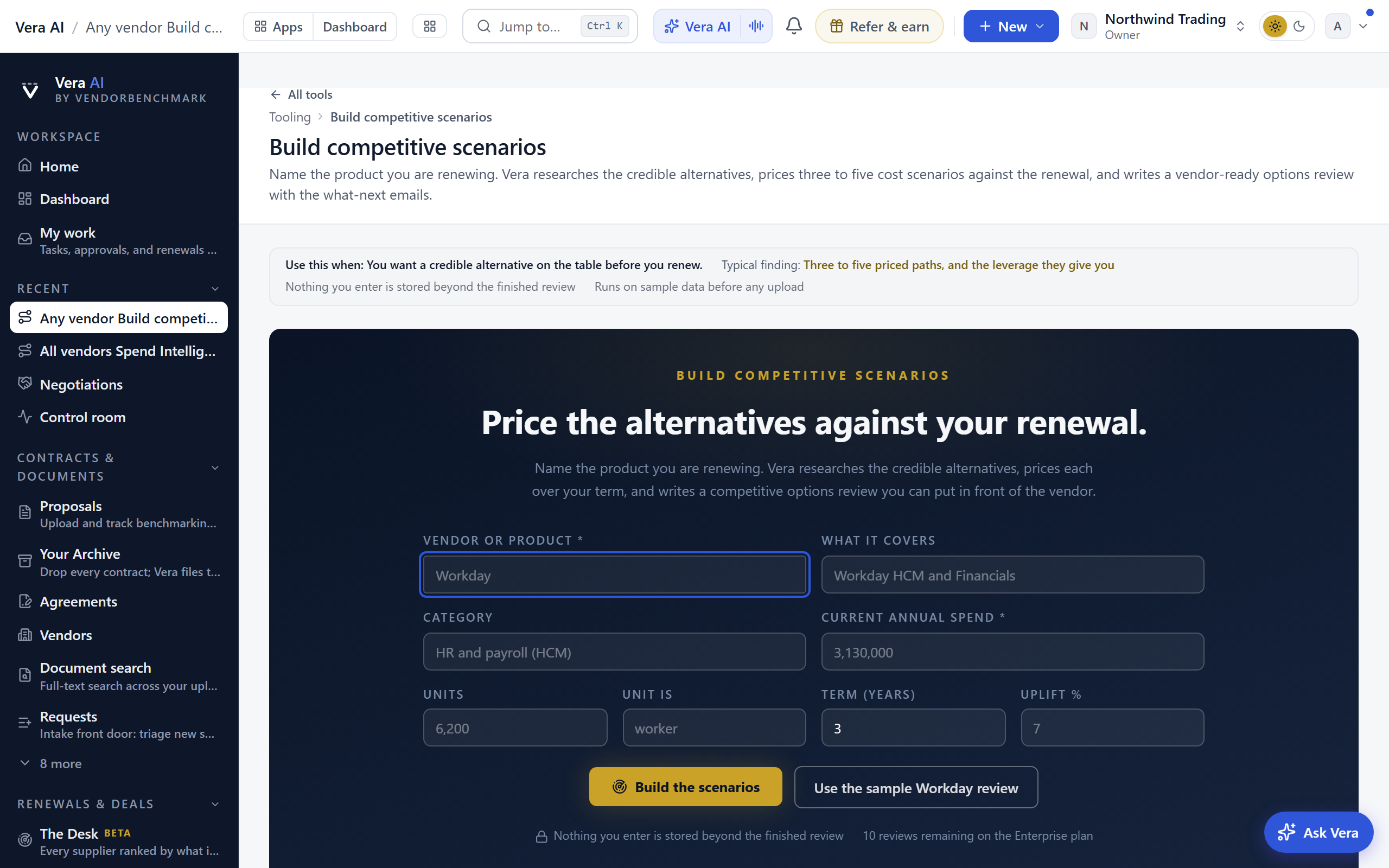
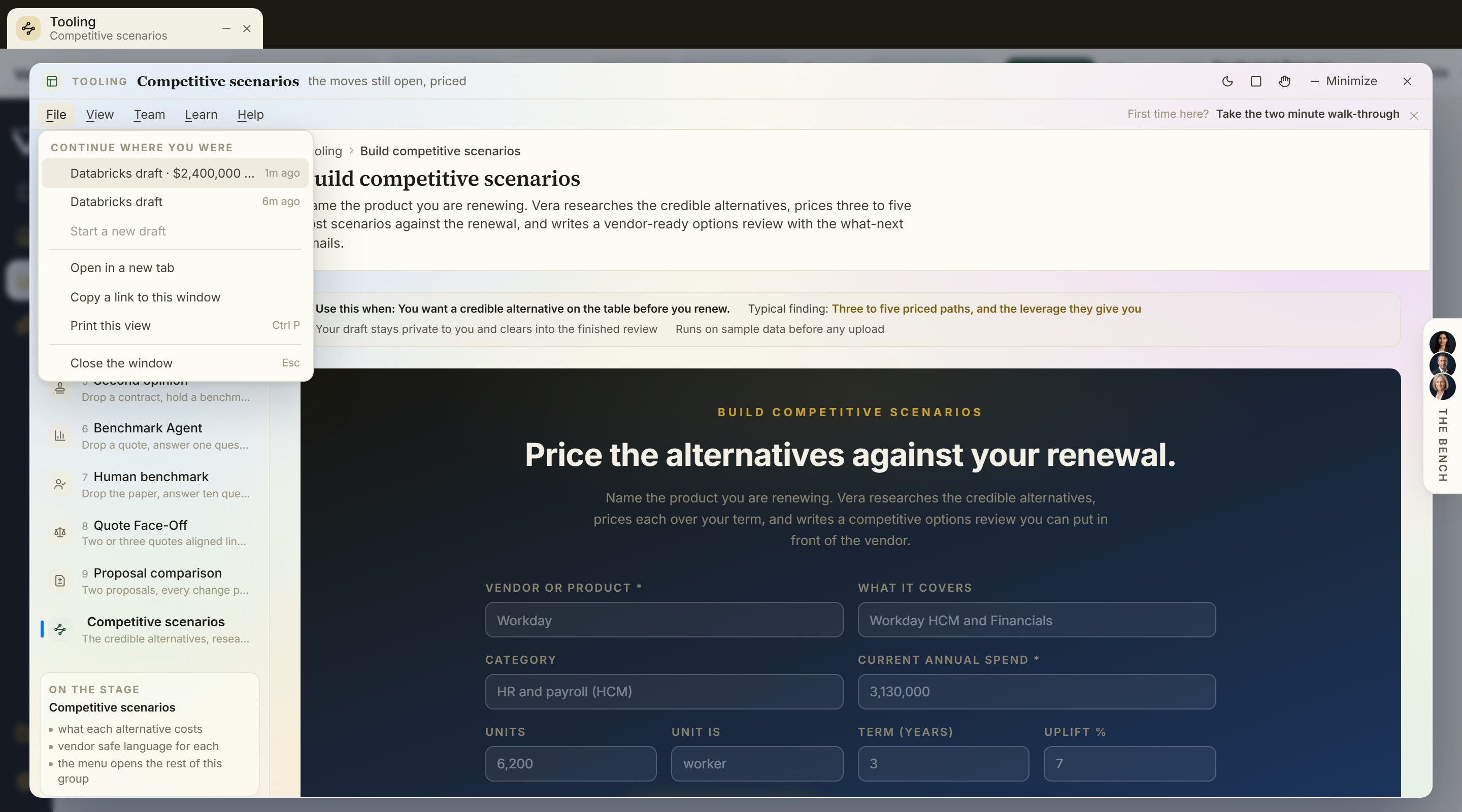
On the screen
- The brief form: name the product you are renewing, the current annual spend, and the seats and term. That is all the model needs. Every field autosaves into a private draft as you type, so navigating away, closing the window, or coming back tomorrow never loses it; the draft clears into the review when you press Build the scenarios, and Start a new draft sets the current one aside without deleting it. A sample Workday review shows the full brief before you run your own.
- Continue where you were: opening the tool with a draft in progress puts it back exactly as you left it. Your last five drafts wait under File, Continue where you were, and Start a new draft in the same menu shelves the current one. Drafts are private to you, follow you to another browser, and are governed by the same Keep this room on my desk switch as the workroom trail: turning it off stops the saving and clears what was saved.
- Start from your estate: a row of chips above the form, read from the agreements you already store. A chip fills the vendor, the stored annual value, and the term, and everything stays editable before the run. A value is offered only where it is stored in a currency the tool reads, a term only where the stored dates give one between one and five years, and sample data never appears.
- The market scan: the dark stage that shows the scan live: the credible alternatives found, each priced at your scale with its migration cost and timeline, and the scenarios being modeled against your renewal.
- The options review: the vendor-safe executive brief: the alternatives evaluated with their fit and pricing posture, the cost scenarios priced over your term as a chart and a table, the modeling assumptions stated plainly, and a measured bottom line. This is the page you hand to the vendor.
- Use this in the room: the leverage layer that stays with you and is never printed and never in the shared copy: the moves to make with the alternatives, so you use them without bluffing a walk-away.
- The what-next emails: two ready drafts behind a button, one to the vendor rep signaling you have completed an options review and are evaluating alternatives, one to your leadership with the recommendation and the review attached. Edit in place, then copy or open in your own mail app. Nothing sends from the platform.
- Share it: email a copy to the whole team (separate several addresses with commas), or copy the workspace link that opens for members of your organization.
- The handoffs: take the deal deeper in one click: the Vera Deal-Room to run the negotiation, Second opinion for the benchmarked read on the incumbent contract, or Proposal comparison once the vendor comes back.
- The sample: a sample Workday HCM review shows the full options review instantly, no input and no AI allowance used. Trial plans use the sample to see exactly what the tool produces; upgrade to a paid plan to run your own.
- Open the workroom: a navy band above a saved review opens it as one case file on a dark stage: the vendor safe options review as the paper, the leverage sheet that stays with you, and the scenario ledger year by year. The ⚡ dock beside the paper carries both what next drafts, the copies, and the handoffs, and the ✦ dock is Ask Vera grounded on the whole review. The rail searches your uploaded documents and keeps your shelf.
How to use it
- Name the product you are renewing and enter the current annual spend, or press Use the sample Workday review first.
- Add the seats, the unit, the term, and the proposed uplift if you have them, then press Build the scenarios.
- Watch the market scan find the alternatives and price the scenarios, then read the options review.
- Open Use this in the room for the leverage moves, and the what-next emails to send from your own inbox with the review attached.
- Email a copy to the team or copy the workspace link, and follow a handoff into the Vera Deal-Room to run the negotiation.
Related: Vera Deal-Room · Second opinion · Proposal comparison
Vera Deal-Room
*In plain words: one upload, the whole negotiation pack: benchmark, decode, brief, playbook, intel, and the priced walk-away.*
When to reach for this
- A deal big enough to deserve the full pack, and a meeting soon enough to need it (the meeting recipe).
- You want the credible alternative priced with crossover math, not asserted.
- The room becomes the working surface for the negotiation, not a one-time report.
Drop one contract and the whole negotiation deal room assembles itself with no further input: the deal placed against peer reference data, the decoded contract with its leverage-ranked ask list, a combined five-page analyst brief, the strategy and tactics playbook, a live web-researched vendor intel briefing, and the credible walk-away alternative priced with crossover math. The theatre is the front door: opening Vera Deal-Room with a finished case on file raises the curtain on the Deal-Room Theatre, the case presented full screen in five acts and run as a complete workspace. Escape steps backstage into the room itself, which runs as one application: a navy masthead carrying the counted verdict and the room's actions, and a numbered tab band over everything the room can do, with every document opening on the case file's stage.
Opened from your home screen (app mode), the Deal-Room opens on the room: the drop stage runs edge to edge, and the page header and meta row sit below it. Opened from the dashboard, the page keeps the composition described here, header first.
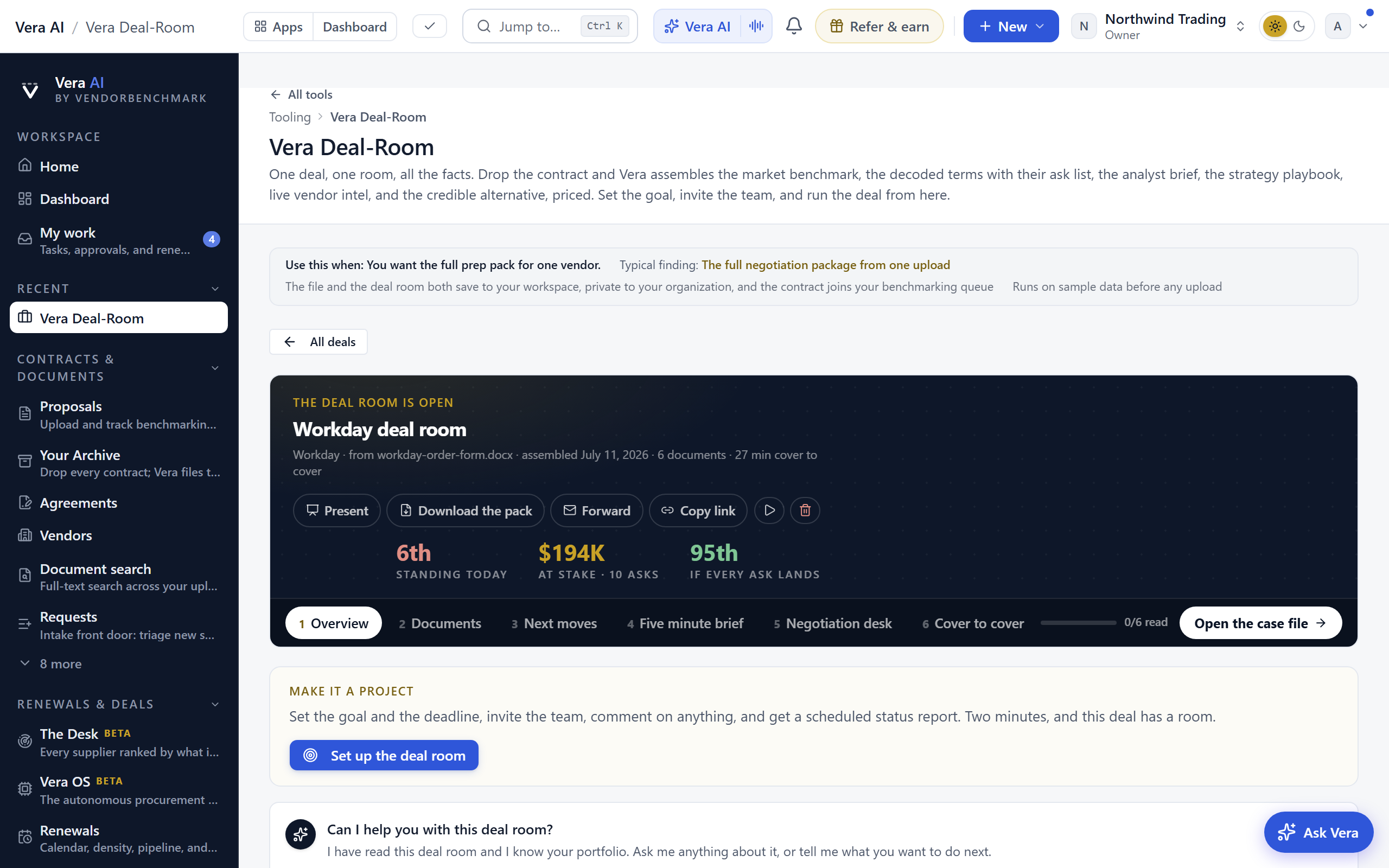
On the screen
- The drop stage: the navy hero shows the six sample documents fanned like an opened case. Drop your contract anywhere on the page, or use the button; the file saves to your workspace as a contract and joins your benchmarking queue.
- The assembly desk: while the pipeline runs, each of the six documents is a paper sheet on a desk: a ghost outline until its stage starts, a typing skeleton while it generates, then its real first page the moment it lands, ready to read while the rest assemble. A ticker narrates each stage, and the money at stake surfaces in a gold band as soon as the decode finds it. When the last document lands, the sheets stack and a gold seal stamps the delivery.
- The masthead: a finished deal room runs as one application under a single navy masthead: the deal's title and source line on the left, the room's actions and the counted verdict on the right (where the terms as written stand against comparable deals, money at stake across the asks, where the deal lands if every ask succeeds, and days to the signing deadline once the room has one). The two standings are stated in words, one of Poor, Below market, At market, Good, or Top of the market, never as a percentile. At its foot sits the tab band that runs the whole room.
- The tab band: numbered tabs over the room's sections: Overview, Documents, Next moves, Five minute brief, Negotiation desk, and Cover to cover. The number keys switch tabs, each tab can be linked to directly, and the band's right end carries the read meter (documents read against documents delivered) and the Open the case file door.
- The case file: clicking any document, on any tab, opens it as a paper on the case file's dark stage, the whole room bound as one numbered workroom: the cover sheet with the mandate and the verdict figures, every document of the room as an exhibit with read tracking, and a closing What now sheet whose forward and share moves land on the room's own Next moves board. The rail lists every document, the arrow keys page from paper to paper, and Escape returns to the tab you left. Under the document list sit a search over your own uploaded documents and your shelf of recent deal rooms. On the right, ⚡ What now carries the same eleven moves as the Next moves rail, so the four Vera drafts (the meeting request, the opening asks, the leadership brief, the working session invite), the workspace link and the forward ride beside every exhibit rather than living on a separate board. On your own rooms, ✦ Ask Vera docks next to it, grounded on this deal's asks, plan, and documents; a worked example carries the moves but not Vera, because she never grounds on data that is not yours.
- Reporting modes: three ways to read the same case. Documents shows the cover sheet (verdict numbers with proof chips, the table of contents with read state, your first three moves) and the document wall of real first-page miniatures. Cover to cover reads every landed document as one continuous paper; the arrow keys move between documents. Five minute brief compresses the whole case into a one page executive readout, assembled verbatim from the deal room's own documents, for the reader who has five minutes before the call.
- The Deal-Room Theatre: the full screen show, and the default entrance: arriving at Vera Deal-Room with a finished deal room opens it on stage behind a curtain rise (arriving at a specific document link, or through the All deal rooms door, does not). The curtain rises on the lobby first: continue the latest case (the card carries its standing and money at stake and says where it picks up), open any other finished deal room from the shelf, or drop a new contract right there, drag and drop or browse. Choosing continue lands on the workroom's What next board; your saved mark wins when you left one, and the overture sits at the top of the bill. The show runs in five acts: the verdict (the counted overture, then the five minute brief), the instruments (the ask ladder), the documents (the cover sheet with read state, then one paper per screen, each with its own download, forward, copy link, and print toolbar), the workroom (the What next board and the war plan), and the curtain call. Presenter notes, the overview grid on G, light or dark stage, and a printable leave-behind of the screens you walked all ride along, and the show remembers where you left off. The View the negotiation strategy button backstage re-enters it any time.
- The ask ladder: every ask is a switch. Turn one off in front of the room and the value selected, the projected standing, and the header ticker recompute live. The scenario dial prices three postures, conservative, expected, and every ask, so leadership sees the honest range.
- Stage tools: three presenter tools float over every scene: the rehearsal clock on R (a five minute target that turns red when you run over), pushback cards on Q (the likely vendor objection on each of your strongest asks, with the counter drawn from the deal room's own clause read), and the spotlight on S (follows your pointer and dims the rest of the stage). The envelope in the header drafts the follow up email without leaving the stage.
- The workroom: the act that answers "what do I do next". The What next board is three columns of operable cards: reach out (Vera drafts the vendor meeting request, the negotiation opener, the CFO brief, or the colleague working session invite; you edit and send from your own inbox), report it (the five minute brief, the PDF pack, the Reporting studio), and prepare (the war plan, the call rehearsal, the analyst handoff).
- The war plan: the negotiation as a four phase project plan with Gantt bars on a real week timeline ending at your renewal date (or a sixteen week runway when the contract states none): read and align, open the channel, negotiate, close and sign. Tasks come from the playbook's own sequencing and your top asks; checking one off fills its phase bar, the ticker counts moves done, and the printed leave-behind includes the plan. Point at any task and the line shows you where to click: its checkbox pulses a blue ring, a click marker appears at the end of the text, and the whole line is the switch, so clicking the words checks the task off.
- The desk saves itself: the ask ladder's switches, the scenario dial, the war plan's check offs, and your place on stage persist per deal room. Once a project room exists (below), the desk also saves to the room itself, so progress follows you across devices and shows on your dashboard's Your deal room card.
- One tab at a time: the active tab gets the whole width under the masthead; there is no side menu to manage. Where you stand is always visible on the band, and any document you open from a tab returns you to that tab when you close the case file.
- The overview: the room's control panel, and the deal on charts. Press Set up the deal room and answer five questions: your goal for the deal, what a win looks like, the signing deadline (prefilled from the contract's renewal date when it states one), who works the deal, and what matters most. The overview then shows the goal band, five vitals (progress, days to deadline, where the deal stands, money at stake, team size), three charts (the standing ladder, which marks the deal as written and where it lands if every ask succeeds, each pin labelled with its verdict word, the top asks as value bars, and the market band with your own price marked on it), and the plan as a Gantt: every task in the four phase plan on its own row with a checkbox, its bar on the shared timeline, and the Today line through it. Tick tasks off on the chart, and assign any task to teammates with their initial chips (an optional RACI over the plan Vera populated from the playbook and your top asks); assignments and check offs save to the room. Before the room exists, the overview shows the charts and the two minute setup invitation.
- Vera in the room: an Ask Vera box sits above the charts on the overview, and Vera reads the room itself while you are in it: the ask list with what each ask is worth, the six documents and which ones you have read, the goal and the deadline, and every planned move still unticked. Ask "What should I do next?" and the answer names the next move on your own plan and the ask worth the most, not general negotiation advice. The room keeps its own saved conversation, so a question asked here is waiting for you next week when you open the room again, and Ctrl/⌘ J, the floating panel, and the voice assistant all answer from the same reading while you stand in the room. See Vera AI.
- The team: invite colleagues by email address; they get an executive brief invite with the room link (a workspace sign in is required to open it) and they join the status report list. Remove anyone with one press.
- Room chat: comments live in the room and can anchor to any document, the next moves, or the war plan; filter by anchor with the chips. Everyone in your workspace sees the same chat, and new comments ride into the next status report. Type @name (first name, full name, or the start of their email) and that member gets an email with the comment and a button into the room; mentions render highlighted in the chat.
- Notes and updates: a notes card on the overview for meeting notes, vendor call summaries, and anything the team should know. Notes are visible to the whole room, ride into the next status report, and @name notifies there too.
- The status report: Vera writes a status report from the room itself, progress, the deadline clock, moves completed since last time, and new comments, and emails it to everyone in the room. Pick every day, weekly on one day, or exactly the days you want, plus the hour; pause or change the schedule any time.
- The negotiation desk: under the Five minute brief sits the toolkit for whoever actually sits at the table: the strategy in one screen, talking points with the exact paste ready words for each ask, how the seller across the table is compensated (quota, accelerators, quarter end), what drives this deal, and the six pitfalls that cost buyers money.
- Market position by instant benchmark: when the stated terms cannot be placed against the reference cohort, Vera runs her instant benchmark from the deal facts themselves, the stated quantity and price against the calibrated market bands, so Market position arrives with where the deal stands, the market range, and a verdict instead of Not available. When the terms cannot be unit priced at all, the document states the clause read’s own placement instead. Either way the basis is spelled out, and deals assembled before this existed are filled in the next time you open them.
- The curtain call desk: the show ends on your first three moves with the whole desk under them: Vera drafts the meeting request, the negotiation opener, or the leadership brief (you edit and send from your own inbox; nothing sends from the stage), and forwarding, the workspace link, the full PDF pack, the analyst handoff, and the call rehearsal sit beside them. Nothing requires stepping backstage.
- Next moves: its own tab, the three move families laid side by side, and it answers "now what". Vera drafts the email for the move you pick: the note to your vendor requesting the renewal conversation, the opener that puts your strongest asks on the table, or the internal brief for your CFO. Every draft is short, friendly, and free of dash punctuation; edit the subject and body in place, then copy the email or open it in your own mail app. Nothing sends from the platform.
- Forward: sends the whole deal room, or any single document, to a colleague as an executive brief email carrying the verdict figures and a link that opens right here in the workspace. The recipient needs a VendorBenchmark login with access to your workspace; the deal room never travels on a public link.
- Copy link: copies the workspace link to the deal room, or to the open document; it opens for members of your workspace after they sign in.
- Download the pack: all six documents as one PDF behind a generated cover page; each document also exports on its own.
- Have an analyst price this: on the next-move rail: opens the advisory concierge desk with the booking agenda pre-filled from this deal room: the vendor, the money on the table, where the terms as written stand, and the number of asks.
- The shelf: saved deal rooms stand as case spines: a gold band means delivered, an assembling spine fills as its documents land. A toggle switches to the dense table.
How to use it
- Drop the vendor contract anywhere on the page.
- Read the documents as they land on the desk; the money numbers arrive within the first couple of minutes.
- When the seal stamps, read the case your way from the tab band: any document you click opens on the case file's stage with the rest of the pack one arrow key away, Documents holds the cover and the grid, Cover to cover the continuous read, Five minute brief the executive readout, and the Negotiation desk the table toolkit. Present, in the masthead's actions, raises the full screen Deal-Room Theatre when you want to walk the case in front of a room; it only opens when you press it.
- Press Set up the deal room on the overview, answer the five questions, and run the deal from there: invite the team, comment on anything, check moves off the runway, and schedule the status report.
- From the next-move rail, let Vera draft the vendor or leadership email, edit it, and copy it into your own inbox; forward the deal room or one document to a colleague when they need the full paper.
- When you want a second read, use Have an analyst price this to take the deal room to a senior analyst with the agenda already written.
Related: Contract Agent · Major renewals
Quote Face-Off
Drop two or three competing quotes for the same need, vendor direct, reseller, or CSP. The board aligns equivalent SKUs into one tale of the tape, benchmarks every line, marks who wins where, and builds the Franken-quote: the best mix across all papers, priced.
*In plain words: the quotes lined up SKU by SKU, and the best mix across all of them priced.*
When to reach for this
- Two or three papers for the same need, and the decision deserves a written why (the recipe).
- Direct against reseller against CSP: the alignment is exactly where those comparisons go wrong by hand.
- The endgame of a bake-off, when the bids are finally on the table.
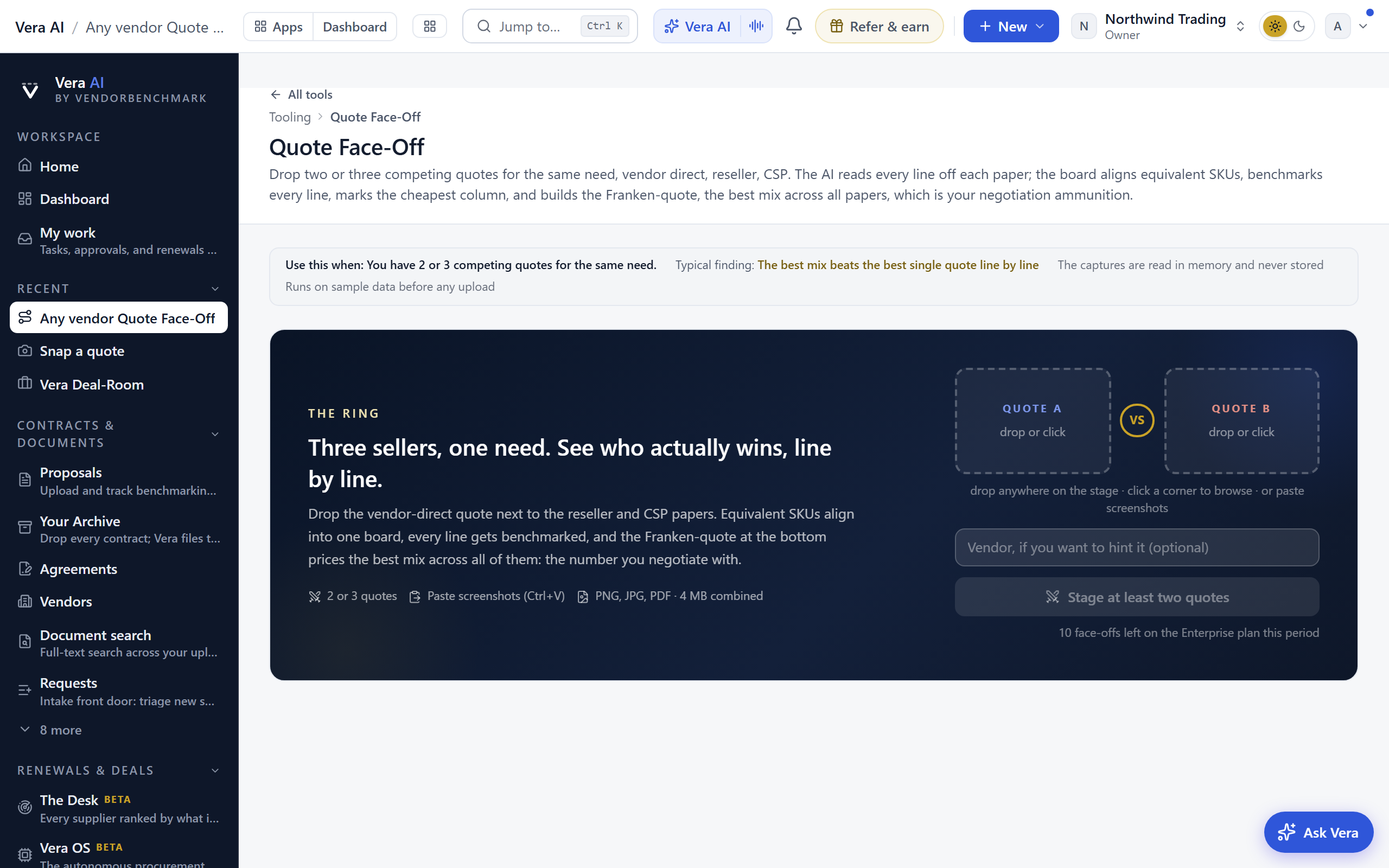
On the screen
- The ring: one corner pad per quote with the VS mark between them: Quote A and Quote B first, a third corner appearing once two are staged. Drop files anywhere on the stage, click a corner to browse, or paste screenshots (Ctrl+V).
- The vendor hint is kept: a vendor name typed before you stage the quotes waits for the read rather than disappearing when you leave the page, and clears itself once the read starts.
- What is kept: a PDF quote saves to your workspace under Contracts, private to your organization, and joins your benchmarking queue; a note under the result names it, links it, and offers to delete it, which removes the record and the stored file and writes a deletion certificate. A photo capture or screenshot is read in memory and never stored, so a phone snapshot of a quote leaves nothing behind. The result footer repeats the rule. Owners can turn the saving off under Data controls, and with it off nothing you hand the tool is kept.
- The sample bout: Or watch a finished bout first under the ring shows a judged face-off before any upload; nothing uploads and no run is spent.
- The bout card: while the deep read runs: the papers facing off across the VS mark, with the judging steps beneath.
- Run bar: a finished face-off opens with a bar across the top: the run's inputs, a Run another face-off button, and the run actions (replay, forward, share, delete).
- Tale of the tape: equivalent SKUs aligned across the quotes, each line benchmarked, the winner marked per line. When you watch a run finish, the rows score themselves clause by clause, the Franken-quote last.
- The Franken-quote: the best mix across all papers, priced, so you can see what the ideal combination would cost.
- Analyst memo: which quote to take, which terms to pull from the losers, and the counter to send.
- The finish row: a judged bout closes with one-press copies of the priced counter and the top asks, and Ask Vera answers from the whole board.
- Save and export: file the whole result (tale of the tape, Franken-quote, and memo) to Deliverables, download it as a Word brief, or print it, from the actions under the verdict.
- The fight cards: every saved face-off as a card: the bout title, the corners, the one-line verdict, and the judgment status. Click one to reopen its board.
- Open the workroom: a navy band above the judged board opens it as one case file on a dark stage: the cover sheet with the verdict tiles, the tale of the tape as an executive brief paper with the Franken-quote row, the analyst memo with its citations intact, and the padding ledger as an exhibit. The ⚡ What now dock beside the paper carries the counter to the winning column, a last call per losing column, the internal decision note, the copy moves, the save and Word export, and the Deal-Room handoff; the ✦ dock is Ask Vera grounded on the whole bout. The rail searches your uploaded documents and keeps your shelf of past face-offs.
How to use it
- Stage the competing quotes for the same need on the corner pads.
- Read the tale of the tape line by line, then the Franken-quote.
- Take the memo's counter back to your preferred supplier, and save the result to Deliverables so the comparison is on file.
Related: Quote Face-Off · Sourcing
Audit letter decoder
*In plain words: the audit letter decoded before you reply to it: who, when, what is actually demanded, and what not to do.*
When to reach for this
- The day the letter lands, before anyone replies or runs a vendor tool (the audit recipe).
- Distinguishing a formal audit from a voluntary SAM engagement dressed as one.
- Turning a threatening deadline into a business-day countdown with a plan against it.
The moment a software audit letter lands, drop it here, PDF or a phone photo, or paste a screenshot with Ctrl+V. The decoder identifies who is actually auditing you (Oracle GLAS, a Big Four firm on IBM's behalf, a voluntary SAM engagement), turns the stated deadline into a business-day countdown over a calendar that runs from today to the due date, separates what is demanded from what is merely implied, and hands you the three things not to do first. Not sure what you would get? See a decoded sample shows a fully decoded Oracle GLAS notice before you upload anything.
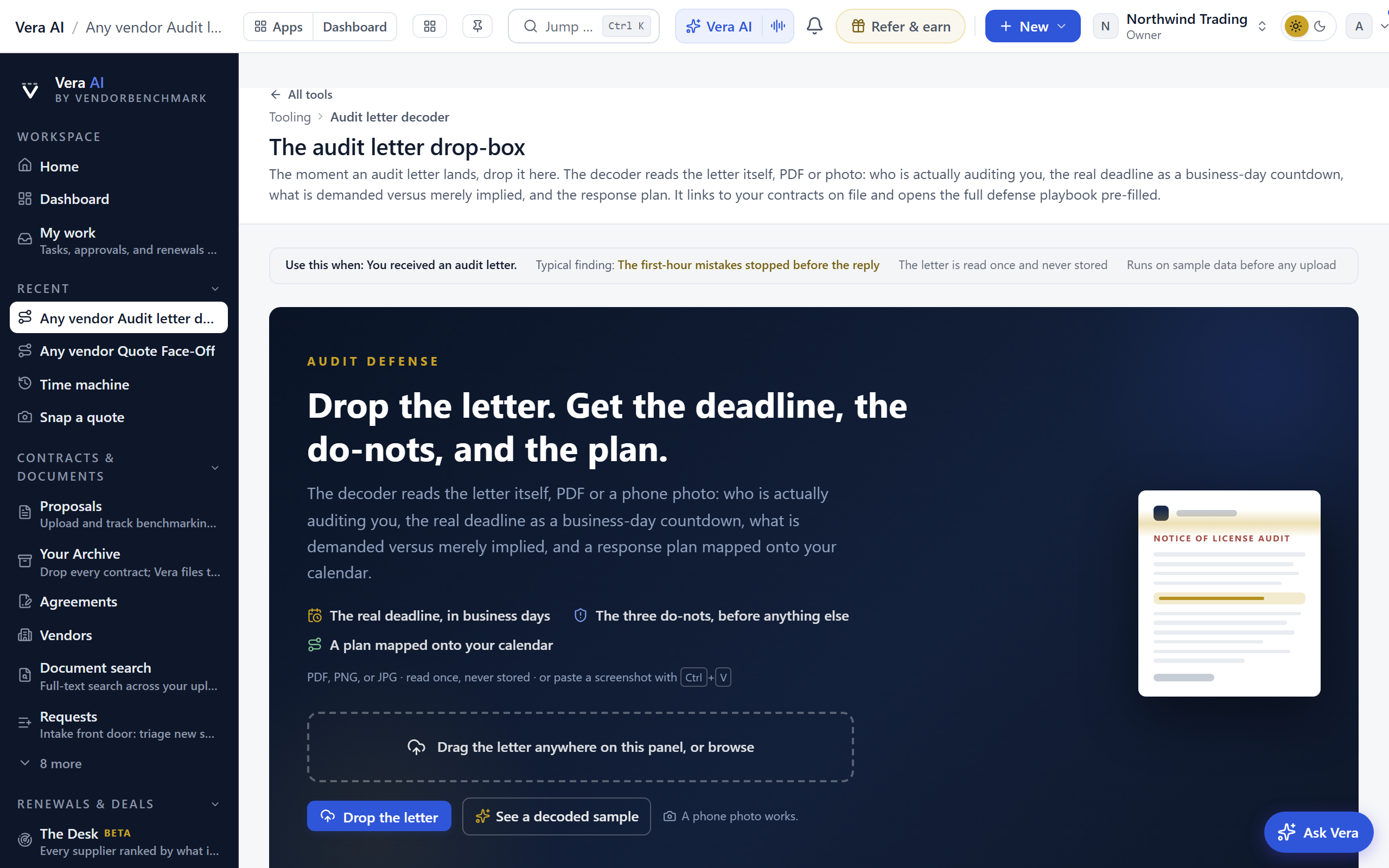
On the screen
- The audit response brief: under the decoded letter, the long form brief the agent writes from the letter's own demands and your agreements with that vendor, with a web search of how they are running audits now: what the letter actually asks for against what it merely implies, what your contract obliges you to give (the audit clause and its limits, the metric definitions that decide any count, any standstill already won), what to hand over and what to refuse with the words to use, the ten clauses that decide the outcome, what is negotiable once they price the findings, and how to run the next thirty days. Press Write the audit response brief and a bar says how long (about five minutes); the decode and its plan above it are unchanged.
- Dropper: the audit letter as a PDF, photo, or pasted screenshot, on the navy upload stage. It is read in memory and never stored.
- Countdown wall: the business days left as a large number, the deadline date, the letter's own wording, and a calendar strip from today to the due date with weekends dimmed.
- Who is auditing: the real party behind the letterhead, and a pressure meter for how hard the letter pushes.
- The three do-nots: numbered cards with the first-hour mistakes to avoid, grounded in how this vendor's audits typically run.
- Scope with a verdict: each demand marked demanded or implied, with our read of whether complying is contractually required, summarized in one strip above the table.
- The response plan, on your calendar: each step mapped onto a real date inside the window the letter leaves you, linked to your contracts on file and the full defense playbook pre-filled.
- The safe first reply: a copy-ready holding reply that acknowledges receipt, concedes nothing, and routes everything through one coordinator.
- Exports: Print or save as PDF, and Send it on, which drafts the covering email for you to send from your own mail. The contract-match rail is deliberately left off the printed pack, so an over-deployment figure of your own is never handed out by accident with the decode.
- Open the workroom: a navy band above a stored decode opens it as a case file on a dark stage: the cover sheet with the business day countdown and the three do-nots, the decoded letter with our read on every scope demand, and the response plan beside what your records show. The ⚡ What now moves run on the stored decode: brief the deal owner and legal with the full figures, send the auditor a neutral acknowledgment that concedes nothing and carries no figures, copy the one line summary and the do-nots, and draft the defense playbook on the matched contract. The ✦ dock is Ask Vera grounded on the letter: the auditor, the deadline, the scope reads, the plan, and the license position on record. The rail searches your uploaded documents and keeps your shelf.
How to use it
- Drop the letter the day it arrives, before anyone replies to the auditor.
- Read the countdown wall, then the three do-nots, then who is auditing and the demanded-versus-implied split.
- Copy the safe first reply, then follow the response plan into the defense playbook.
Related: Contract Agent · Diligence
Rate Card Benchmark
*In plain words: every day rate on the card placed against its market band, with the overpay priced per line.*
When to reach for this
- A consulting or SI rate card is on the table, or buried inside an SOW.
- The negotiated rates deserve enforcement: the vault remembers them so every later review checks against them.
- Services spend has never had the scrutiny the software line gets; it usually pays for the look.
Upload a services rate card or SOW and see every day rate on the ladder: the market band per role, delivery region, and vendor tier, your rate as the dot, and the annualized overpay per line. Services hide 30 to 40% of software spend; this is where it surfaces. The page also holds your MSA rate card vault: record the rates you actually negotiated once and every SOW review, benchmark board, and invoice check enforces them from then on.
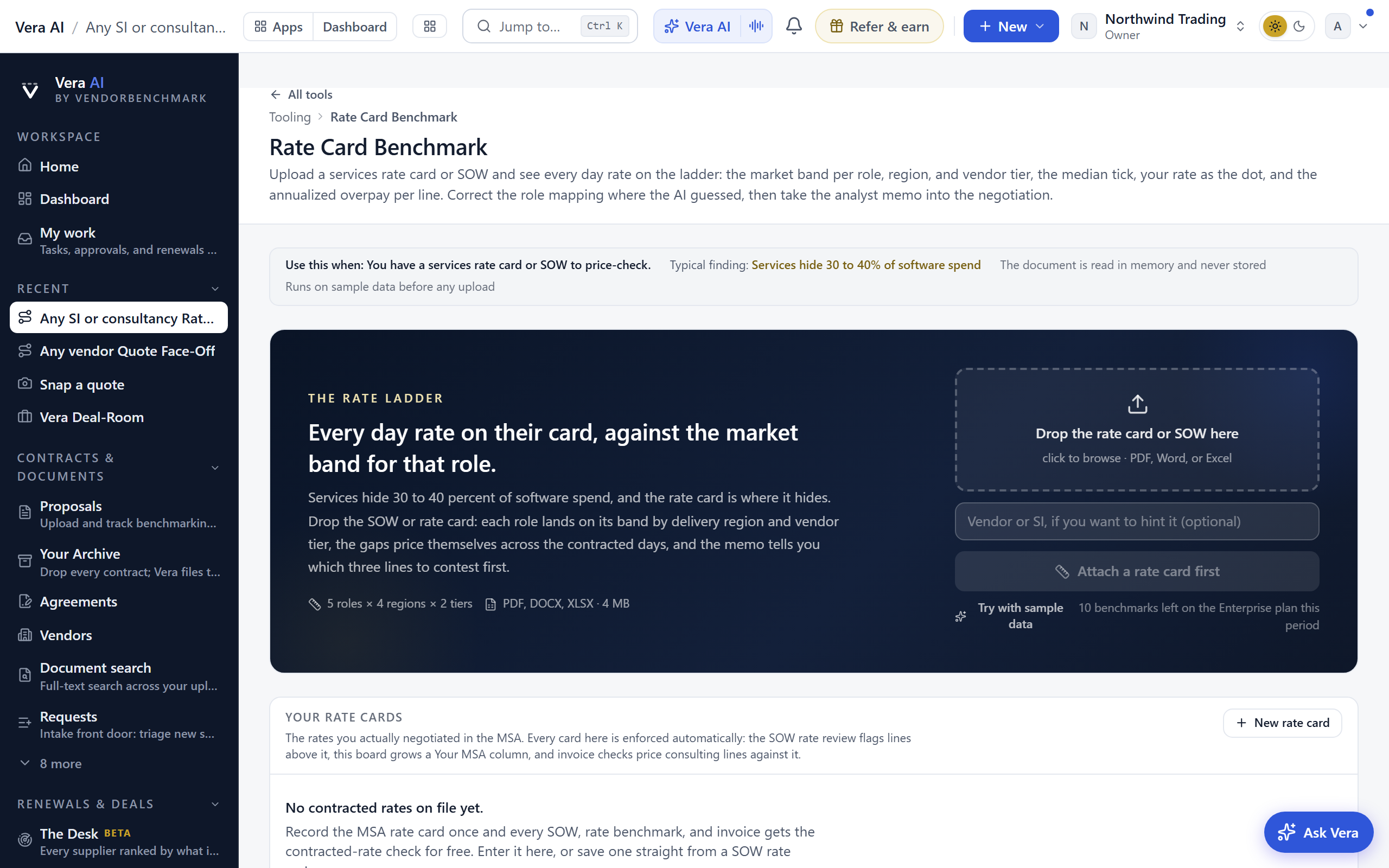
On the screen
- Upload: the rate card or SOW, dropped anywhere on the panel.
- What is kept: a PDF or Word document saves to your workspace under Contracts and joins your benchmarking queue, with a note that links it and offers to delete it. An XLSX rate card is a data file rather than a contract, so it is read in memory and never stored, and the result footer says so. Owners can turn the saving off under Data controls.
- Exports: the memo carries the shared deliverable toolbar: Print or save as PDF, Word, and Send it on, which drafts the covering email for you to send from your own mail. A sample run keeps print and Word.
- The ladder: one row per role with the market band and your rate marked against it.
- Role mapping: correct the AI's role mapping inline if a title was misread; the ladder reprices as you fix it.
- Your contracted rates: when a saved MSA rate card matches the read vendor, a strip above the mapping states how many lines price above what you already negotiated, and a Your MSA column appears per line: the contracted day rate, the delta, and the annualized overage, all computed in code. Contract compliance, not a market ask.
- Blended rate deconstruction: any blended or offshore-blended line gets a Deconstruct this rate panel: the plausible senior/standard/junior mixes at that price, the implied vendor cost per day against the billed rate, and the margin range each read implies, from a curated delivery cost basis (five roles by four regions).
- Your rate cards: the vault below the tool. List, create, edit, and delete the organization's negotiated rate cards, one dense grid per card: role as the MSA prints it, benchmark role, region, level, unit, and the contracted rate. Cards can also arrive in one click from a finished SOW rate review (Save as rate card).
- Analyst memo: which lines to contest, the blended-rate trap, and the counter-structure to propose.
- Theatre: once lines are benchmarked, the Theatre button on the verdict band presents the findings to procurement full screen: the opening position, each role family against its market band, then priced negotiation targets and the analyst memo. Presenter notes guide the walkthrough, and the leave-behind prints the screens you covered.
- Open the workroom: a navy band above a benchmarked card (real runs, not the sample) opens it as one case file on a dark stage: the position cover sheet, the full ladder worst gap first with the annual figure per line, the analyst memo once one exists, and the unmapped lines as an exhibit with the reason each could not be judged. The ⚡ dock carries the rate challenge to the vendor, stating only the day rates we need per role and their own printed rates, never the band behind them, plus the internal position note with the full placement and the annualized overpay, the copies, the Word brief, and the Deal-Room and vendor record handoffs; the ✦ dock is Ask Vera grounded on the stored extraction and your saved corrections. The rail searches your uploaded documents and keeps your shelf.
How to use it
- Record your MSA rate card once, by hand in Your rate cards or with Save as rate card on a SOW rate review.
- Upload the rate card or SOW to benchmark.
- Fix any role mappings the AI got wrong.
- Read the Your MSA column first (already agreed, just enforce it), then the market gaps, then take the memo into the negotiation.
Related: Contract Agent · The benchmark library
Time machine
Drop last year's paper and this year's for the same vendor. The machine narrates what actually changed: the terms you won, the protections that quietly disappeared, and the real price walk line by line. Renewals smuggle in term degradation, and the machine reads for it so you do not have to.
*In plain words: last year's paper against this year's, with every quiet change named.*
When to reach for this
- The renewal draft arrived and "nothing else changed" deserves verification, not trust.
- Post-signature archaeology: what did we actually give up over the last three renewals?
- The history you kept in Contracts is exactly what this machine eats.
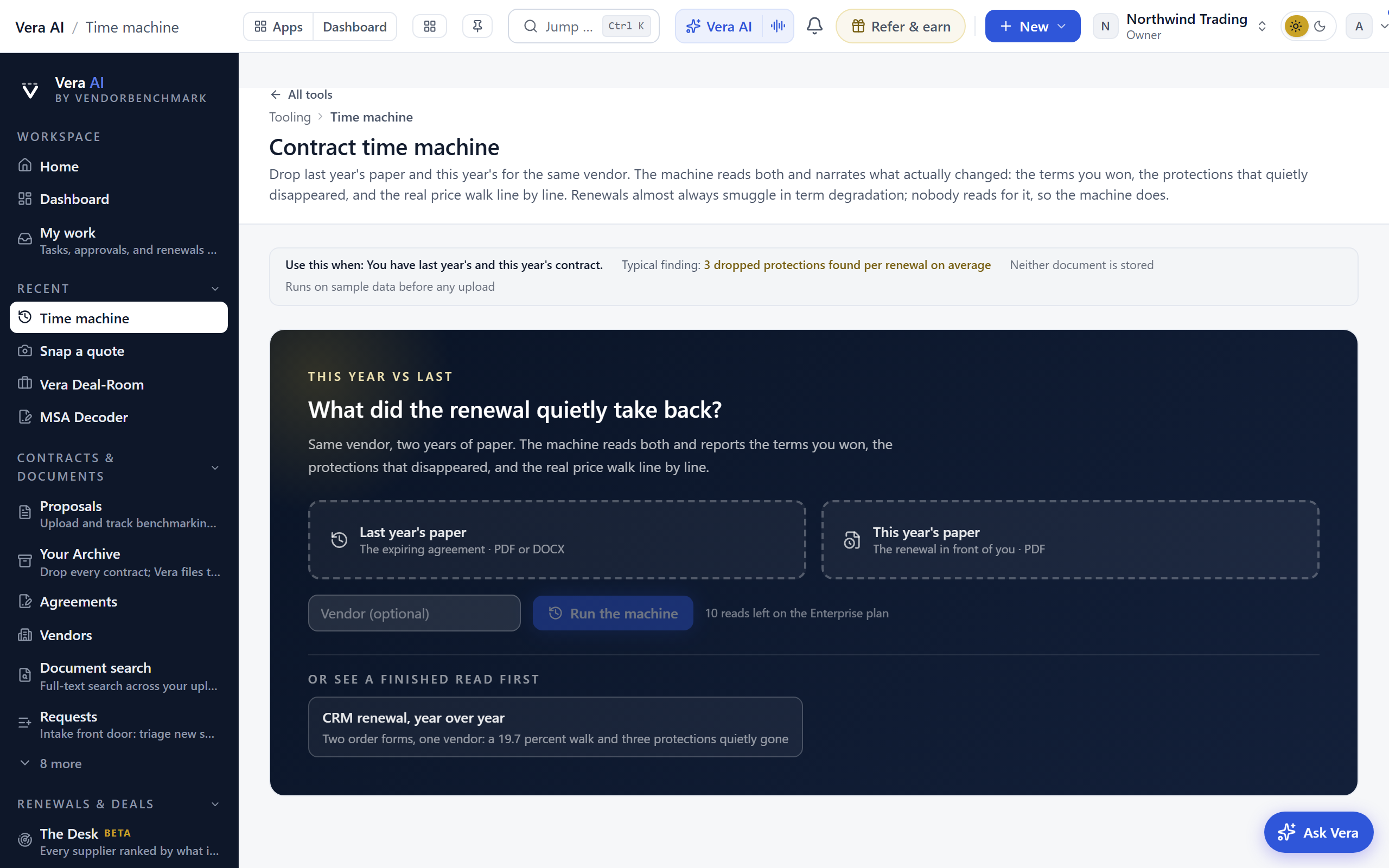
On the screen
- Two uploads: last year's document and this year's.
- The vendor hint is kept: a vendor name typed before you drop the documents waits for the read rather than disappearing when you leave the page, and clears itself once the read starts.
- Start from your estate: a row of chips above the uploads, read from the agreements you already store. Where a vendor holds two readable documents, the pair itself is offered and the comparison runs on the stored files with no re-upload and nothing new saved. Other chips fill the vendor name only, and the line beneath says why: the workspace stores fewer than two readable documents for those vendors.
- What is kept: on the upload path, both documents save to your workspace under Contracts, private to your organization, and join your benchmarking queue, with a note that names each one, links it, and offers to delete it. On the stored-pair path nothing is uploaded and nothing is saved again. Owners can turn the saving off under Data controls.
- Or see a finished read first: a worked example under the two upload slots, two order forms for the same vendor a year apart. It walks a 19.7 percent price walk that decomposes into unit price on products you already had, added volume and one new product, and a retired line that takes money back out, plus three protections that quietly left the paper. Pressing it replays the example as an already finished read, workroom included. Nothing uploads, nothing saves, and no read is spent.
- The narrative: what you gained, what you lost, and where.
- Price walk: the real increase line by line, not just the headline number.
- Saved reads: the walk delta is kept with each saved read.
- Theatre: a finished read carries a Theatre button that plays the comparison full screen for a renewal review: the verdict, what you gained and lost, the protections that quietly left the paper, then the price walk a stretch of lines at a time while the cumulative figure counts up in the header. The show ends on your position and the watchouts to raise before signing.
- The timeline workroom: the navy band above the read opens it as two executive-brief papers: the timeline brief, with the price walk drawn as a journey (last year, the movers, this year, every value printed at the data), what moved each way, and the quiet losses as a verdict table; and the line ledger, every priced line both years with the movement per line. The dock beside the paper drafts the renewal reply that asks every changed term and quiet removal back to last year's language, briefs the deal owner with the full figures, and hands off to the negotiation, the vendor room, and Second opinion; Ask Vera rides the same dock, grounded on the whole read.
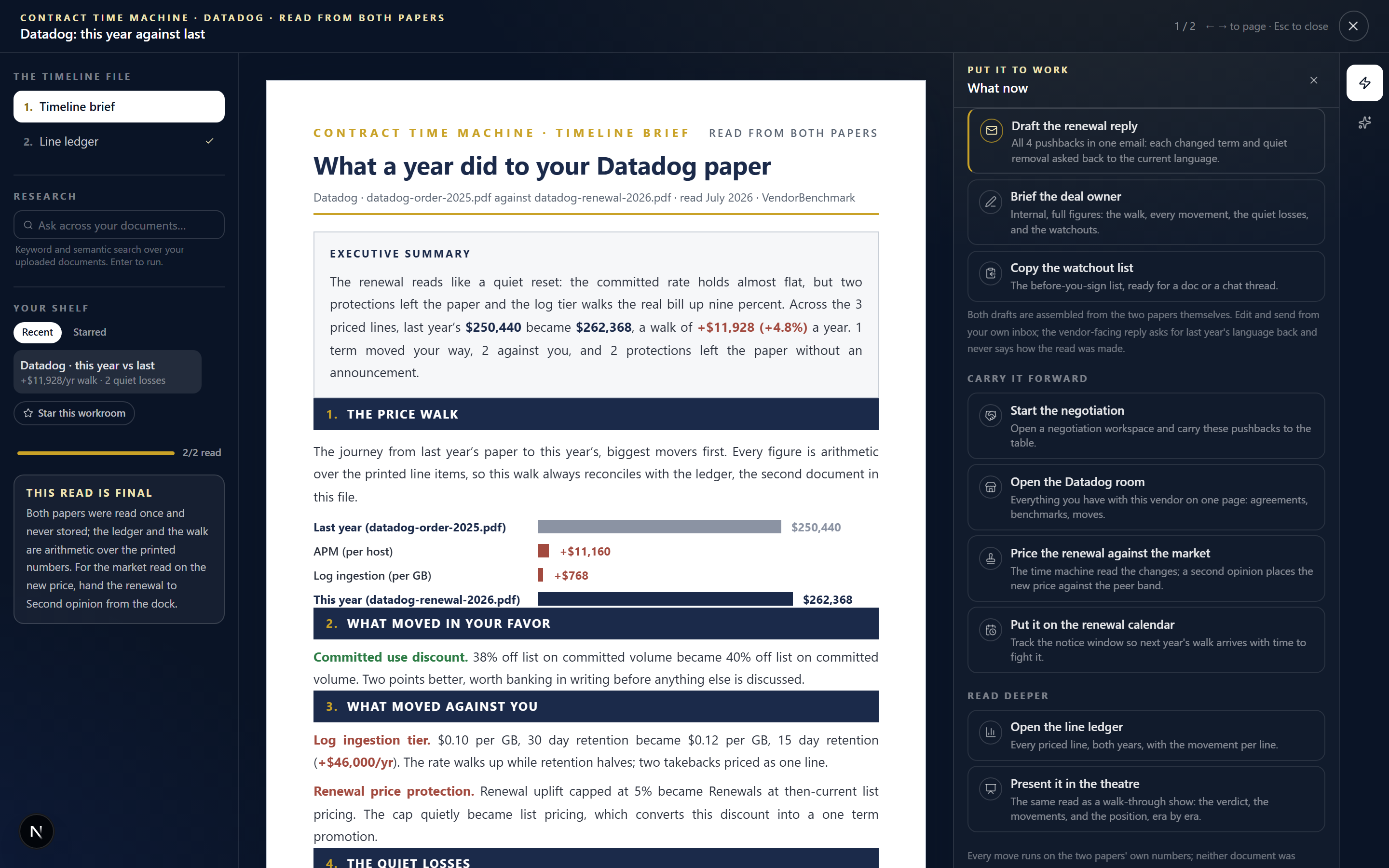
How to use it
- Press the worked example if you want to see a finished read before uploading your own paper.
- Upload both versions of the same vendor's contract.
- Read the narrated diff, watching for dropped protections.
- Take the findings into the renewal.
Related: Compare contracts · Renewal playbook
Report extract
Your layout is kept. The preset you start from, every field you tick or untick, and a custom field you are part way through describing are all saved in this browser. Downloading does not clear them; click a layout tile to go back to that preset. The uploaded XLSX template is not stored, so that is supplied again.
Everything document search has read across your contracts, exported as one workbook: one row per contract, columns you choose. Use it when you need the contract register in Excel, when your SAM tool (Xensam, Flexera One, ServiceNow, Snow, USU) wants an agreement import, or when your team's own report template should fill itself.
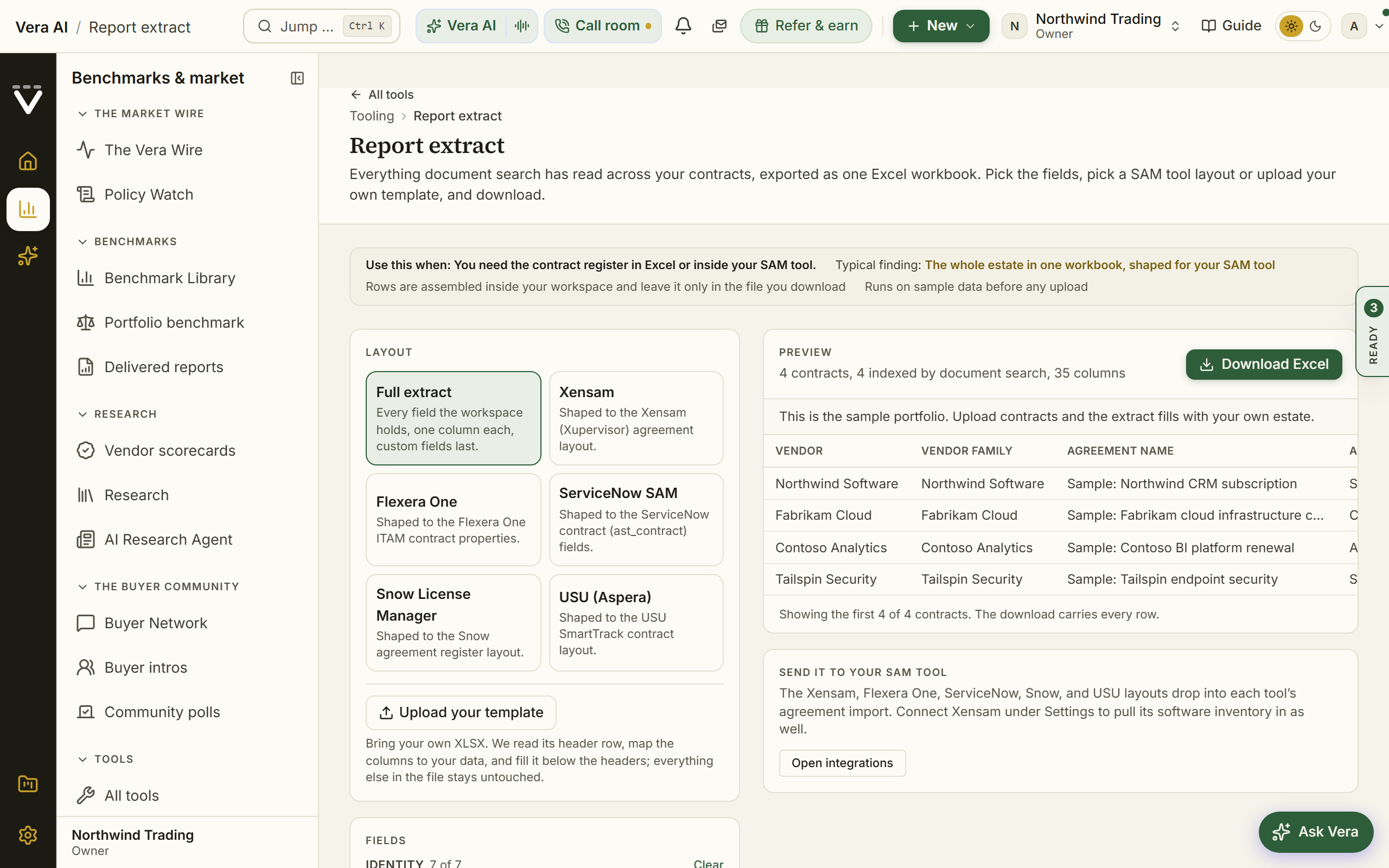
On the screen
- Layout — six starting points: the full extract with every field, or layouts shaped to the agreement imports of Xensam, Flexera One, ServiceNow SAM, Snow License Manager, and USU. Below them, upload your own XLSX template.
- Fields — every column the workbook can carry, grouped: identity, term dates, renewal mechanics, values in the original currency and in USD at today's rate, documents, detected clauses, evidence quotes, and your custom fields. Tick what you need; the preview follows.
- Column mapping — with a template loaded, each of your template's columns and the field that fills it. Columns are auto-mapped by header name; fix any of them with the dropdown. Unmapped columns are left exactly as they are.
- Custom fields — anything the standard fields miss: payment terms, governing law, data residency. Add a field with a name and what to look for, then Scan contracts re-reads every indexed contract and records the value with the verbatim quote it was read from. A blank cell honestly means the paper does not state it.
- The preview — the first rows exactly as the workbook will carry them, with the contract and indexed counts. The download carries every row.
- Send it to your SAM tool — the SAM layouts drop into each tool's agreement import, and the Xensam connector under Settings › Integrations syncs its software inventory into License intelligence the other way.
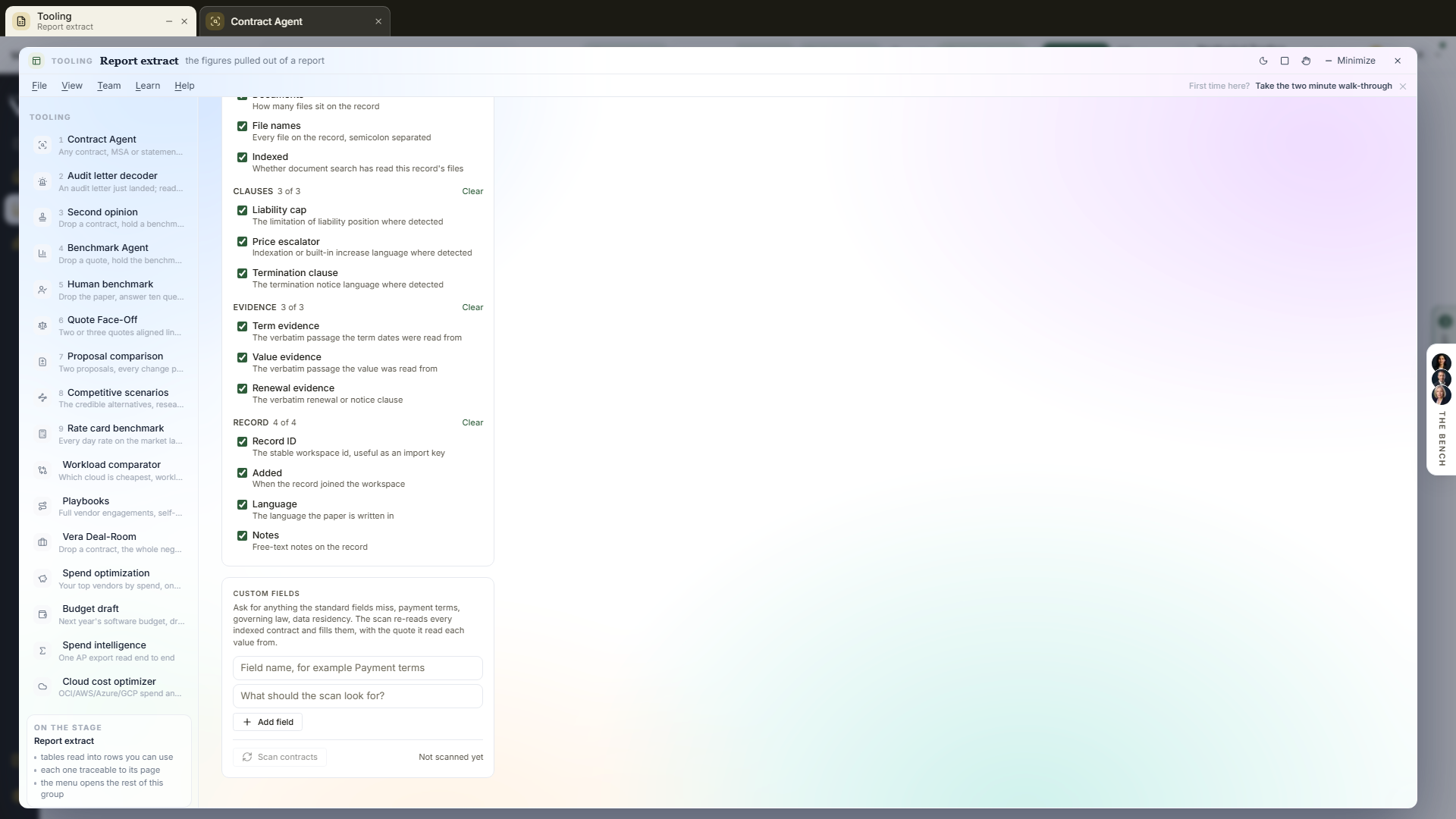
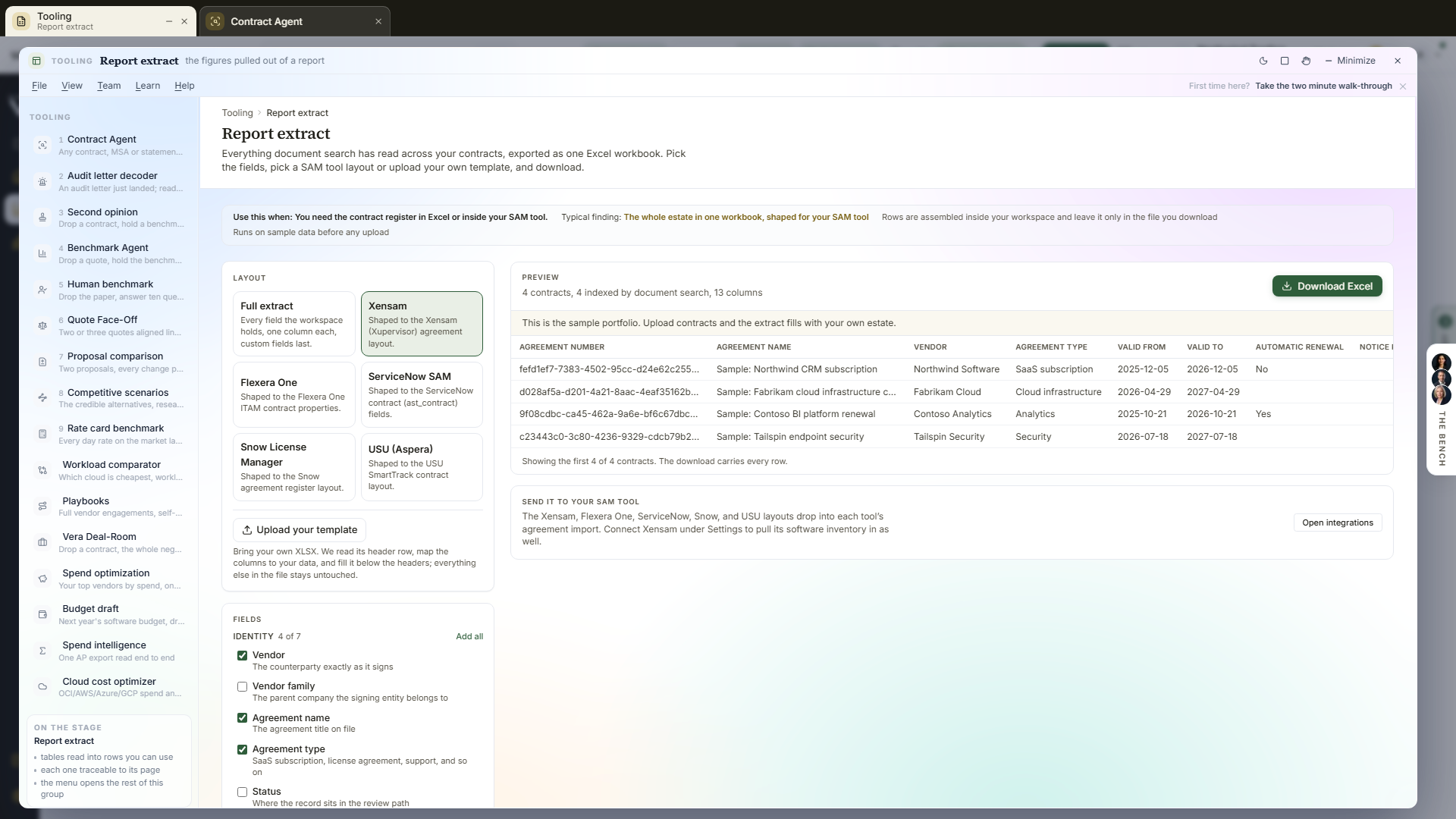
How to use it
- Pick a layout, or upload your template and check the column mapping it proposes.
- Adjust the fields until the preview shows the columns you want.
- Optionally add custom fields and press Scan contracts; the scan runs in the background and the coverage counts fill in as it reads.
- Press Download Excel. A fresh workbook carries a Contracts sheet and an About sheet; a filled template comes back as your own file with the data under its headers.
Tips
- Review the file in your SAM tool's import preview before committing the import; every tool maps a few columns its own way.
- Money exports in the original contract currency and in USD at today's rate, each as its own column, so pick whichever your report needs.
- A record joins the scan once document search has read its files; the Indexed column shows exactly which rows that is.
Related: Document Agent · Vera AI with your SAM tool · The integration catalog
Cloud cost optimizer
*In plain words: your cloud bill read for waste, with the findings staged and the plan phased.*
When to reach for this
- The monthly cloud bill grew again and nobody can say exactly why.
- Before a committed-spend negotiation: know your optimized baseline before committing to the unoptimized one.
- The export parses in your browser, so the first pass costs nothing but the drop.
Pick your hyperscaler on the navy stage and drop a daily cost export from OCI, AWS, Azure, or GCP. Every run plays the FinOps scan: a full screen stage where a beam sweeps a miniature of your estate while a live ticker narrates real findings parsed from your file in the browser, then an executive reveal with the figures counting up. Behind it sit a savings dashboard, an executive brief, a full FinOps report, and a phased action plan you can track.
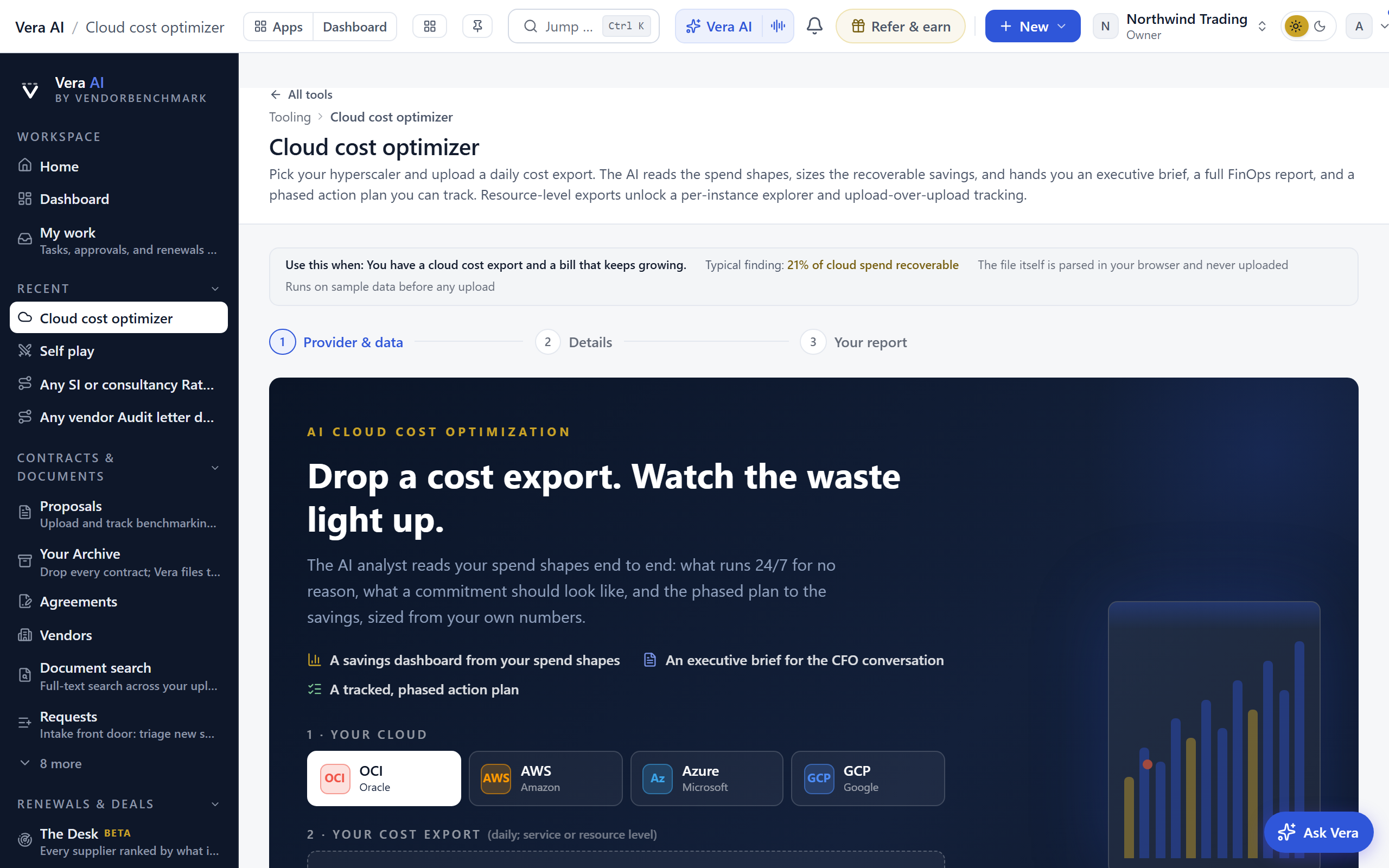
On the screen
- Before you commit: a card above the stage pointing at the Commitment Playbook, the ten part research series on sizing and running a committed spend agreement. It opens the document the series anchors on your vendor, and links the whole series, so you can read the method before the tool hands you a number.
- The stage: choose the cloud from the four provider marks and drop the cost export on the zone that lights up. The file is parsed in your browser and never uploaded.
- Your draft is kept: the cloud you pick, the estate details and your notes are saved on this browser as you type, so leaving the tool or closing the window loses nothing. Reopening lands on the draft as you left it; the last five drafts wait under File, Continue where you were, and Start over (in the tool or under File) sets the current one aside. The export itself is parsed in your browser and never uploaded, so it cannot be saved with the draft: the tool names the file it last read and asks you to drop it again, and the moment you do you land back where you were.
- The FinOps scan: while the AI writes (one to three minutes on a real upload), the estate miniature colors in dot by dot (green healthy, gold rising, brick always on, blue new arrivals) and the ticker calls out your run rate, 24/7 bands, weekend deltas, and spike days. The reveal shows the verdict and the top findings, then opens the report.
- The dashboard: count up figures, the money bridge waterfall from today's run rate to the optimized number, a weekday by week spend rhythm heatmap with spike days ringed in gold, per service sparklines, and your recoverable share placed against the market's 18 to 25 percent band. Hover the daily spend chart for a crosshair with every service's cost on that exact day.
- Findings triage: mark each top finding Pursue, Later, or Dismiss; the choice is saved for your whole team and the tally shows what the pursued set is worth per year.
- Dial the ambition: drag between the Conservative, Realistic, and Aggressive scenarios and watch the annual savings, ROI, and payback track the thumb.
- Executive brief and full report: the short read and the deep read.
- Share and forward: mint a 30 day read-only link to the brief, or send it by email as an executive brief with the headline figures and top findings. Both carry aggregates and the written assessment only; the cost export itself never left your browser. Links can be revoked at any time.
- Action plan: a phased plan with a momentum header: the overall completion ring, per phase progress, and a savings activated tally that counts up as steps are checked off.
- What next: the result ends with a What next module seeded from the run's own numbers, so the follow-through starts from this estate rather than a generic list.
- Upload-over-upload tracking: a resource-level export unlocks a per-instance explorer, and your next upload adds a since your last export ribbon with the run-rate delta and the biggest movers.
- Open the workroom: a navy band above the result opens all six views as one case file on a dark stage: the executive brief and the full report as papers, the dashboard and the resource ledger as exhibits, and the action plan and the commitment sizing as action papers. The ⚡ dock beside the paper splits the stage and carries the moves, and the ✦ dock is Ask Vera grounded on the whole analysis. The rail lists your other runs, searches your uploaded documents, and keeps your shelf.
- The moves in the dock: draft the commitment ask to your provider (the level your run rate implies, with the discount schedule, rollover, true-down right, and overage rate asked for by name), draft the CFO savings memo (the measured savings range with the evidence under each spend pattern), hand the action plan to its owners split by the owner each step names, book the change into your renewal calendar, jump to the commitment levers to rerun the sizing, watch drift against the plan, mint the share link, copy the plan, and export the brief to Word. Nothing sends from the workroom and no alert is armed: drift is the run-rate delta between your last export and the next one, and it says whether the plan is landing.
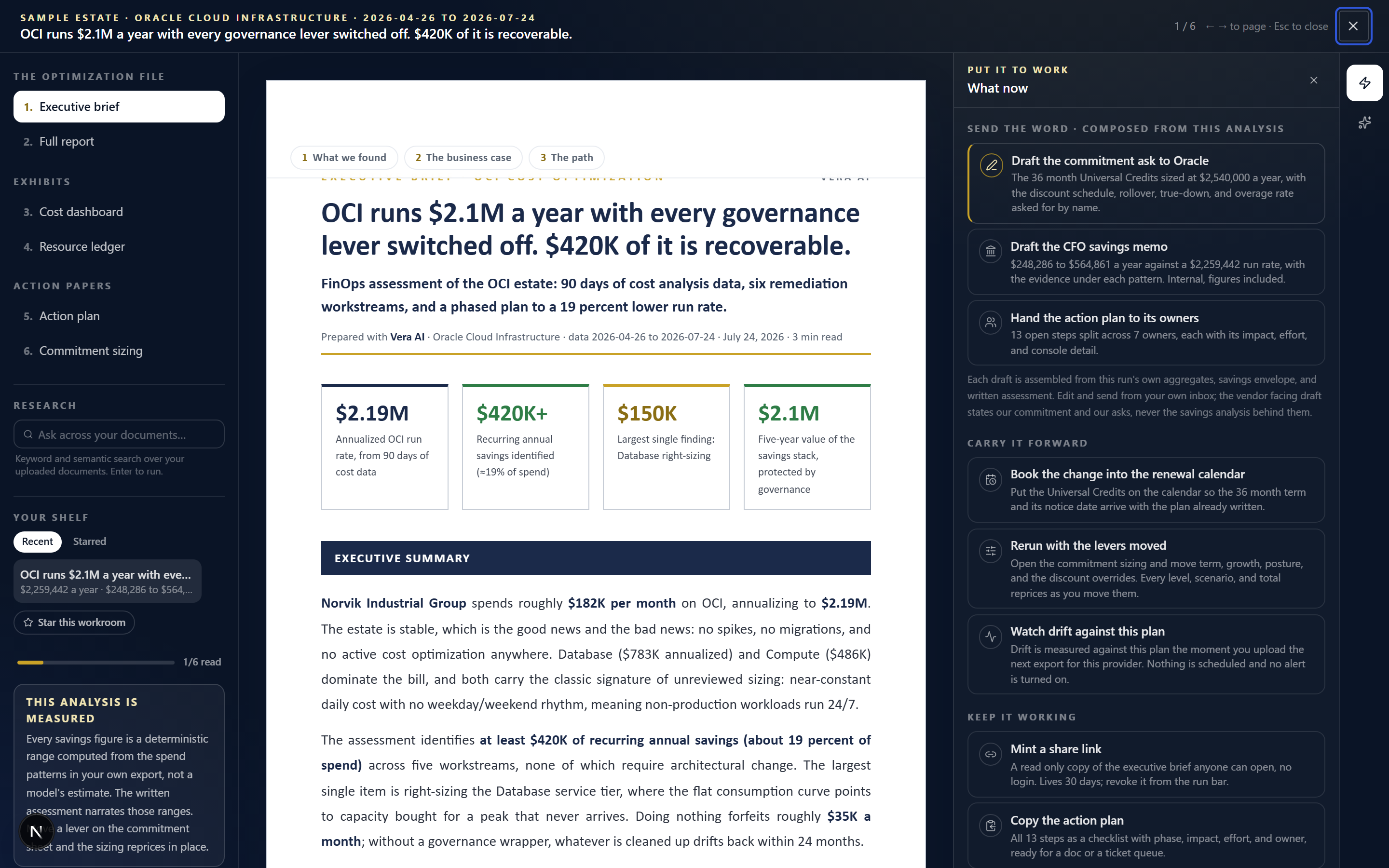
How to use it
- Select the provider on the stage and upload the daily cost export (or press Try with sample data to watch the whole ceremony first).
- Watch the scan, read the reveal, then open the full report.
- Read the dashboard: the money bridge says what the number is, the heatmap says where the rhythm is wrong. Triage the top findings and dial the scenario that matches your appetite.
- Press Open the workroom and read the brief with the ⚡ dock open beside it; draft the CFO memo and the commitment ask from there.
- Work the phased plan and watch the savings activated tally climb; re-upload later to track the run rate.
- Share the brief with the budget owner by link or email when the case is ready.
Related: Workload comparator
Workload comparator
*In plain words: every workload priced on all four clouds, and the ones on the wrong platform named.*
When to reach for this
- A cloud negotiation needs a credible alternative: the cross-cloud price is the evidence.
- Platform strategy season: where the estate would sit if placed by price rather than history.
- A consolidation question (the recipe) where workloads, not licenses, are the unit.
Save analysis files the placement verdict brief and its cost atlas to your Documents library, where it reopens at /tooling/analyses/workload-compare without a re-run. Your working session also stays in this browser per organization.
Describe your workloads or import an inventory CSV and the comparator prices each one on AWS, Azure, GCP, and OCI at list, then opens with the verdict: the optimal multi-cloud mix, the annualized saving, how many workloads sit on the wrong platform today, and a three sentence executive read written live from your numbers. A sample portfolio loads on arrival so every panel is visible before you upload anything.
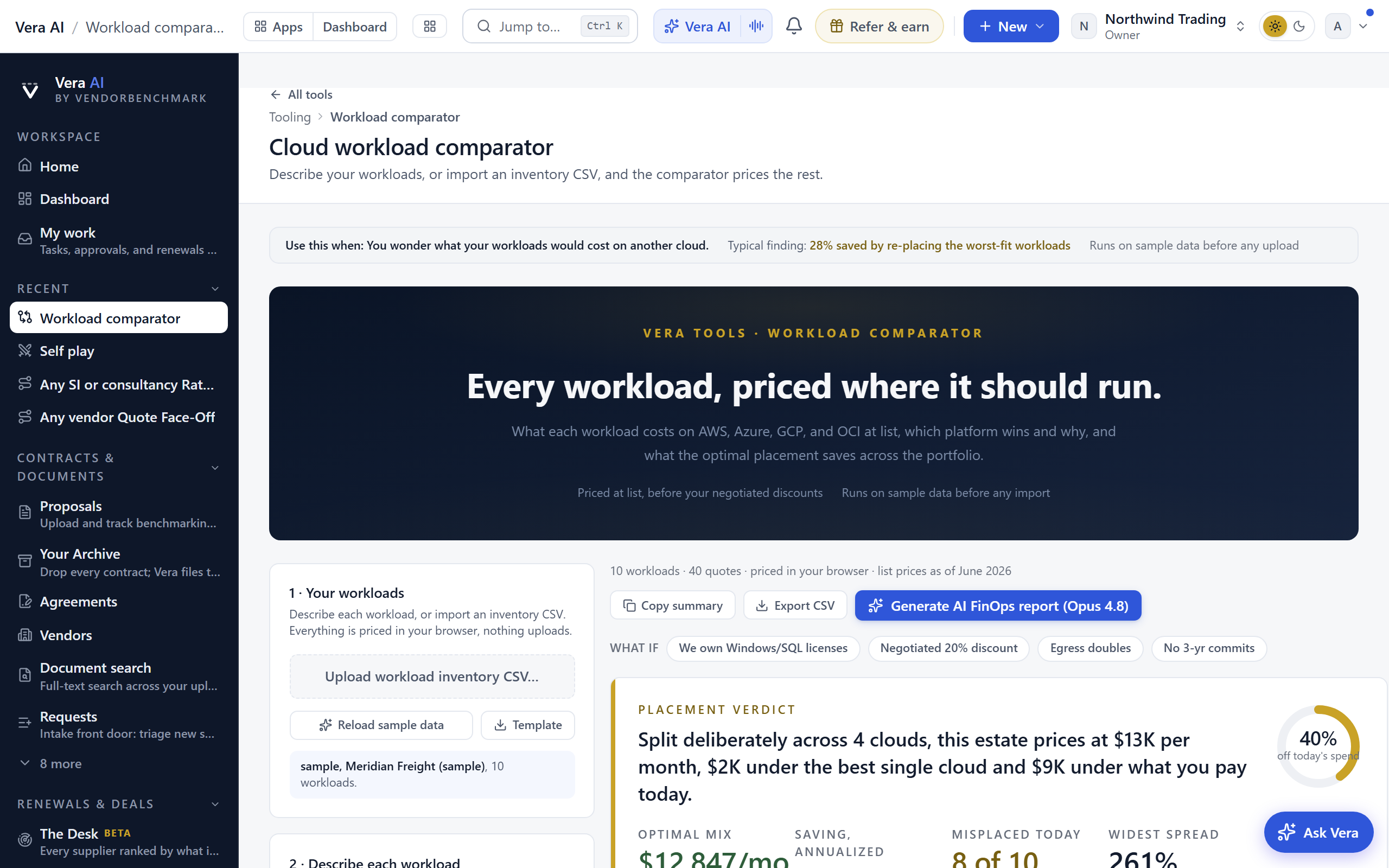
On the screen
- Placement verdict: the optimal mix per month, the saving annualized, the misplaced count, and the widest cross-platform spread, with an estate shape line (how much spend runs 24/7, what is licensing, egress, and GPU).
- What if switches: four scenario toggles that re-price the whole estate live: owned Windows/SQL licenses (Azure Hybrid Benefit), a negotiated 20% discount, doubled egress, and a one year commitment cap. A chip shows what the scenario saves or adds against plain list.
- Executive read: three analyst sentences over your numbers: what the mix is worth, the single biggest lever, and what to do first.
- Open the workroom: once results exist, a band under the executive read opens the comparison as a six document case file, recomposed live from the current comparison: all four contenders' cost lines as exhibits, the cost atlas with per line deltas, the verdict brief (with the four single platform totals and the optimal mix drawn as a labelled bar chart), the switch sheet with the one time cost, the breakeven month, and the cumulative net position at twelve, twenty four, and thirty six months, and a What now sheet with a full figures stakeholder draft and links to the four clouds' commitment benchmarks. The same moves ride the ⚡ dock beside every paper, the ✦ dock is Ask Vera grounded on the whole comparison, and the rail searches your uploaded documents and keeps your shelf. Moves copy to your clipboard or open in your own inbox; nothing sends.
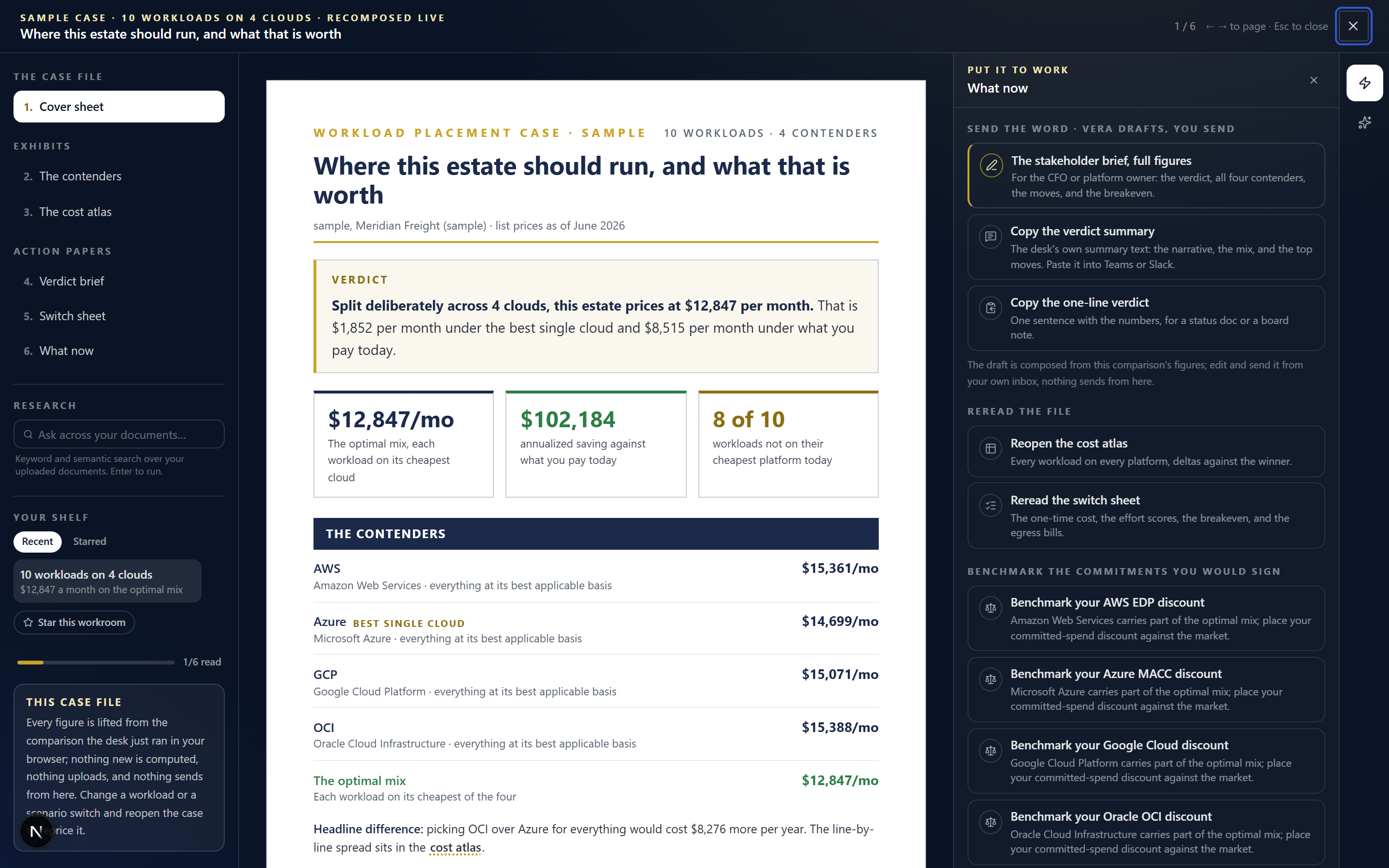
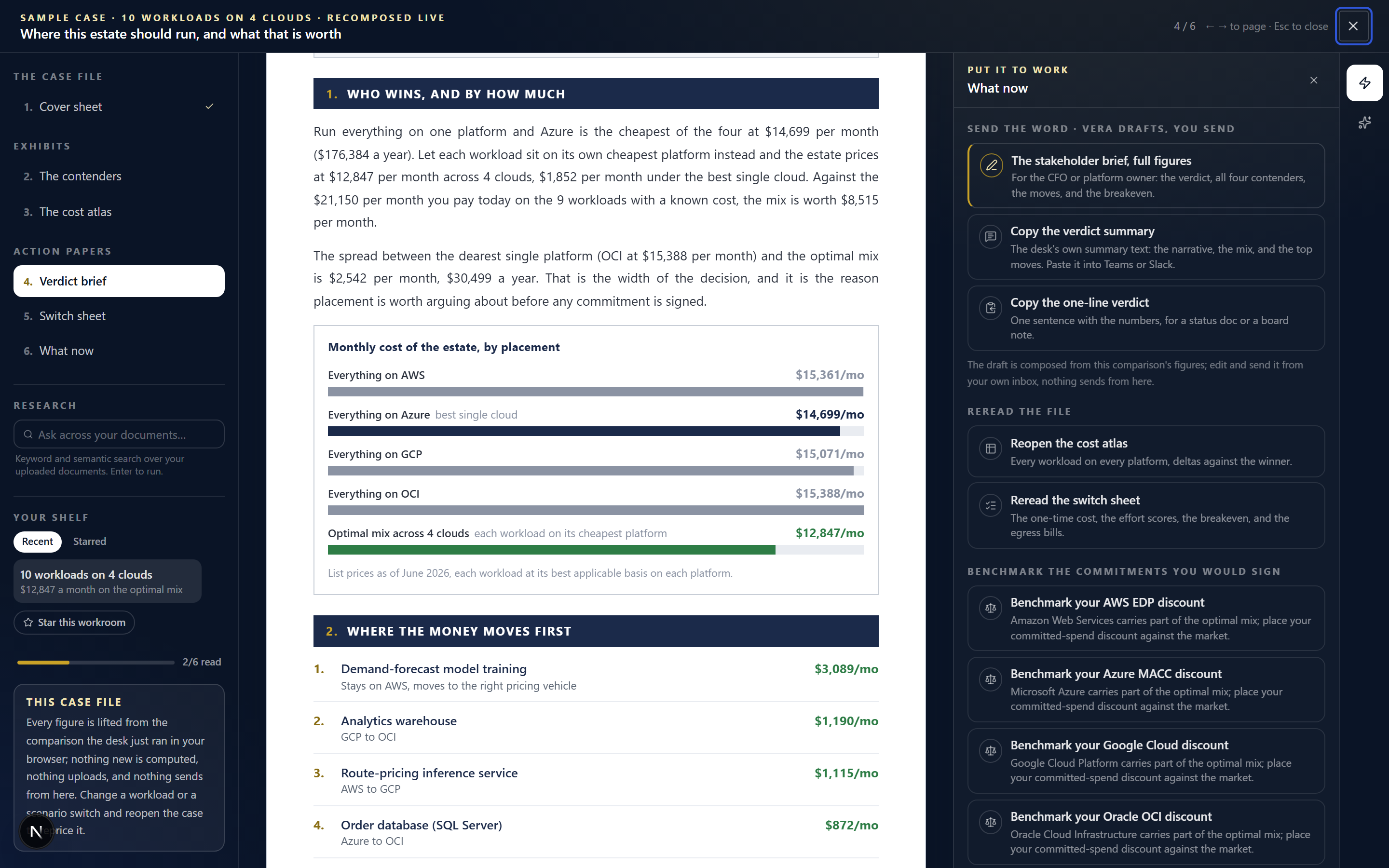
- Estate map: every workload as a block sized by monthly cost, colored by where it runs today or where it should run, with the movers outlined in gold. Click a block to open its breakdown.
- Cheapest platform per workload: the comparison matrix: cells shade with cost, non-winners show the premium over the winner, each workload carries its cost driver chip (compute, licensing, GPU, storage, or egress led), and every column sorts.
- The full picture: the selected workload's cost anatomy on each cloud, the on-demand and commitment prices, a negotiation angle with a one to five leverage meter, and a migration effort read.
- Where the money should move: flow ribbons from today's platforms to the optimal placement, sized by monthly cost.
- Where the saving comes from: a waterfall splitting the saving between pricing discipline (commitments and spot, no migration needed) and replatforming.
- 36-month projection: cumulative spend on today's path against the optimal mix, with an adjustable one-time migration estimate and the breakeven month marked.
- Which moves to make first: each move plotted by monthly saving against migration effort; start in the quick wins corner.
- Commitment plan, data gravity, and the price of one cloud: which pricing vehicle each cloud's share rides on, the portfolio's egress bill on each platform, and the premium every single-cloud consolidation pays over the mix.
- Exports: the full quote set as CSV, a copyable executive summary, and the AI FinOps placement report.
- What next: the result ends with a What next module seeded from the run's own numbers.
- Your session keeps: the portfolio, switches, and results stay in this browser per organization, so leaving or reloading does not lose the run; Start over clears it.
How to use it
- Describe or import your workloads, honest sizes, egress, and licensing give an honest answer.
- Read the verdict and the executive read, then click through the estate map and the matrix.
- Flip the what if switches that match your reality, owned licenses or a negotiated discount change winners.
- Press Open the workroom and read the verdict brief and the switch sheet with the ⚡ dock open beside them; draft the stakeholder brief from there.
- Work the quick wins corner first, and take the flows, waterfall, and CSV into your architecture and pricing talks.
Related: Cloud cost optimizer
M365 optimization
Save analysis files the playbook to your Documents library, where it reopens at /tooling/analyses/m365-optimization without a re-run. The per-user action list stays in your browser and is never part of the saved copy.
Upload your Microsoft 365 usage export to find inactive accounts, right-size E7/E5/E3/E1 tiers, and size Copilot. Generating the playbook opens the estate scan, a full screen reveal where every licensed user is a dot that colors in as its verdict lands, ending in an executive readout with the money bridge from today's spend to the optimized mix.
*In plain words: your Microsoft seats against actual usage, with the surplus priced.*
When to reach for this
- The EA renewal or true-up is inside a year: walk in with the surplus already found (the recipe).
- Copilot sizing is on the table and deserves usage data rather than the vendor's enthusiasm.
- Quarterly hygiene: inactive seats accrue quietly between renewals.
A worked example. The sample estate's Microsoft position is 1,800 E3, 350 E5, and 900 F3 seats, and the flagged exposure on the E3 pool alone runs $64,800 a year. That is the shape of finding this tool exists for: not a dramatic discovery, just seats nobody uses and tiers nobody right-sized, priced and turned into a per-user reassignment plan you can actually execute.
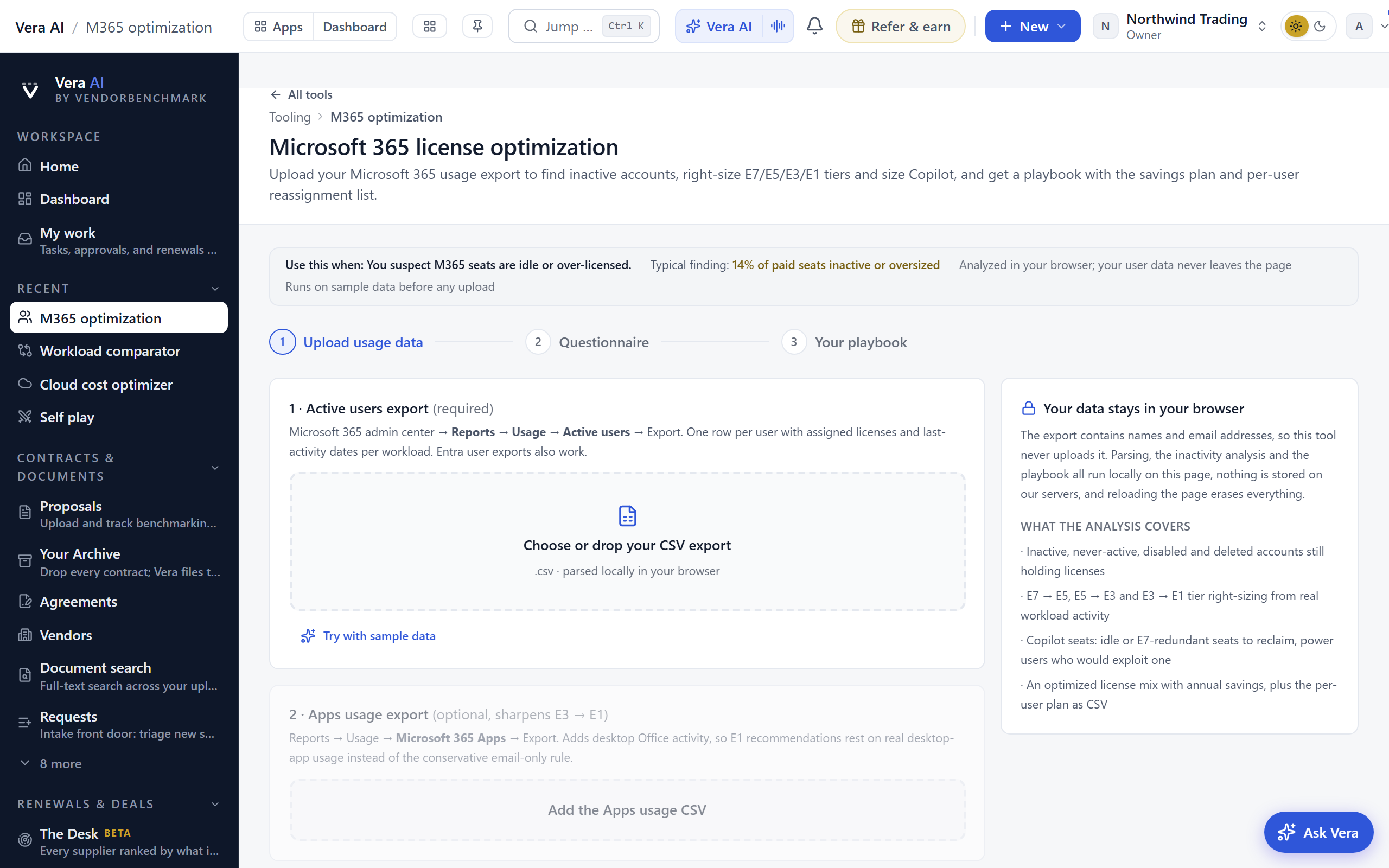
On the screen
- Before you commit: a card pointing at the Commitment Playbook, the ten part research series on sizing and running a committed spend agreement. On this screen it opens the Microsoft document, on ramps, co-terms and the multi-year shape, and links the rest of the series.
- Usage upload: your M365 usage export, analyzed in your browser so your user data never leaves the page. A sample 500 user estate is one click away if you want to see the result first. Your session stays in this browser per organization, so leaving or reloading does not lose the analysis; Start over clears it.
- The estate scan: the reveal that plays when you generate the playbook: the scan beam, the live findings ticker, the headline numbers with your waste share placed against peer estates, the money bridge (stamped when the math closes), the seat-flow map of where every seat goes, and the largest individual moves. A renewal inside 120 days shows a countdown chip. Skip it with one click or replay it any time with Replay the reveal.
- Verdict band: the four numbers that matter (annual spend, identified savings, net position, accounts flagged) pinned above the playbook. Drag the inactivity threshold anywhere from 14 to 180 days, or use the 30/60/90 presets, and flip the Copilot appetite; every number in the band and the report recomputes in place.
- Scenarios A and B: freeze the current assumptions into a slot, change them, and read the two positions side by side with deltas. Load either scenario to put the whole playbook on its numbers.
- The playbook: the print-ready report, opening on an executive cover page: estate inventory, the silence curve, the what-Microsoft-sees table (assigned seats against the seats actually working, per tier), the per-department waste rollup with the worst offender named (when your export carries a Department column), tier right-sizing with evidence, Copilot sizing with a per-appetite return model, the savings plan line by line, and the 12-month realization curve of what lands when.
- Share readout: a 30-day read-only link to the executive readout for a CFO or a colleague. It carries aggregates only, never user names; the per-user plan stays in your workspace.
- Send to EA playbook: carries the optimized seat counts into the Microsoft EA renewal playbook, where they appear as your opening position for the quantity conversation.
- Reassignment plan (CSV): the per-user action list, ready for your admin team.
- Open the workroom: a navy band above the result opens the playbook and the seat commitment sheet as one case file on a dark stage, with the ⚡ dock beside the paper and the ✦ dock for Ask Vera grounded on the whole estate. The rail searches your uploaded documents and keeps your shelf.
- The moves in the dock: draft the seat true-down ask to Microsoft (your optimized seat count against today's assignment, asking for the true-down right, price protection, and the published tier rates by name), draft the CFO savings memo, hand the three reassignment waves to IT with their counts, book the renewal into your calendar, mint the share link, export the reassignment CSV, copy the savings plan, and run the EA playbook handoff without leaving the paper. No draft names a person; the user list never leaves your browser.
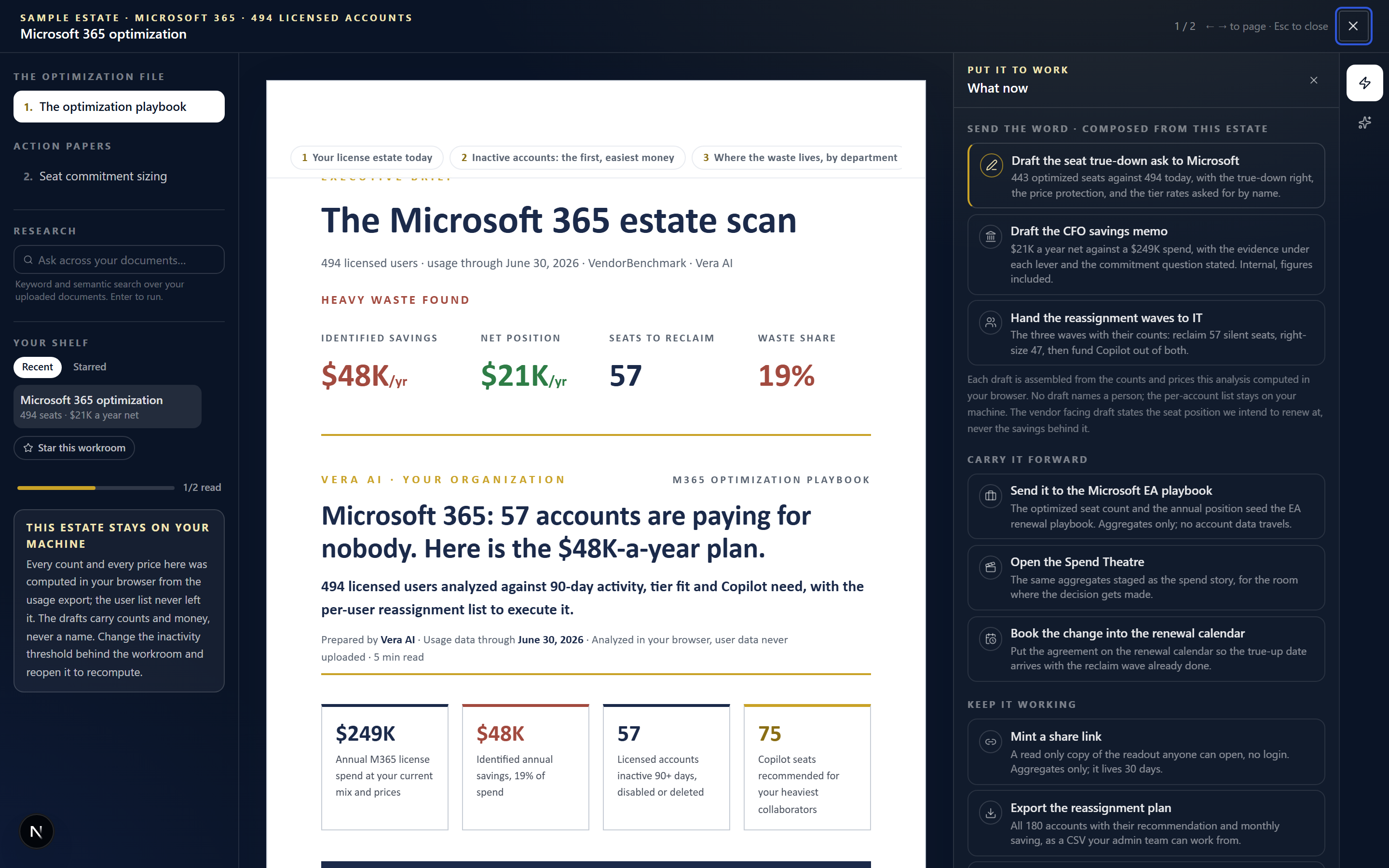
How to use it
- Upload the usage export (or start from the sample data).
- Answer the questionnaire and generate the playbook; watch the estate scan land the verdict.
- Scrub the threshold and Copilot settings in the verdict band until the assumptions match your reality; freeze scenarios A and B if two positions are on the table.
- Press Open the workroom and draft the seat position for Microsoft and the CFO memo with the playbook still on screen.
- Share the readout with the budget owner, send the optimized counts to the EA playbook, and work the reassignment list into your next true-up or renewal.
Related: EA renewal playbook · Spend optimization
Commitment Studio
Commitment Studio (named Spend Studio until August 2026; the address is unchanged) is the one place to size a committed-spend deal with an AI vendor and to work the rest of your savings tools. It opens on four tabs.
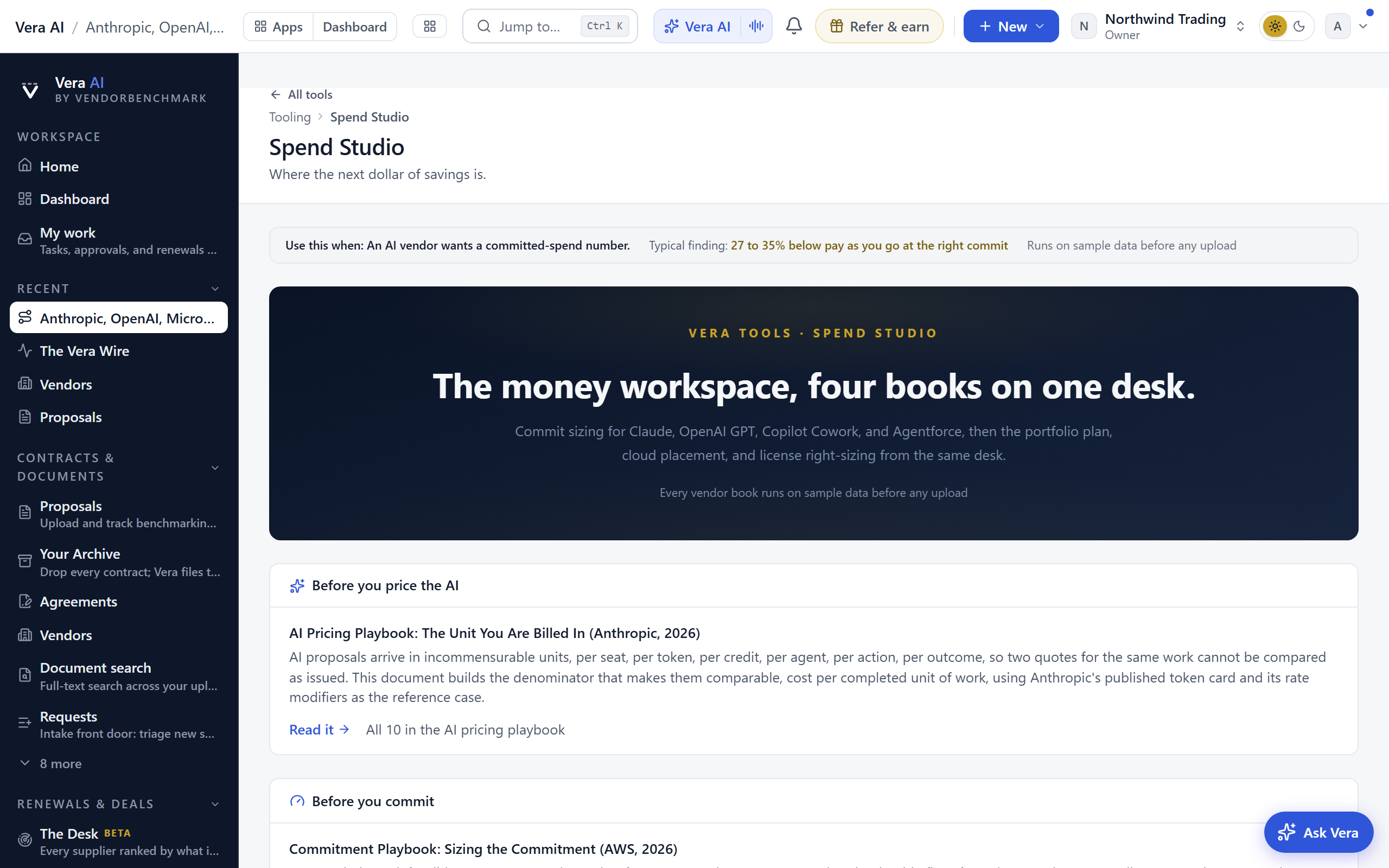
On the screen
- Before you price the AI: a card above the tabs pointing at the AI Pricing Playbook, the ten part research series on buying AI when the meter is new: translating seats, tokens, credits and outcomes into one comparable number, what counts as a billable outcome, credit expiry and revaluation, the AI clause set, and what to do when the model behind the endpoint changes. It opens the document anchored on whichever AI vendor you have selected, so picking Claude, OpenAI or Copilot changes what it shows.
- Before you commit: a card above the tabs pointing at the Commitment Playbook, the ten part research series on sizing and running a committed spend agreement: how to size the number off your own forecast, what a bigger commitment is actually worth, what happens to what you do not spend, and how to run the drawdown review afterwards.
- Commit sizing: pick the vendor, Claude, OpenAI, Copilot Cowork, or Agentforce, and that vendor's book opens with its own price book. Each book reads your usage export (or sizes workloads from prompt counts), adds the seat side of the contract, runs the commit-readiness gate, and prices the minimum, medium, and maximum commitment before you sign. The four books are documented in full below. Your choice stays in the link, so
/tooling/spend-studio?vendor=claudeopens straight into the Claude book and can be shared. - Plan: opens Spend optimization, the all-vendor plan that ranks your whole stack by annual spend and writes the prioritized savings moves.
- Cloud: the Cloud cost optimizer and the Workload comparator, for cloud placement and FinOps savings.
- Licenses: the M365 optimizer and the VCF licensing right-sizer.
How to use it
- Open Commitment Studio and, under Commit sizing, pick the vendor you are negotiating with.
- Drop in that vendor's usage export (or start on the sample data) and work the book to a sized commitment.
- Use the Plan, Cloud, and Licenses tabs to reach the portfolio plan and the cloud and license tools from the same desk.
Related: Spend optimization · Cloud cost optimizer
Agentforce optimizer
The Agentforce book inside Commitment Studio sizes a Salesforce Flex Credit commitment from your own consumption. Feed it your Salesforce Digital Wallet export (from a POC or production), or type your monthly credit burn if agents are not live yet, then set the term, growth, and planned use cases, and the tool prices the minimum, medium, and growth commitments against the forecast. The page opens on sample data, clearly marked, so every panel is visible before any upload; nothing you upload leaves your browser.
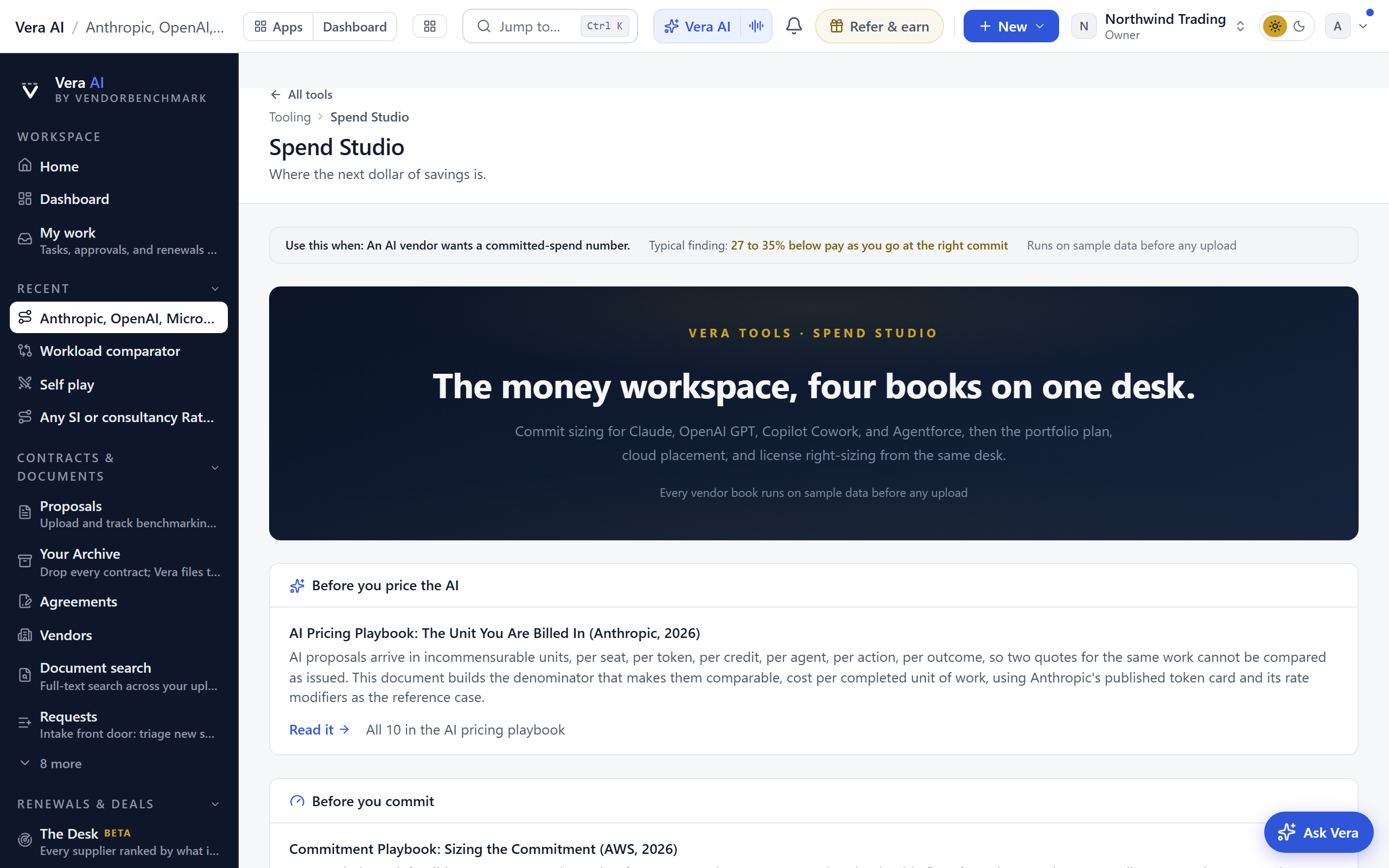
On the screen
- Five numbered steps: the model's inputs down the left. Consumption data takes the Digital Wallet CSV or a typed monthly credit burn; Term & growth plans sets the term, organic growth, and the planned new use cases (case deflection, a voice agent, and more), each with its monthly actions, start month, and ramp; Risk posture sets which forecasting mistake stings more; Negotiation levers holds the negotiated discount, credit rollover, and the scenario odds; and Check Salesforce's quote prices any quoted commitment and discount against your own forecast, flagging shelfware when the quote sits well above your expected burn and true-up overage when it sits below.
- Commit verdict: the recommended level, the annual commitment, expected savings versus pay as you go, expected utilization against its break-even point, and a plan robustness score: how many of roughly thirty perturbed futures still pick the same level.
- Commitment levels: minimum, medium, and growth cards, each with expected utilization against its break-even tick and where the expected money goes (committed spend, unused spend, overage).
- Forecast chart: credit burn drawn as an uncertainty cone from conservative to aggressive against the commit levels, with overage shading and a monthly headroom strip.
- Discount staircase: the three levels placed on the volume-discount ladder, with a nudge when committing slightly more costs less.
- What drives the burn: annual credits and yearly cost by source, baseline versus each planned use case.
- Total cost by scenario: every level priced across the conservative, expected, and aggressive paths, with a pay-as-you-go reference.
- Your negotiation ask: a copy-ready note with the sized number and the terms worth asking for.
- Save analysis and AI report: file the sized result into your Documents library, or generate the full commitment-sizing white paper.
- Open the workroom: opens the sizing report as a case file on a dark stage, with the ⚡ dock beside it and the ✦ dock for Ask Vera grounded on the sizing, including how each level lands under each demand scenario. The dock drafts the Flex Credit commitment ask to Salesforce (the credits you will commit on your term, with rollover, the overage rate, a true-down right, and the discount as a rate per credit asked for by name), drafts the CFO commitment memo, copies the whole commitment position, books the term into your renewal calendar, and opens the Salesforce room or the Deal Room. When a commitment does not beat pay as you go, the memo says so plainly.
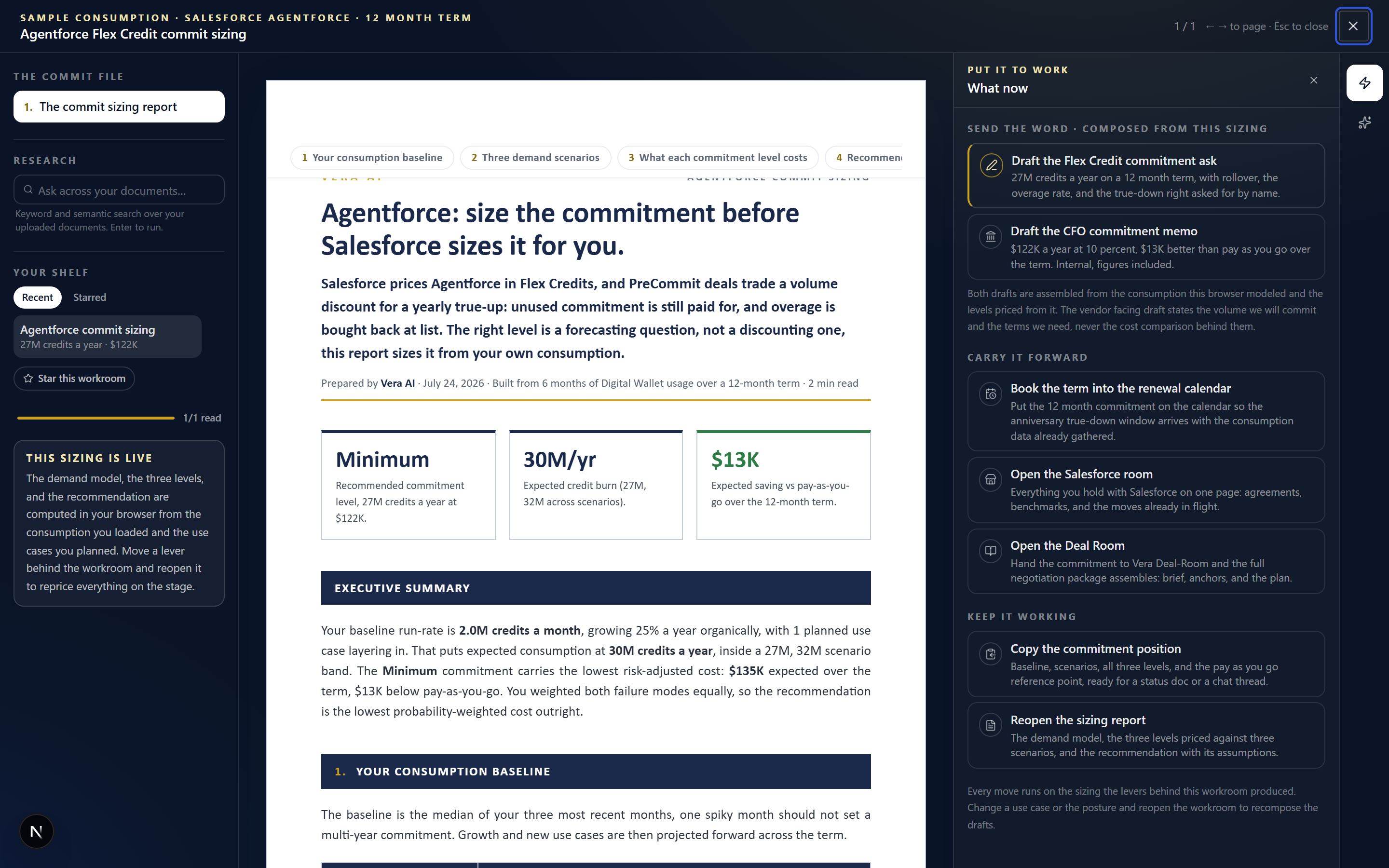
How to use it
- Drop in your POC or production Digital Wallet export, or type your monthly credit burn; the sample stays on until you do.
- Work down the steps: term, growth, and planned use cases, then the risk posture and the negotiation levers. The verdict, the three levels, and the charts update as you type.
- When Salesforce quotes you a number, paste it into Check Salesforce's quote to see how it prices against your own forecast.
- Press Open the workroom and draft the commitment ask and the CFO memo with the sizing report on screen.
- File the result with Save analysis, or generate the AI report for the full white paper.
Related: Salesforce SELA
VCF licensing
*In plain words: your real billable VCF core count under Broadcom's rules, and the renewal scenarios priced.*
When to reach for this
- The VMware renewal is coming and the 16-core minimum makes intuition wrong.
- You need the number before the meeting: counts are instant, in your browser, from the RVTools export you already have.
Upload your RVTools export to see exactly how many VCF cores Broadcom will bill you for under the 16-core minimum, build three pricing scenarios against real-world discount bands, and walk into the renewal with a verdict: the market curve, your leverage scored, the signing window dated, and an AI negotiation playbook.
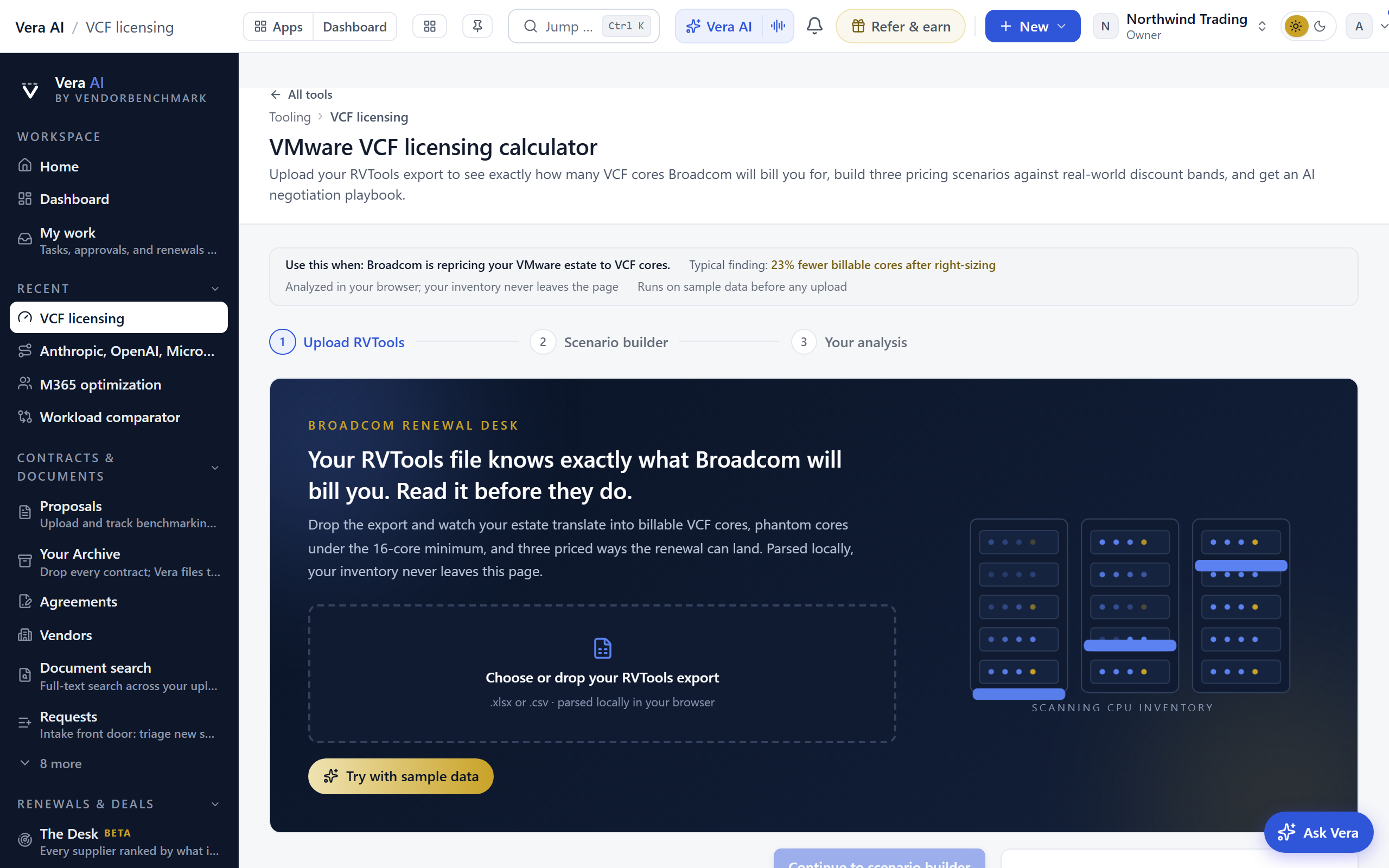
On the screen
- Upload stage: drop the RVTools export on the dark stage; it is analyzed in your browser so your inventory never leaves the page. Try with sample data loads a full 48-host estate with spend and deadline so every screen renders before you upload anything.
- Your draft is kept: the step you reached, the questionnaire answers and the lever positions are saved as you go, so leaving at step two never sends you back to step one. Reopening lands on the draft as you left it; the last five drafts wait under File, Continue where you were, and Start over (in the tool or under File) sets the current draft aside rather than deleting it.
- Estate scan: the parse narrated line by line: hosts found, sockets counted, the 16-core minimum applied, and the phantom cores it adds (cores billed that your hardware does not have) before the billable total counts up.
- Savings odometer: the money on the table at your target scenario, reacting live to every change in the builder.
- Three scenarios: conservative, target, and best case, each with a committed-core count, term, and a discount slider showing the benchmarked typical range; a verdict chip says whether your discount sits below, inside, or above that band.
- Leverage scorecard: six negotiation levers (exit alternative, benchmark anchor, full-estate commit, multi-year term, quarter-end timing, executive sponsor) checked off into a strength score, with one click to apply the earned lift to your best case.
- When to sign: Broadcom's fiscal quarter closes plotted with your deadline as a T-minus chip and a dated four-phase plan ending at the right quarter close.
- Market curve and tier ladder: realized discounts by committed cores with your estate marked, all five volume tiers listed, and a flag when you are close enough to price the deal one band deeper.
- Cost heatmap: annual cost at every term and discount step, the typical band outlined, your scenarios plotted.
- Verdict band: the analysis opens on the four numbers that matter (billable cores, list exposure, target, savings) over a deal journey from list price down to best case.
- Estate evidence: a five-year cumulative cost chart, the 16-core minimum drawn host by host with phantom cores as dashed cells, a cluster strip, and a sortable host explorer with the worst phantom offenders first.
- Consolidation lab: toggle keep, consolidate, or retire per cluster and watch the core count, band, and annual cost reprice.
- The walk-away, priced: your target rate against directional per-core costs of Nutanix, OpenShift, Azure Local, and Proxmox, plus the vSAN entitlement and the VVF crossover if you run compute only. The card links the third-party support playbook for pricing that exit in full.
- What next: the result ends with a What next module seeded from the run's own numbers.
- Verdict card and exec summary: export a navy verdict card as a PNG or copy a one-paragraph exec summary for email.
- Playbook: the AI negotiation guidance for the reprice; only aggregate totals are sent, never host names.
- Save analysis: file the result into your Documents library as a durable document; host names are stripped before anything is stored.
- Open the workroom: a navy band above the verdict opens the licensing analysis as a case file on a dark stage. The ✦ dock is Ask Vera grounded on your parsed estate: the hosts, the clusters, the billable cores, the phantom cores, the volume band, and the three priced landing zones. The rail searches your uploaded documents and keeps your shelf.
- The moves in the dock: draft the true-down ask to Broadcom (your own core count, the phantom cores priced, and relief on the hosts under the minimum, a true-down right at each anniversary, the vSAN entitlement in writing, and price protection for the term asked for by name), draft the CFO memo, book the renewal into your calendar, export the host worksheet, copy the three landing zones, and open the Deal Room or the Broadcom room.
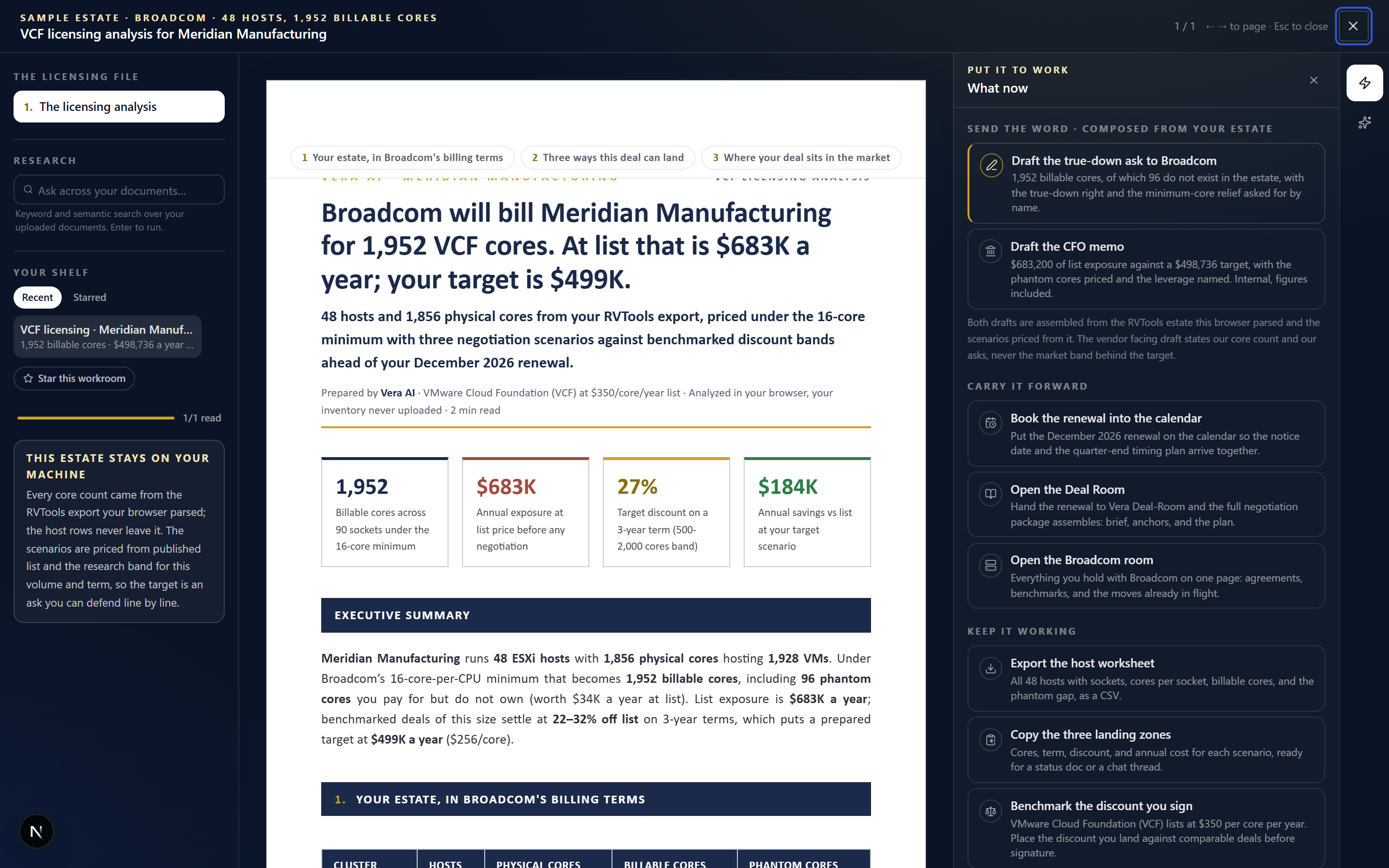
How to use it
- Upload the RVTools export (or load the sample) and watch the estate scan land on your billable core count.
- Fill in the renewal facts, check off the leverage you actually have, and tune the three scenarios against the shaded benchmark bands.
- Generate the analysis, test consolidation moves and the walk-away, then take the verdict card, the exec summary, and the playbook into the negotiation.
- Press Open the workroom and draft the true-down ask with the analysis on screen, or put a question to Vera about the estate from the ✦ dock.
Related: Playbooks
Oracle ERP Cloud pricing calculator
Build the Oracle Fusion ERP order the way Oracle quotes it: pick the cloud services on your proposal, enter the quantities, and apply a discount deal wide or line by line. The calculator prices the subscription, shows what the term costs once the annual uplift compounds, and places the net annual fee on the Fusion discount ladder so you can see whether the discount is good for a deal your size.
The catalog carries Oracle's own published figures for every component: the list price, the metric it is sold on, the stated minimum quantity, and the Oracle part number, read from the Oracle Fusion Cloud Service Global Price List. A weekly job re-reads that list from Oracle and updates the prices here when Oracle republishes it, so the date printed under the catalog is the list you are actually pricing against. List is a ceiling anchor, not a price anyone pays, which is what the discount and the ladder are for. Every price stays editable, so where your own proposal differs your figure wins. No order leaves your browser unless you choose to send it.
On the screen
- Pick the cloud services: the Fusion ERP catalog grouped by family (enterprise resource planning, tax, procurement, enterprise performance management, supply chain, warehouse and logistics, subscription management, analytics and AI, environments and options). Each tile shows Oracle's published list price, the metric it is sold on, and the stated minimum. Click a tile to put it on the order at its minimum quantity.
- Your order: one row per component with the Oracle part number, the metric, the quantity, the list price per unit, an optional per line discount that overrides the deal discount, and the resulting annual net. A quantity below Oracle's published minimum is flagged on the line, because Oracle writes the order at the minimum. Lines with no quantity yet are excluded from every total.
- Apply the discount and the term: the deal wide discount off list, the subscription term in years, and the annual uplift. Oracle's standard opening position is 8 percent uncapped, so the uplift starts there.
- The four tiles: annual list, net fees to Oracle per year, the term total with the share of it that is uplift, and the ladder tier with its median and 90th percentile.
- Market position: the full Fusion discount ladder with your tier highlighted and your blended discount marked on it, plus a plain reading of where you stand. Tiers band on net fees payable to Oracle per year, the annual subscription value after discount, not on the list value of the components.
- The priced report: the executive brief version of the order, the line table, the ladder, the year by year term cost, and the four moves to make first. It prints and forwards as one document.
- Send the report: email the priced order to up to ten colleagues with an optional note. The email carries the figures on the page.
- Invite others to this calculator: email colleagues a link to the calculator itself. The invitation carries no figures from your order and grants no access to your workspace.
How to use it
- Open the calculator and press Try with a sample order to see every panel, or start picking components straight away.
- Add each cloud service on the Oracle proposal, then set the quantity. The list price fills itself from Oracle's published list; overwrite it where your proposal quotes a different figure.
- Set the discount, the term, and the uplift. Give any line its own discount where Oracle discounted it differently, which is common on non-production environments.
- Read the market position: your tier, the median and 90th percentile for it, and the gap in dollars a year.
- Send the report to the people who need it, or invite them to price their own view.
Related: Oracle HCM Cloud pricing calculator · Oracle ULA
Oracle HCM Cloud pricing calculator
The same instrument for the HCM side of Fusion, on the same published price list. Pick the cloud services on your proposal, enter the quantities, apply a discount deal wide or line by line, and the calculator prices the subscription and places the net annual fee on the Fusion discount ladder. ERP Cloud and HCM Cloud ride the same discount curve, so a combined subscription negotiated as one deal reaches tiers that neither pillar reaches alone.
On the screen
- Pick the cloud services: the Fusion HCM catalog grouped by family (core HR, talent, workforce management, payroll and compensation, analytics and AI, environments and options), every line carrying Oracle's published list price, metric, minimum, and part number. The nine country payroll services are listed separately, as Oracle prices them.
- Your order: one row per component with the part number, the metric, the quantity in that metric, the list price per unit, an optional per line discount, and the resulting annual net.
- Apply the discount and the term: the deal wide discount off list, the subscription term, and the annual uplift.
- The four tiles: annual list, net fees to Oracle per year, the term total, and the ladder tier.
- Market position: the Fusion discount ladder with your tier highlighted and your blended discount marked on it.
- The priced report, Send the report, and Invite others to this calculator work exactly as they do on the ERP calculator.
How to use it
- Open the calculator and press Try with a sample order, or start picking components.
- Add each HCM cloud service on the proposal and set the quantity in that line's metric, usually employees. The published list price fills itself; overwrite it where your proposal differs.
- Set the discount, the term, and the uplift, then read your tier and the distance to its 90th percentile.
- Send the report, or invite colleagues to the calculator.
Related: Oracle ERP Cloud pricing calculator · Oracle ULA
Claude optimizer
Upload your Claude Console usage export or size each workload from prompt counts, add the seat side of the contract, run the commit-readiness check, and size the committed-spend deal, minimum, medium, or maximum, before you sign. Everything is analyzed in your browser; the export never leaves the page.
On the screen
- The spend scan: when an export (or the sample) lands, a full-screen reveal scans your bill: one dot per slice of monthly spend colors in under the beam (brick means a premium tier doing commodity work, gold means a cacheable prompt prefix, blue means batchable traffic, green means right-priced) while a ticker calls out findings from your file. It closes on an executive readout: the verdict, a strip placing your optimization headroom against the Claude estates we size, the money bridge from today's run-rate to the optimized mix, and the commit podium with the level worth signing stamped. Press Escape or Skip to jump ahead; Replay the reveal brings it back.
- Live verdict band: the four numbers that matter (run-rate today, optimized mix, the commit to sign, the saving vs pay-as-you-go) with a verdict pill, plus two what-if switches that flip prompt caching or the Batch API off so every number on the page snaps back to the unoptimized bill.
- Usage or prompt profiles: upload the Console export, or size workloads from prompt counts.
- Model right-sizing: each workload on the cheapest model that clears its quality bar, with a lever strip attributing the saving to re-tiering, prompt caching, and the Batch API, a Sonnet 5 introductory-pricing note while the promotion runs, and a spend-flow map tracing where the traffic should move.
- The commit dial: drag across commitment sizes and watch expected cost, unused risk, and overage recompute on a cost curve with the sweet spot marked; a growth slider in step 4 re-flexes the whole forecast the same way.
- Take these to the table: the negotiation angles your numbers support (band anchoring, rollover, overage at the committed rate, a ramp), ranked by what each is worth.
- When the savings land: the realization curve: caching first, re-tiering next, batch after, and what year one captures.
- What one unit costs: per-workload cards pricing one request, message, or run today versus on the optimized mix.
- Seats: add Team or Enterprise seats to the model.
- Commit-readiness check: whether your run rate is stable enough to commit, scored on a ring gauge with the open steps listed.
- Share, hand off, export: Share readout mints a 30-day read-only link for a CFO (aggregates only, the export never leaves your browser), Send to EA playbook opens the Anthropic EA playbook from your sized commit, Board slide downloads a one-page PPTX readout, and Save analysis files the result into your Documents library.
How to use it
- Upload the usage export (or load the sample) and watch the spend scan land on your verdict.
- Classify each workload in step 2 so the right-sizing and the levers price correctly.
- Add the seat side, scrub the growth and commit dials until the numbers hold, and run the readiness check.
- Forward the readout link or the board slide, then take the sized commitment into the agreement, or send it straight into the Anthropic EA playbook.
Related: Anthropic EA playbook · OpenAI optimizer
OpenAI optimizer
Upload your OpenAI usage export or size each workload from prompt counts, add the ChatGPT seat side of the contract, run the commit-readiness check, and size the committed-spend deal, minimum, medium, or maximum, before you sign.
On the screen
- Usage or prompt profiles: upload the usage export, or size workloads from prompt counts.
- Seats: add ChatGPT Team or Enterprise seats.
- Commit-readiness check: whether your run rate is ready to commit.
- Deal sizes: the committed-spend deal at minimum, medium, and maximum.
- Save analysis: file the sized result into your Documents library as a durable document you can reopen any time.
How to use it
- Upload the usage export or build workloads from prompt profiles.
- Add the seat side and run the readiness check.
- Take the sized commitment into the deal.
Related: Claude optimizer
Copilot Cowork optimizer
Copilot Cowork, Microsoft's agent layer inside Microsoft 365 Copilot, bills metered Copilot Credits on top of every Copilot seat: the first Microsoft 365 line that behaves like cloud consumption instead of a seat. This tool models what it will actually cost before you enable it or prepay for it. Facts current as of July 2026; the live tier sheet in Azure reservations governs at purchase.
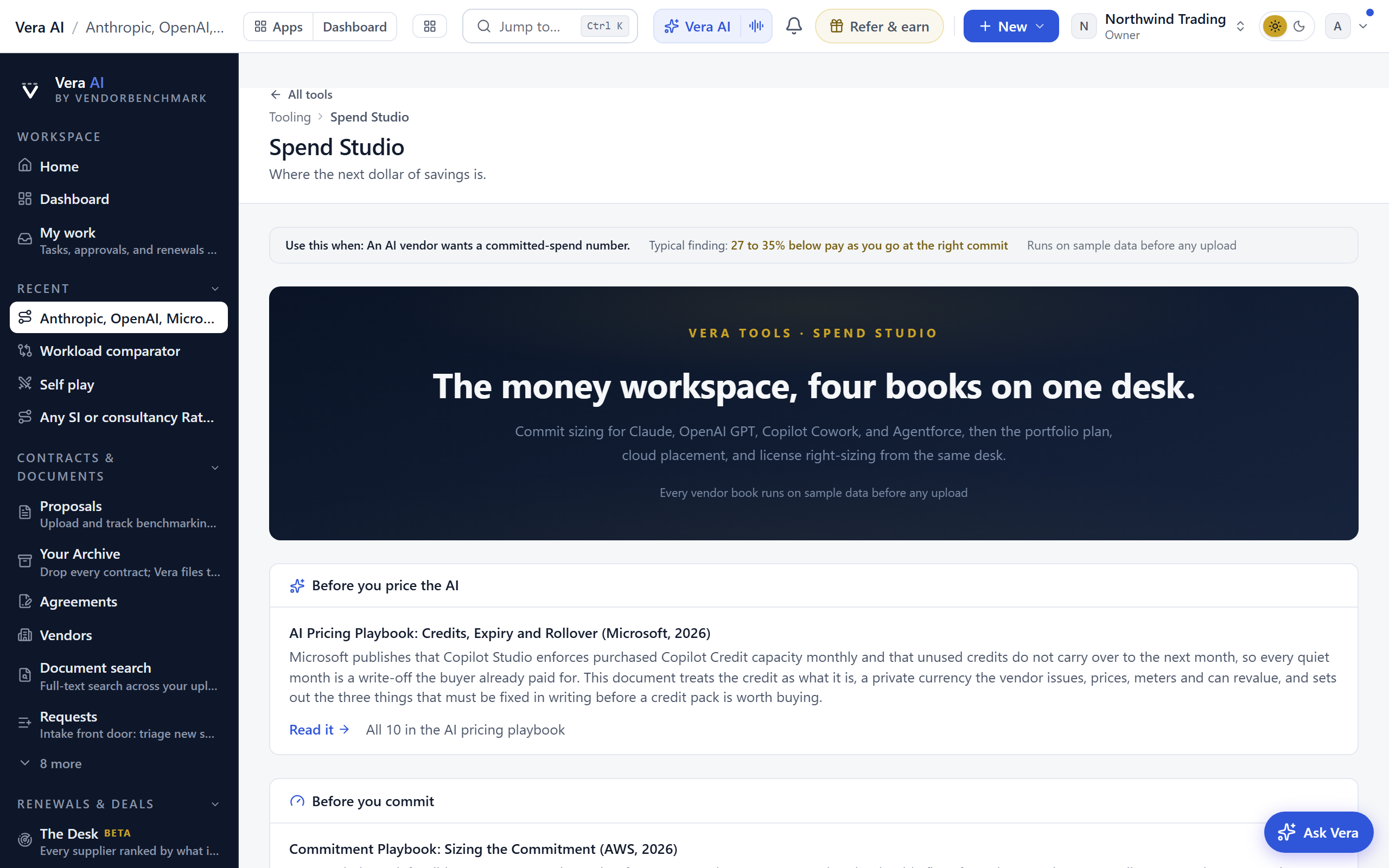
On the screen
- Your Cowork plan: enabled users, how many already hold Copilot seats, weekly active share, tasks per active user, adoption growth, and the task mix (light, medium, heavy, each with editable credits per task). Everything recalculates as you type.
- The forecast KPIs: month-one and year-one credits, the pay-as-you-go year cost at $0.01 per credit, and the all-in figure including any new Copilot seats the rollout forces.
- The twelve-month burn: monthly credit consumption with your adoption growth compounding each quarter.
- Commit options: Floor, Balanced, and Ceiling P3 pre-purchase sizes against the forecast, each with its tier discount, upfront cost, expected pay-as-you-go overflow, and the expiry risk if usage lands under forecast. Prepaid units expire at term end and purchases are final, which is why the tool sizes commits to measured burn, never ambition.
- Commit readiness, five checks: a measured pilot, spending caps configured, a named budget owner, named workloads, and the EA's Reserved Instances policy enabled. The score decides which commit option the tool recommends, including recommending none.
- The seat prerequisite and the E7 question: the incremental Copilot seats a rollout forces, and the E7 math ($99 bundles E5, Copilot, Entra Suite, and Agent 365, about $18 under the parts, with no Cowork credits included).
- The asks: rate protection, rollover or credit-back, auto-renew off, an adoption-gated second purchase, and the effective discount stated against your existing discounts.
How to use it
- Enter the pilot you actually intend to run, not the org chart, and tune the task mix.
- Read the forecast and the commit options; answer the five readiness checks honestly.
- Follow the recommendation: pay as you go until the checks pass, then commit at the floor.
- Generate the AI report and take the asks into the agreement conversation.
Tips
- Type
/costinside Cowork during the pilot to see real per-task credit costs, then replace the band defaults with your measured numbers. - The Microsoft EA playbook's Copilot Decision screen carries a compact version of this model, so the renewal case and the Cowork sizing reconcile.
Related: Microsoft EA playbook · M365 optimization
Vendor playbooks
*In plain words: a full renewal engagement for one vendor, run yourself over days, ending in an executive report.*
When to reach for this
- The big-vendor renewal (Microsoft EA, SAP RISE, Oracle ULA, and their peers) where the engagement deserves weeks, not an afternoon.
- You would have hired help for this deal: the playbook is the methodology, self-run.
- Learning a vendor's game before playing it: each playbook teaches while it works.
Full renewal and migration engagements, run yourself. The playbooks live as cards in the tool wall's Renewal playbooks group; the old separate Playbooks page redirects there. Each playbook is a guided Prepare, Analyze, Execute, Deliver journey for one vendor, with live recalculation as you change inputs, work-back timelines, a negotiation desk, and an executive report at the end. Everything runs in your browser and progress saves as you go; every playbook works fully on its sample estate, and your own data runs on every plan. Every playbook ends on a What Next desk rather than the report.
Moving through a playbook. All ten navigate the same way: a phase menu down the left hand side, the phases in order with each one's completion percentage, every screen listed under its phase so you can see the whole journey and jump anywhere in one click, and the screen you are on as a filled blue pill. Back and Next step buttons ride at the foot of the page as you scroll, so the walk works either way. On a narrow window the menu becomes the compact stepper across the top.
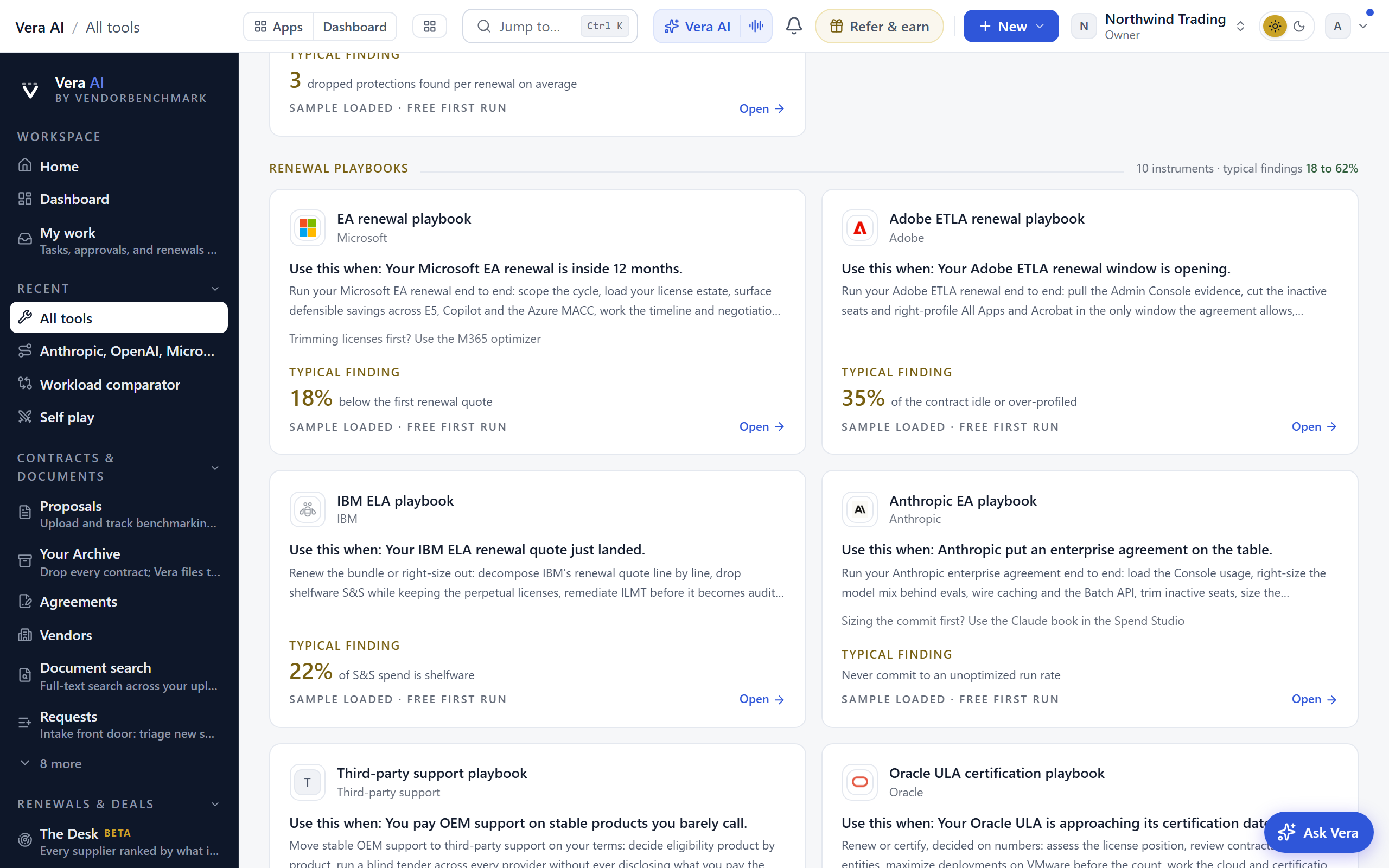
On the screen
- Playbook cards: one card per vendor engagement, ten in all.
- The stages: inside each, the Prepare, Analyze, Execute, Deliver path with its live models.
- The report reads the vendor's own pages while it writes: the analyst behind the executive report searches the web as it works, for the half of the argument that goes stale. The vendor's current published price list and packaging, its stated uplift, renewal and repricing policies, its licensing and metric definitions, its audit practice and its fiscal calendar, plus anything it has announced since your paper was signed. Those sentences name their source and carry its date, so you can check them. Your own figures are never searched for: they come from your records and the paper you handed the playbook, and where a page on the web disagrees with your contract, your contract wins. The report takes about four minutes for this reason, rather than the two it took when it wrote from memory alone.
- Executive report: the CFO business case and the exec report the journey produces. The report screen closes with a Take this forward row: start a negotiation, open the vendor room, or attach the report to a contract, with a copyable target line for the deal.
- Your own records at the end: on the Microsoft EA, RISE with SAP, Oracle ULA certification, and IBM ELA playbooks, the closing desk reads your workspace rather than offering generic links. If a case or negotiation is already live on that publisher, it says so and links it instead of offering to start a duplicate. If a matching agreement is on file, Open the {vendor} renewal record goes to your own renewal, with the notice clock and the paper of this cycle.
- File this target on the renewal: on those same four playbooks, one button writes the target the playbook just computed, and the savings behind it, into that vendor's discussion, dated and attributed to you, so the number survives the browser tab. The note lands on the shared vendor discussion, so it shows on the renewal record and the vendor page alike. It appears only where a real agreement in your workspace matches the publisher, and never on the sample walkthrough; there is no confirmation step and no undo, so read the figure before you press it.
Because every playbook shares that shape, each entry below gives its route, what the engagement is for, the key moves it walks you through, and when to reach for it.
Microsoft EA
Watch: Microsoft EA renewal playbook (5:35)
/tooling/ms-ea-renewal · Run a Microsoft Enterprise Agreement renewal from scoping to the CFO business case, solo in your browser or as a team project the whole deal team works on together, with a built-in consultant that adapts every screen to your answers.
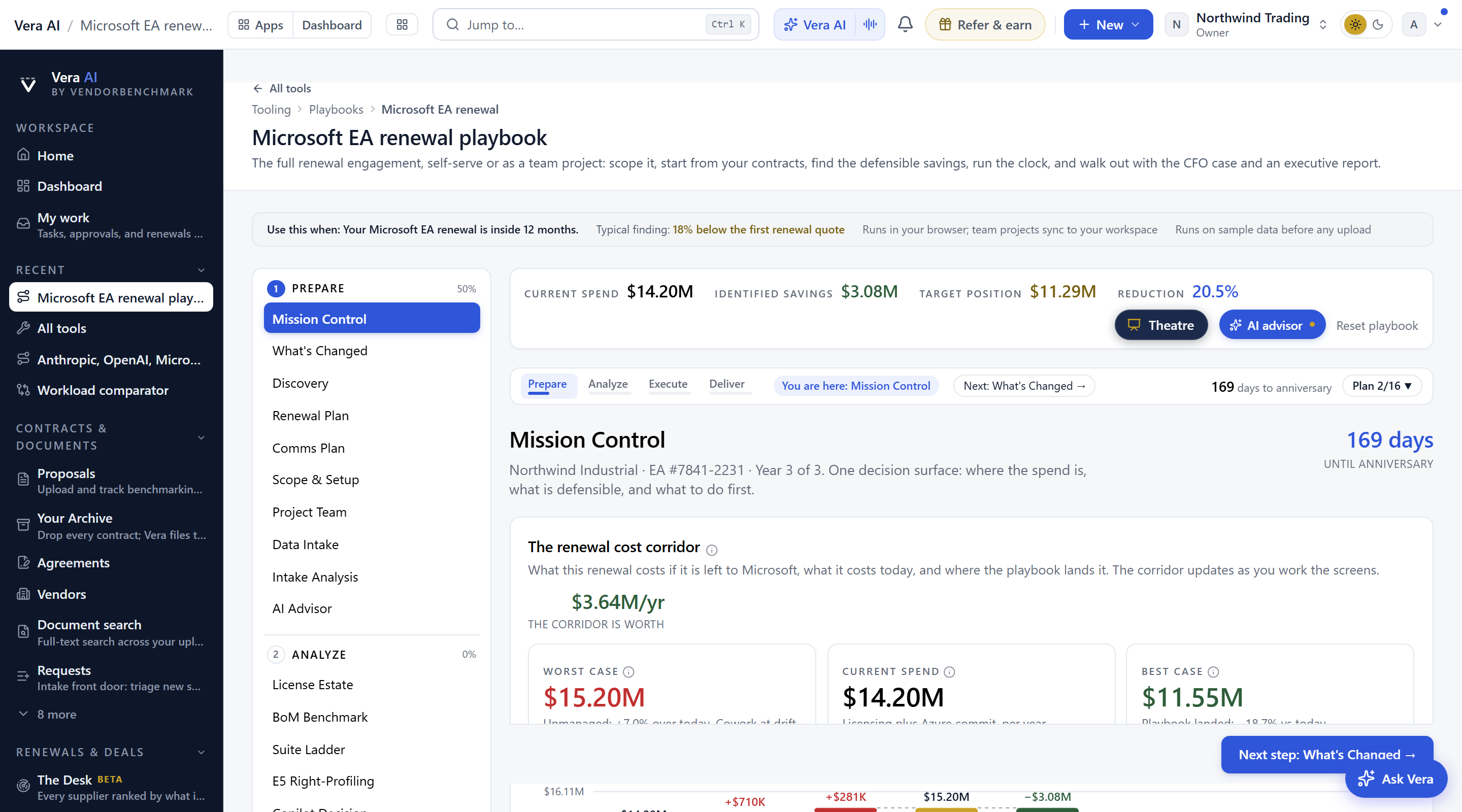
The Microsoft playbook runs like a real engagement, and now it opens like one too. The first open is a guided kickoff in three steps: the Discovery interview first, then Opus 5 drafts your project plan from your answers and your numbers, then a confirm step where you check the four fields every date derives from (client, agreement, anniversary, where in the term you are), adjust anything, regenerate if the anniversary moved, and step onto Mission Control. You can skip the kickoff with one click and run it later from the Discovery screen; either way the playbook remembers and opens on Mission Control from then on. Team projects, shared view links, and screen deep links never see the kickoff.
The interview itself works the same wherever you run it (goals, the Microsoft relationship, constraints, Copilot intent, Azure posture), and you choose how: answer the structured questions yourself, or talk it through with Vera, by voice (tap to talk) or typing, and she extracts your answers into the questionnaire live. Both modes fill the same answers, so you can start in one and finish in the other, and everything Vera captures stays reviewable in the form. Opt in and Vera saves a digest of the interview to her long-term memory (manageable on the Ask page), so she recalls your renewal anywhere in the app; the playbook state itself stays in your browser. As you answer, a live What I'm hearing panel plays the forming strategy back, then commits to a named posture such as Structured cost reduction or Leverage-building exit track. From that point every screen opens with Your consultant's read: what this page is for, what to look at first, and how your answers changed it, plus a leverage score out of 100 with the gaps to fix. The journey runs 32 focused screens across Prepare, Analyze, Execute, and Deliver, one idea per page, carried in a left hand menu grouped by phase: every screen always visible, each phase with its completion percentage, the active screen a filled blue pill (small windows keep the compact stepper instead). Everything explains itself on hover, from KPI tiles to table columns. The results ticker also carries a Theatre button: pick the light or the dark stage, or resume where the last show left off, and the whole playbook runs full screen, one screen at a time, everything still editable. The stage goes truly fullscreen, its chrome fades after a few seconds of stillness and returns on any movement, and arrow keys move between screens; crossing into a new phase raises a short title card with the act number and the running savings figure. Press G for a grid of all 32 screens and jump anywhere in one click, N for the presenter note (a one line analyst takeaway under each screen), and I for the ink pen: gold strokes drawn over the screen on a live call that fade on their own and clear when the screen changes. The live position numbers ride in the header and briefly show the delta each edit contributed, Ask Vera opens right over the stage, and the show lives in the page address, so a shared link drops a colleague onto the same screen of the same show. The leave-behind button prints exactly the screens you walked as a navy and gold packet. Escape steps back out one layer at a time to exactly where you were, and the stage choice is remembered. It opens with What's Changed, the research brief on everything that moved since your last signature (the July 2026 price increase, Cowork and metered credits, E7, the MCA-E push). The Analyze phase adds the Suite Ladder (E1 to E7 with six step-down questions), Substitutions (the components you may be paying twice for, with the cheaper Microsoft shape and the third-party alternative per row), and the BoM Benchmark (your bill of materials priced line by line against the peer unit-price corridor); the Azure screen teaches how to structure the commitment across reservations, savings plans, and the MACC. At the table, Opus 5 prepares the negotiation strategy pack (internal talking points, scripted lines for Microsoft, the trade list, the watchouts) and the two-to-four page brief for your CFO and CIO. After discovery, your project plan is one click away and hard to miss: Mission Control carries a Your project plan card where you generate it (and read the headline, the steps in order, and the key dates without leaving the overview), and the Renewal Plan screen renders the full dashboard (key dates on your calendar, workstreams with owners, internal questions, risks, and the three-number position), rule-based instantly and personalized by Opus 5 on one click. The Intake Analysis screen then has Opus judge your loaded evidence before you brief the advisor, and the Commit Scenarios screen prices four ways to commit side by side with a live recommendation.
The renewal cost corridor. Mission Control opens with the three numbers that frame the renewal, drawn as a waterfall: the worst case if the agreement is left to Microsoft (current spend plus the expected list uplift, plus Cowork credits drifting at pay as you go when your discovery says agents are in play), the current annual spend, and the best case with every identified saving landed, the concessions target negotiated, and any Cowork spend committed at the discounted ladder instead of drifting. The corridor recomputes live from the same state as every other screen, so each seat count you correct and each lever you set moves it, and the headline shows what the corridor is worth per year, the distance between doing nothing and running the playbook.
The Cowork Cost Lab (Analyze phase, after the Copilot Decision) prices the agent layer before Microsoft prices it for you. Set the rollout (users, seat coverage, weekly actives, tasks per user, quarterly growth), the task mix on Microsoft's published planning bands (light 70 to 200 credits, medium 400 to 600, heavy 1,500 and up), and the model mix per LLM at Microsoft's published rate tiers: mini models at 0.1 credits per 1,000 tokens, general models (GPT-4.1, GPT-5 chat, Claude Sonnet 4.6) at 1.5, deep reasoning models (GPT-5 reasoning, Claude Opus 4.6) at 10. The lab shows the model-mix multiplier, the cost per weighted task, the year-one burn, and the prerequisite Copilot seats the rollout quietly adds, then prices floor, balanced, and ceiling commitments against the published nine-tier P3 discount ladder (5% at 300K credits to 20% at 300M), with the expiry risk of every prepaid option stated next to its discount and a recommendation gated on your readiness score. Every rate is pinned to the Microsoft price documents listed at the top of the screen, verified on a stated date and re-fetched daily by the Vendor Changes agent: if Microsoft changes the price list, the screen flags it and links the change analysis on the Vendor Changes page.
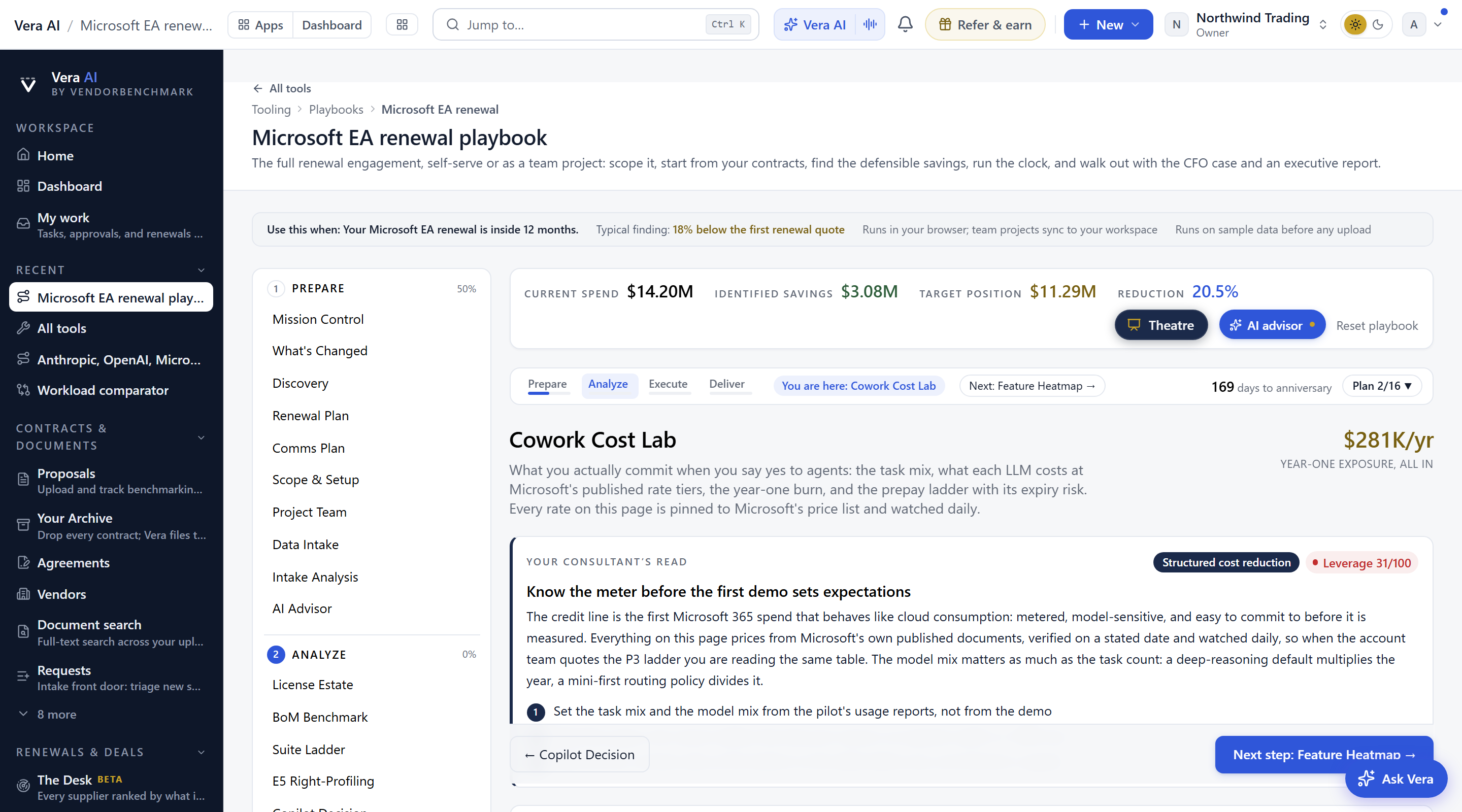
The Feature Heatmap (Analyze phase, after the Cowork Cost Lab) draws the whole suite argument in one picture once the ladder, the E5 profile, and the Copilot decision are worked: features down the side, the E1 to E7 rungs across the top, every included feature colored by how deeply your estate actually uses it. Levels derive from the same telemetry as the rest of the playbook (SKU utilization, the E5 segmentation, the Copilot adoption bands) and every row can be corrected by hand; corrections mark themselves and persist. The argument card composes the lines to say at the table, we only use this many of the features that separate E5 from E3, with the right-profiling dollars as the evidence value, and the send desk makes the grid travel: Vera drafts the feature-use email to Microsoft, the CFO brief, or a colleague note from the grid, and a monospaced text version copies straight into Teams or Slack.
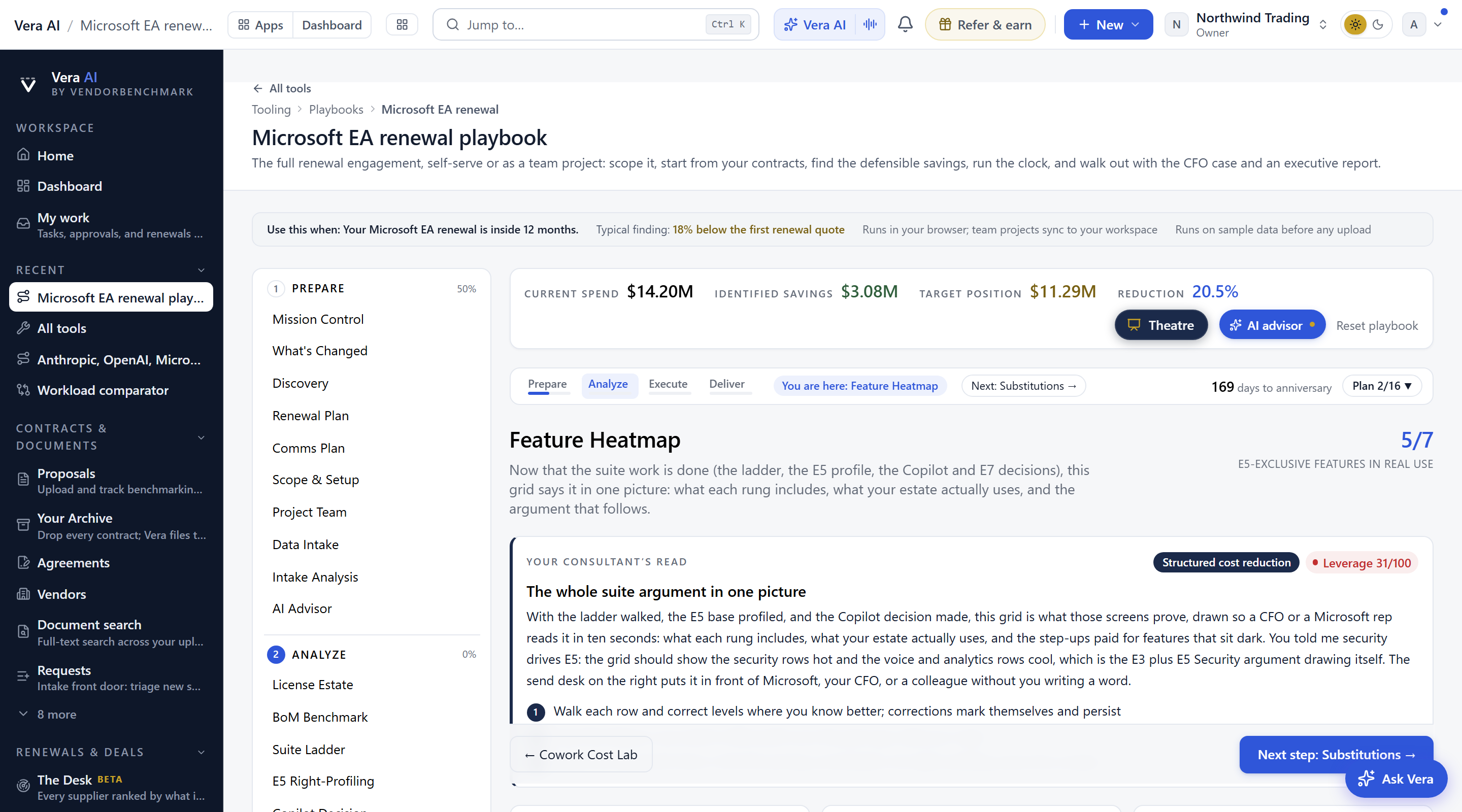
Running it as a team. The Project Team screen (Prepare phase) turns the playbook into a shared project saved to your workspace: everyone on the team works on one live state with autosave, and a project trackboard rides under the phase stepper on every page, the four stages with progress, a you-are-here marker, the next step, and the anniversary countdown, expanding into a full Gantt of the 16 work-back activities with a today line. Editors need a workspace account; viewers can be anyone, invited by email with a read-only link that opens the live project as a sandbox (they can test numbers, nothing they change is saved). Every screen carries a notes and corrections box, comments and corrections sync to the whole team, and the project log holds meeting notes and decisions as the renewal runs. Any page can be shared with a revocable view link from its notes box. The playbook's questionnaires, the discovery interview, the readiness check, and the three assessments, can be emailed to anyone, on the platform or not: the tokenized page opens pre-filled, and their answers merge back into the project under their name. When a phase completes, the project mails everyone an exec-brief formatted update (KPIs, phase table, what happens next, what is coming due); a weekly digest goes out Monday mornings, and every recipient chooses what they receive through a personal preferences link in each email footer, with the same toggles editable per person on the Project Team screen.
Starting from your contracts. The Data Intake screen opens with the contract starting point: pick agreements already uploaded to the portal or drag the enrollment pack in (PDF or DOCX), and Opus 5 reads the paper into the playbook, agreement facts, evidenced quantities, the terms that will matter with a favors-you, watch, or risk verdict on each, risks, and interview answers the paper supports with a citation for each. Apply what looks right with one click and start the interview from the contract instead of a blank form. Dropped documents are kept: each saves to your workspace as a contract and joins your benchmarking queue, and the saved records are listed under the analysis for one-click open or delete.
The comms plan. The Prepare phase includes a Comms Plan screen: what to tell Microsoft from the first call. Five message windows from T minus 9 months to signature, each with a goal, lines to deliver roughly verbatim, and what must not leave the room; the five standing principles (one voice, share process not position, everything on the record); six lines that cost money with their replacements; and a scripted first meeting agenda. The read at the top tailors itself to your discovery answers.
The assessments. The Azure Commit, Copilot Decision, and Cowork panels each carry a weighted assessment bank (ten, ten, and eight questions) that scores your readiness out of 100 and ranks the fixes by what they are worth at the table; every question explains on hover why a veteran asks it.
The Deliver phase runs five screens: the Outcome Dashboard (KPI wall, savings mix, the waterfall from spend to target, preparation and assessment verdicts, the Azure landing, and what remains open, each tile clicking through), the Business Case, the Executive Report, What Next, and Updates & Sharing, where you send a project update on demand and see exactly who receives what.
The What Next desk ends the journey the way the Benchmark Case does: an open desk that puts the computed position to work, every move running on the playbook's live numbers. Six emails Vera drafts for you to edit and send from your own inbox: the Microsoft meeting request, the asks letter, the feature-use case, the CFO brief, the procurement frame, and the internal team alignment note; the Microsoft-facing drafts carry your asks and your own usage facts, never your savings target, the corridor, or the strategy. Around them: the copy-ready position digest and the heatmap text block for chat, the management brief generated right on the desk, one-click routes to the Executive Report and the CFO Business Case, Ask Vera with the position preloaded, and exit ramps into a tracked negotiation, the Microsoft vendor room, benchmarking, and an analyst session.
Key moves
- Run the guided kickoff: the discovery interview sets the strategy with you, Opus 5 drafts the project plan from it, and you confirm the timeline before Mission Control opens. Or start from your contracts and let Opus pre-fill the interview.
- Read the renewal cost corridor first: worst case, current, best case, and what the gap is worth, then watch it close as you work.
- Create a team project so the deal team, and invited outsiders, work one live state instead of a screenshot chain.
- Load the license estate, then work E5 right-profiling, the Copilot decision, the Cowork Cost Lab (the task mix, the per-LLM model mix, and the P3 commit ladder with its expiry risk), hygiene and SA benefits, and the Azure MACC, each on its own page, and run their assessments until the fixes list is empty.
- Build the Feature Heatmap once the suite screens are worked, correct any level you know better, and send the feature-use case to Microsoft from the grid.
- Follow the Comms Plan: set the frame at T minus 9 months, land the anchors before the first quote, and never name a budget.
- Apply the recommended lever settings derived from your interview, then stress-test them in the scenario studio.
- Take the peer benchmarks, program split, and a table plan tailored to Microsoft's past behavior with you into the rounds.
- Finish on the Outcome Dashboard, the CFO business case, and an executive report framed to the win you defined, then work the What Next desk: brief your own side first, book the Microsoft session, and let the project send the closing update itself.
When to use it: your Microsoft EA renewal is inside 12 months.
RISE with SAP
/tooling/rise-with-sap · Run the move from ECC or on-premise S/4HANA to RISE from scoping to the CFO business case, solo in your browser or as a team project the whole deal team works on together, with a built-in consultant that adapts every screen to your answers.
Like the Microsoft playbook, RISE runs as an engagement: the discovery interview (answer the questions, or talk it through with Vera by voice) commits to a named posture, every screen opens with Your consultant's read and a leverage score, the levers arrive pre-set from your answers with one-click apply, and the Negotiation Desk adds questions and counterplays for the tactics you report. The strategy layer is current to July 2026, including the EU's binding SAP commitments (no reinstatement fees, capped back-maintenance, landscape segmentation), which reshape the 2027 deadline conversation. The same planning layer as the Microsoft playbook applies: a Conversion Plan dashboard after discovery (Opus 5 personalizes it on one click), an Intake Analysis verdict on your evidence, and Commit Scenarios pricing RISE now, the third-party support bridge, the on-premise conversion, and staying put side by side with five-year totals; the alternatives card links the third-party support playbook it names, so the bridge option is one press from its full runbook. The project plan also lives on Mission Control: generate or regenerate it right on the overview and read the headline, the steps, and the key dates without leaving the front page; the discovery interview now also asks your BTP intent, SAP's platform attach, so the credits in the proposal get priced against a real roadmap rather than accepted as padding. Mission Control also leads with a cost corridor: a single waterfall showing what the move costs on SAP's opening proposal left unmanaged (worst case), what you pay on the current platform today (current run rate), and where the playbook lands the subscription once the FUE count is rebuilt, the discount is anchored to the peer corridor, BTP is right-sized, and the conversion credit is applied (best case). It recomputes as you work the screens, and the swing between the two ends is the number the playbook exists to close.
It opens like an engagement too. The first open is a guided kickoff in three steps: the Discovery interview (answer the questions yourself or talk it through with Vera), then Opus 5 drafts the project plan from your answers and your numbers, then a confirm step on the fields every date derives from (client, current platform, target signature, and the maintenance cliff) before Mission Control opens. Skip it with one click and the playbook opens on Mission Control from then on; team projects, shared view links, and screen deep links never see the kickoff. The screens are carried in a left hand menu grouped by phase, each phase with its completion percentage and the active screen a filled blue pill (small windows keep the compact stepper), and the results ticker carries a Theatre button: pick the light or the dark stage and the whole playbook runs full screen, one screen at a time, arrow keys to move, everything still editable, Escape to step back out exactly where you were. The plan stays live on the Conversion Plan screen.
Running it as a team. The Project Team screen (Prepare phase) turns the playbook into a shared project saved to your workspace: everyone works on one live state with autosave, and a project trackboard rides under the phase stepper on every page, the four stages with progress, a you-are-here marker, the next step, and the countdown to your target signature, expanding into a full Gantt of the 16 work-back activities with a today line. Editors need a workspace account; viewers can be anyone, invited by email with a read-only link that opens the live project as a sandbox (they can test numbers, nothing they change is saved). Every screen carries a notes and corrections box, comments and corrections sync to the whole team, and the project log holds meeting notes and decisions as the conversion runs. Any page can be shared with a revocable view link from its notes box. The playbook's questionnaires, the discovery interview, the readiness check, and the three assessments, can be emailed to anyone, on the platform or not: the tokenized page opens pre-filled, and their answers merge back into the project under their name. When a phase completes, the project mails everyone an exec-brief formatted update (KPIs, phase table, what happens next, what is coming due); a weekly digest goes out Monday mornings, and every recipient chooses what they receive through a personal preferences link in each email footer, with the same toggles editable per person on the Project Team screen.
Starting from your contracts. The Data Intake screen opens with the contract starting point: pick agreements already uploaded to the portal or drag the license orders, the maintenance base letter, or the RISE proposal in (PDF or DOCX), and Opus 5 reads the paper into the playbook, agreement facts, the user counts the paper evidences applied as SAP's proposed classification per band, the terms that will matter with a favors-you, watch, or risk verdict on each, risks, and interview answers the paper supports with a citation for each. Apply what looks right with one click and start the interview from the contract instead of a blank form; your evidence counts stay yours to set on the Users & FUE screen. Dropped documents are kept: each saves to your workspace as a contract and joins your benchmarking queue, and the saved records are listed under the analysis for one-click open or delete.
The comms plan. The Prepare phase includes a Comms Plan screen: what to tell SAP from the first call. Five message windows counted back from your target signature, each with a goal, lines to deliver roughly verbatim, and what must not leave the room; the standing principles, including the SAP-specific one, keeping the audit and measurement track strictly separate from the commercial track; six lines that cost money with their replacements (never concede the 2027 deadline as binding); and a scripted first meeting agenda. The read at the top tailors itself to your discovery answers on cliff pressure, classification evidence, and alternatives.
The assessments. The Users & FUE, RISE Offer, and Negotiation Desk screens each carry a weighted assessment bank (FUE classification, BTP commitment, and contract terms; ten, eight, and eight questions) that scores your readiness out of 100 and ranks the fixes by what they are worth at the table; every question explains on hover why a veteran asks it.
The FUE Heatmap. The Analyze phase ends with a heatmap that makes the classification argument in one picture. RISE has no suite ladder to grade the way a Microsoft agreement does; its one great price lever is how users are classified, so the grid puts the four FUE bands SAP prices against (Advanced, Core, Self-service, Developer) across the top and your user populations down the side, and colors each population by how intensely it actually works in SAP. It shows what a blanket Advanced count hides: the approvers, requisitioners, and self-service users who belong a band, or two, below where SAP proposes, with the annual value of the reclassification printed above the grid and the argument to make at the table composed live beneath it. Correct any level by hand where you know better than the derived read, and the argument, the copyable text grid, and the emails all recompose around your number.
The What Next desk. The Deliver phase carries an open desk that puts the whole position to work. Vera drafts six emails from your live numbers: the meeting request, your asks, and the FUE-activity case to SAP, plus briefs for your CFO, procurement, and your own team. The SAP-facing drafts carry only your own asks and your own usage facts, which are the argument, and never your savings target or the corridor; the internal drafts carry the full position. You edit each one and send it from your own inbox, nothing sends from the platform. Alongside the emails sit copy-ready digests (the position in five lines, or the FUE heatmap as a text grid), the management brief written on one click, and the exit ramps into a tracked negotiation, the SAP vendor room, a market comparison, and an analyst pressure test.
The Deliver phase runs five screens: the Outcome Dashboard (KPI wall, the savings mix across FUE right-classification, discount, BTP right-size, and the conversion credit, the waterfall from SAP's proposal to your target, preparation and assessment verdicts, the five-year TCO read with the payback year, and what remains open, each tile clicking through), the Business Case, the Executive Report, the What Next desk, and Updates & Sharing, where you send a project update on demand and see exactly who receives what.
Key moves
- Answer the discovery interview and let the playbook set the strategy with you, or start from your contracts and let Opus pre-fill it.
- Create a team project so the deal team, and invited outsiders, work one live state instead of a screenshot chain.
- Rebuild the FUE count from usage evidence, baseline your current run rate, and run the three assessments until the fixes list is empty.
- Follow the Comms Plan: set the frame at T minus 9 months, keep the audit track separate, and never treat the 2027 cliff as binding.
- Decompose SAP's offer, price the alternatives against it, and work the migration timeline and the commercial asks.
- Read the cost corridor on Mission Control, then open the FUE Heatmap to build the classification argument and send the FUE-activity case to SAP from the What Next desk.
- Finish on the Outcome Dashboard, the five-year TCO business case, and an executive report, and let the project send the closing update itself.
When to use it: SAP is pushing you from ECC or on-premise toward RISE.
Oracle ULA
/tooling/oracle-ula-certification · Decide renew versus certify on the numbers, then exit clean, solo in your browser or as a team project the whole certification team works on together.
The Oracle playbook runs the ULA endgame like a real engagement: the discovery interview commits the strategy, the License Assessment holds the deployment inventory and every data source, the Renew vs Certify screen decides the path on five-year numbers, and the Maximize and Certification Desk screens execute it. Everything the other deep playbooks have applies here too, with certification semantics throughout.
It opens like an engagement too. The first open is a guided kickoff in three steps: the Discovery interview (answer the questions yourself or talk it through with Vera), then Opus 5 drafts the project plan from your answers and your numbers, then a confirm step on the fields every date derives from (client, agreement, the ULA end date, and the notice window) before Mission Control opens. Skip it with one click and the playbook opens on Mission Control from then on; team projects, shared view links, and screen deep links never see the kickoff. The screens are carried in a left hand menu grouped by phase, each phase with its completion percentage and the active screen a filled blue pill (small windows keep the compact stepper), and the results ticker carries a Theatre button: pick the light or the dark stage and the whole playbook runs full screen, one screen at a time, arrow keys to move, everything still editable, Escape to step back out exactly where you were. The plan stays live on the Timeline & Activities screen.
Running it as a team. The Project Team screen (Prepare phase) turns the playbook into a shared project saved to your workspace: everyone works on one live state with autosave, and a project trackboard rides under the phase stepper on every page, the four stages with progress, a you-are-here marker, the next step, and the countdown to the ULA end date, expanding into a full Gantt of the 16 work-back activities that runs one month past the end date to carry the post-cert VMware exit. Editors need a workspace account; viewers can be anyone, invited by email with a read-only link that opens the live project as a sandbox. Every screen carries a notes and corrections box that syncs to the team, the project log holds meeting notes and decisions, and any page can be shared with a revocable view link. The questionnaires, the discovery interview, the readiness check, and the three assessments, can be emailed to anyone: the tokenized page opens pre-filled and their answers merge back under their name. Phase completions mail an exec-brief update; a weekly digest goes out Monday mornings; every recipient controls what they receive.
Starting from your contracts. The License Assessment screen opens with the contract starting point: pick agreements already uploaded to the portal or drag the ULA ordering document, master agreement, amendments, and support renewals in (PDF or DOCX), and Opus 5 reads the paper into the playbook, agreement facts, the terms that will matter with a favors-you, watch, or risk verdict on each, risks, and interview answers the paper supports with a citation for each. Processor counts the paper evidences apply with one click; the deployment inventory ultimately owns those numbers. Dropped documents are kept: each saves to your workspace as a contract and joins your benchmarking queue, and the saved records are listed under the analysis for one-click open or delete.
The comms plan. The Prepare phase includes a Comms Plan screen built around the ULA-specific discipline: your renew-or-certify intent is the single most valuable fact you hold, and it is spent last. Five message windows counted back from the ULA end date, from the quiet evaluation frame through absorbing the renewal push, deciding inside while holding outside, the notice and GDR window, and the close; six lines that cost money with their replacements (never volunteer deployment talk, never invite Oracle's measurement scripts, never share the VMware topology); and a scripted first meeting agenda. The read at the top tailors itself to your VMware position, audit history, and GDR readiness.
The assessments. The License Assessment, Maximize, and Certification Desk screens each carry a weighted assessment bank (certification evidence, VMware maximization, and certification desk discipline; ten, eight, and eight questions) that scores your readiness out of 100 and ranks the fixes by what they are worth; every question explains on hover why a veteran asks it.
The Deliver phase runs five screens: the Outcome Dashboard (the certified quantity composition across physical, VMware maximized, and the cloud 365-day average, the waterfall from the renewal's five-year cost down to certifying, the buffer years, preparation and assessment verdicts, and the renew-signal verdict, each tile clicking through), the Business Case, the Executive Report, the What Next desk, and Updates & Sharing.
The discovery interview runs in either mode: answer the structured questions (VMware footprint, cloud evidence, audit history, and now your Oracle Java exposure, the cross-sell lever Oracle raises mid-negotiation), or talk it through with Vera by voice or typing and she fills the questionnaire live. After the interview, Mission Control carries Your project plan: one click and Opus 5 turns your answers and your numbers into the engagement plan, the steps in order, key dates against the certification clock, workstreams with owners, and the risks with mitigations, all on the overview.
A built-in consultant. Once the interview is answered, the playbook consults. Every working screen opens with Your consultant's read: a named posture drawn from your goal and situation, a leverage score out of 100 with the strengths and the gaps behind it, and a per-screen headline that tells you what the page is for and what to do first, tailored to your growth outlook, your VMware footprint, and how defensible your deployment evidence is. It is rule-based and instant, not an AI call, so it updates the moment you change an answer.
The planning screens. After Discovery, a Certification Plan screen turns your answers into the project plan a firm would charge for: the default path, key dates counted back from your ULA end date, workstreams with owners, the internal questions, and the three-number position, generated rule-based instantly and rebuilt by Opus 5 on one click. In the Execute phase, a Commit Scenarios screen prices the ways to commit side by side (maximize-certify-exit, certify as-is, or renew) with the five-year totals and a recommendation that updates live as your answers change.
The cost corridor. Mission Control leads with a corridor: what renewing the ULA costs over five years (the new license fee plus the support that compounds on it forever), what five years of support at today's rate costs as a neutral baseline, and where certifying and exiting lands it (support unchanged, no new fee, plus the one-time certification project), as one waterfall that recomputes as you work the screens. The swing between renewing and certifying is the number the playbook exists to capture.
The Certification Heatmap. The Analyze phase ends with a heatmap that makes the certified position visible product by product. For each option the ULA covers it shows what you have deployed today, the count you can defensibly certify to, the banking headroom in between, and the perpetual license value that headroom is worth. It flags the products carrying real headroom (certify each at its maximized count, since support is fixed and the headroom is then free forever) against the drop candidates with none (stop paying 22% support on them rather than folding them into a renewal). Java and cloud sit below the products as context rows, kept off the ULA paper. Correct any level by hand and the argument and the emails recompose.
The What Next desk. The Deliver phase carries an open desk that puts the whole position to work. Vera drafts six emails from your live numbers: the meeting request, your asks, and the certified-position case to Oracle, plus briefs for your CFO, procurement, and your own team. The Oracle-facing drafts carry only your own deployment facts, which are the argument, and never your savings target or the corridor; the internal drafts carry the full position. You edit each and send it from your own inbox, nothing sends from the platform. Alongside the emails sit copy-ready digests (the position in five lines, or the certification heatmap as a text grid), the management brief written on one click, and the exit ramps into a tracked negotiation, the Oracle vendor room, a market comparison, and an analyst pressure test.
Key moves
- Answer the discovery interview (form or with Vera), or start from your contracts and let Opus pre-fill it, then generate the project plan on Mission Control.
- Create a team project so SAM, DBAs, infrastructure, legal, and procurement work one live state.
- Assess the license position, review the contracts and entities in scope, and run the three assessments until the fixes list is empty.
- Follow the Comms Plan: hold the evaluation posture, keep the measurement track separate, and let the notice letter carry the decision.
- Maximize deployments on VMware before the certification count is taken, and work the cloud and certification rules.
- Read the cost corridor and the consultant's read on Mission Control, then open the Certification Heatmap to see what to certify at its maximized count and what to drop rather than renew.
- Finish on the Outcome Dashboard and the CFO case, send the certified-position case to Oracle from the What Next desk, and let the project send the closing update itself.
When to use it: your Oracle ULA is approaching its certification date.
IBM ELA
/tooling/ibm-ela · Decide whether to renew the bundle or right-size out of it, solo in your browser or as a team project the whole renewal team works on together.
The IBM playbook runs the ELA renewal like a real engagement: the discovery interview commits the strategy, the License Position holds entitled versus deployed versus S&S paid for every product with the data sources beside it, the Renew vs Right-size screen decomposes IBM's quote and decides the path on five-year numbers, and the Shelfware and ILMT screens execute it. Everything the other deep playbooks have applies here too, with renewal semantics throughout.
It opens like an engagement too. The first open is a guided kickoff in three steps: the Discovery interview (answer the questions yourself or talk it through with Vera), then Opus 5 drafts the project plan from your answers and your numbers, then a confirm step on the fields every date derives from (client, agreement, the ELA end date, and where in the term you are) before Mission Control opens. Skip it with one click and the playbook opens on Mission Control from then on; team projects, shared view links, and screen deep links never see the kickoff. The screens are carried in a left hand menu grouped by phase, each phase with its completion percentage and the active screen a filled blue pill (small windows keep the compact stepper), and the results ticker carries a Theatre button: pick the light or the dark stage and the whole playbook runs full screen, one screen at a time, arrow keys to move, everything still editable, Escape to step back out exactly where you were. The plan stays live on the Timeline & Activities screen.
Running it as a team. The Project Team screen (Prepare phase) turns the playbook into a shared project saved to your workspace: everyone works on one live state with autosave, and a project trackboard rides under the phase stepper on every page, the four stages with progress, a you-are-here marker, the next step, and the countdown to the ELA end date, expanding into a full Gantt of the 16 work-back activities. Editors need a workspace account; viewers can be anyone, invited by email with a read-only link that opens the live project as a sandbox. Every screen carries a notes and corrections box that syncs to the team, the project log holds meeting notes and decisions, and any page can be shared with a revocable view link. The questionnaires, the discovery interview, the readiness check, and the three assessments, can be emailed to anyone: the tokenized page opens pre-filled and their answers merge back under their name. Phase completions mail an exec-brief update; a weekly digest goes out Monday mornings; every recipient controls what they receive.
Starting from your contracts. The License Position screen opens with the contract starting point: pick agreements already uploaded to the portal or drag the ELA/ESSO schedule, the Passport Advantage agreement, amendments, and IBM's renewal quote in (PDF or DOCX), and Opus 5 reads the paper into the playbook, agreement facts, the terms that will matter with a favors-you, watch, or risk verdict on each, risks, and interview answers the paper supports with a citation for each. Entitlements the paper evidences apply with one click; deployment counts stay yours to set from your own discovery. Dropped documents are kept: each saves to your workspace as a contract and joins your benchmarking queue, and the saved records are listed under the analysis for one-click open or delete.
The comms plan. The Prepare phase includes a Comms Plan screen built around the two IBM disciplines: your compliance posture is discussed with nobody while ILMT is remediated, and nothing un-itemized gets discussed. Five message windows counted back from the ELA end date, which is also IBM's December 31 fiscal close, from the quiet frame through absorbing the Cloud Pak and watsonx pitch, landing the decomposed anchors, contesting into the year-end rounds, and closing on the Passport Advantage record; six lines that cost money with their replacements; and a scripted first meeting agenda. The read at the top tailors itself to your ILMT posture, shelfware stance, and Cloud Pak intent.
The assessments. The License Position, ILMT & Audit Exposure, and Negotiation Desk screens each carry a weighted assessment bank (license position, ILMT compliance, and renewal terms; ten, eight, and eight questions) that scores your readiness out of 100 and ranks the fixes by what they are worth; every question explains on hover why a veteran asks it.
The Deliver phase runs five screens: the Outcome Dashboard (the S&S base split across kept, shelfware, and bundled lines, the waterfall from IBM's ask down to the right-sized target, the audit exposure until remediated, preparation and assessment verdicts, and the renew-signal verdict, each tile clicking through), the Business Case, the Executive Report, the What Next desk, and Updates & Sharing.
The discovery interview runs in either mode: answer the structured questions (Cloud Pak and watsonx intent, ILMT coverage, the shelfware stance, and now your recent audit posture, because an audit letter near a renewal is leverage on IBM's side of the table), or talk it through with Vera by voice or typing and she fills the questionnaire live. After the interview, Mission Control carries Your project plan: one click and Opus 5 turns your answers and your numbers into the engagement plan, the steps in order, key dates against the year-end close, workstreams with owners, and the risks with mitigations, all on the overview.
A built-in consultant. Once the interview is answered, the playbook consults. Every working screen opens with Your consultant's read: a named posture drawn from your goal and situation, a leverage score out of 100 with the strengths and the gaps behind it, and a per-screen headline that tells you what the page is for and what to do first, tailored to your ILMT position, how much shelfware you are willing to cut, and whether you can decompose the Cloud Pak bundle. It is rule-based and instant, not an AI call, so it updates the moment you change an answer.
The planning screens. After Discovery, a Renewal Plan screen turns your answers into the project plan a firm would charge for: the default path, key dates counted back from your ELA end date, workstreams with owners, the internal questions, and the three-number position, generated rule-based instantly and rebuilt by Opus 5 on one click. In the Execute phase, a Commit Scenarios screen prices the ways to commit side by side (right-size and rebuy, renew the bundle, or settle-then-right-size) with the five-year totals and a recommendation that updates live as your answers change.
The cost corridor. Mission Control leads with a corridor: what IBM's bundled renewal ask costs (last year's S&S base, the uplift, and the Cloud Pak padding), what your current S&S base costs as a baseline, and where right-sizing lands it (the bundle declined, the uplift capped, shelfware S&S dropped, and IBM's selective repricing absorbed), as one waterfall that recomputes as you work the screens. The swing between the bundle and the right-sized run rate is the number the playbook exists to capture.
The Right-Sizing Heatmap. The Analyze phase ends with a heatmap that makes the position visible product by product. For each product it shows what you are entitled to, what you actually deploy, the utilization, and the S&S sitting on the gap. It flags the heavy-shelfware products to right-size (drop the maintenance on undeployed entitlements while keeping the perpetual licenses) against the healthy ones to keep, with the total shelfware S&S printed above the grid. Correct any level by hand and the argument and the emails recompose.
The What Next desk. The Deliver phase carries an open desk that puts the whole position to work. Vera drafts six emails from your live numbers: the meeting request, your asks, and the right-sizing case to IBM, plus briefs for your CFO, procurement, and your own team. The IBM-facing drafts carry only your own deployment facts, which are the argument, and never your savings target or the corridor; the internal drafts carry the full position. You edit each and send it from your own inbox, nothing sends from the platform. Alongside the emails sit copy-ready digests (the position in five lines, or the right-sizing heatmap as a text grid), the management brief written on one click, and the exit ramps into a tracked negotiation, the IBM vendor room, a market comparison, and an analyst pressure test.
Key moves
- Answer the discovery interview (form or with Vera), or start from your contracts and let Opus pre-fill it, then generate the project plan on Mission Control.
- Create a team project so SAM, procurement, legal, and the platform teams work one live state.
- Build the license position, decompose IBM's renewal quote line by line, and run the three assessments until the fixes list is empty.
- Follow the Comms Plan: hold the line-by-line posture, keep compliance off every commercial call, and let the year-end close work for you.
- Drop shelfware subscription and support while keeping the perpetual licenses, and remediate ILMT before it becomes audit leverage.
- Read the cost corridor and the consultant's read on Mission Control, then open the Right-Sizing Heatmap to see what to right-size and what to keep.
- Finish on the Outcome Dashboard and the CFO case, send the right-sizing case to IBM from the What Next desk, sign inside IBM's year-end close, and let the project send the closing update itself.
When to use it: your IBM ELA renewal quote just landed.
Adobe ETLA
/tooling/adobe-etla · Run an Adobe ETLA renewal inside the one window the agreement allows, solo in your browser or as a team project the whole renewal team works on together.
The Adobe playbook runs the renewal like a real engagement: the discovery interview commits the strategy (answer the questions or talk it through with Vera), the License Position holds seats contracted versus assigned versus active for every product with the data sources beside it, the Renew vs Right-size screen decomposes Adobe's proposal and decides the path, and the seat and AI screens execute it. Everything the other deep playbooks have applies here too, with ETLA semantics throughout.
It opens like an engagement too. The first open is a guided kickoff in three steps: the Discovery interview (answer the questions yourself or talk it through with Vera), then Opus 5 drafts the project plan from your answers and your numbers, then a confirm step on the fields every date derives from (client, agreement, the ETLA end date which is also Adobe's fiscal close, and where in the term you are) before Mission Control opens. Skip it with one click and the playbook opens on Mission Control from then on; team projects, shared view links, and screen deep links never see the kickoff. The screens are carried in a left hand menu grouped by phase, each phase with its completion percentage and the active screen a filled blue pill (small windows keep the compact stepper), and the results ticker carries a Theatre button: pick the light or the dark stage and the whole playbook runs full screen, one screen at a time, arrow keys to move, everything still editable, Escape to step back out exactly where you were. The plan stays live on the timeline screen.
Running it as a team. The Project Team screen (Prepare phase) turns the playbook into a shared project saved to your workspace: everyone works on one live state with autosave, and a project trackboard rides under the phase stepper on every page, expanding into a full Gantt of the work-back activities. Editors need a workspace account; viewers can be anyone, invited by email with a read-only link that opens the live project as a sandbox. Every screen carries a notes and corrections box that syncs to the team, the project log holds meeting notes and decisions, and any page can be shared with a revocable view link. The questionnaires, the discovery interview, the readiness check, and the three assessments, can be emailed to anyone: the tokenized page opens pre-filled and their answers merge back under their name. Phase completions mail an exec-brief update; a weekly digest goes out Monday mornings; every recipient controls what they receive.
Starting from your contracts. The License Position screen opens with the contract starting point: pick agreements already uploaded to the portal or drag the ETLA order form, license schedule, amendments, and Adobe's renewal proposal in (PDF or DOCX), and Opus 5 reads the paper into the playbook, agreement facts, the seats the paper evidences applied as the contracted counts, the terms that will matter with a favors-you, watch, or risk verdict on each, risks, and interview answers the paper supports with a citation for each. Active-usage counts stay yours to set from the Admin Console evidence. Dropped documents are kept: each saves to your workspace as a contract and joins your benchmarking queue, and the saved records are listed under the analysis for one-click open or delete.
The comms plan. The Prepare phase includes a Comms Plan screen built around the Adobe disciplines: your seat inactivity data is released once, as an anchor, never volunteered early; every generative AI line goes to separate paper; and the VIP alternative is mentioned once, factually. Five message windows counted back from the ETLA end date, which is also Adobe's late-November fiscal close; six lines that cost money with their replacements; and a scripted first meeting agenda. The read at the top tailors itself to your AI intent, profile drivers, and exposures.
The assessments. Three weighted assessment banks score the seat position, the AI and premium lines, and the renewal terms out of 100 (ten, eight, and eight questions), each with a verdict and the fixes ranked by what they are worth; every question explains on hover why a veteran asks it.
The Deliver phase runs four screens: the Outcome Dashboard (Adobe's ask decomposed, the right-sized target, the inactive seat waste, and every assessment verdict, each tile clicking through), the Business Case, the Executive Report, and Updates & Sharing.
Key moves
- Run the guided kickoff, or start from your contracts and let Opus pre-fill the interview.
- Create a team project so IT, procurement, and the creative leads work one live state.
- Pull the Admin Console evidence on real seat activity, cut inactive seats, right-profile All Apps and Acrobat, and run the three assessments until the fixes list is empty.
- Follow the Comms Plan: release the usage evidence once as an anchor, decompose the generative-AI padding onto separate paper.
- Price the VIP alternative and sign inside Adobe's fiscal year close.
- Finish on the Outcome Dashboard and the CFO case, and let the project send the closing update itself.
When to use it: your Adobe ETLA renewal window is opening.
Salesforce SELA
/tooling/salesforce-sela · Renew the Salesforce wrap on your measured usage, not the quote, solo in your browser or as a team project the whole renewal team works on together.
The Salesforce playbook runs the SELA renewal like a real engagement: the discovery interview commits the strategy (answer the questions or talk it through with Vera), the License Estate holds provisioned versus active seats for every cloud with the data sources beside it, the renewal screens decompose the quote against your measured usage, and the Agentforce screen right-sizes the consumption commitment. Everything the other deep playbooks have applies here too, with SELA semantics throughout.
It opens like an engagement too. The first open is a guided kickoff in three steps: the Discovery interview (answer the questions yourself or talk it through with Vera), then Opus 5 drafts the project plan from your answers and your numbers, then a confirm step on the fields every date derives from (client, agreement, the anniversary the plan works back from, and where in the term you are) before Mission Control opens. Skip it with one click and the playbook opens on Mission Control from then on; team projects, shared view links, and screen deep links never see the kickoff. The screens are carried in a left hand menu grouped by phase, each phase with its completion percentage and the active screen a filled blue pill (small windows keep the compact stepper), and the results ticker carries a Theatre button: pick the light or the dark stage and the whole playbook runs full screen, one screen at a time, arrow keys to move, everything still editable, Escape to step back out exactly where you were. The plan stays live on the timeline screen.
Running it as a team. The Project Team screen (Prepare phase) turns the playbook into a shared project saved to your workspace: everyone works on one live state with autosave, and a project trackboard rides under the phase stepper on every page, expanding into a full Gantt of the work-back activities. Editors need a workspace account; viewers can be anyone, invited by email with a read-only link that opens the live project as a sandbox. Every screen carries a notes and corrections box that syncs to the team, the project log holds meeting notes and decisions, and any page can be shared with a revocable view link. The questionnaires, the discovery interview, the readiness check, and the three assessments, can be emailed to anyone: the tokenized page opens pre-filled and their answers merge back under their name. Phase completions mail an exec-brief update; a weekly digest goes out Monday mornings; every recipient controls what they receive.
Starting from your contracts. The estate screen opens with the contract starting point: pick agreements already uploaded to the portal or drag the SELA master agreement, order forms, amendments, and Salesforce's renewal quote in (PDF or DOCX), and Opus 5 reads the paper into the playbook, agreement facts, the seats the paper evidences applied as the provisioned counts, the terms that will matter with a favors-you, watch, or risk verdict on each, risks, and interview answers the paper supports with a citation for each. Thirty-day active counts stay yours to set from your own telemetry. Dropped documents are kept: each saves to your workspace as a contract and joins your benchmarking queue, and the saved records are listed under the analysis for one-click open or delete.
The comms plan. The Prepare phase includes a Comms Plan screen built around the Salesforce disciplines: the account team reads internal champions for renewal certainty, so one voice matters double; adoption weakness is never volunteered; un-itemized bundles are returned, not discussed; and the close sequences into the January 31 fiscal year end. Five message windows counted back from the anniversary; six lines that cost money with their replacements; and a scripted first meeting agenda. The read at the top tailors itself to your edition drivers, add-on shelfware, and Agentforce intent.
The assessments. Three weighted assessment banks score the license position, the platform and AI lines, and the renewal terms out of 100 (ten, eight, and eight questions), each with a verdict and the fixes ranked by what they are worth; every question explains on hover why a veteran asks it.
The Deliver phase runs four screens: the Outcome Dashboard (current spend, the quote as uplifted, the right-sized target, the savings mix across edition right-profiling, hygiene, and the Agentforce right-size, and every assessment verdict, each tile clicking through), the Business Case, the Executive Report, and Updates & Sharing.
Key moves
- Run the guided kickoff, or start from your contracts and let Opus pre-fill the interview.
- Create a team project so admins, procurement, and the business owners work one live state.
- Segment the Unlimited base against real usage, clear the add-on shelfware, and run the three assessments until the fixes list is empty.
- Follow the Comms Plan: one voice, adoption weakness never volunteered, un-itemized bundles returned.
- Right-size the Agentforce commitment to the measured conversation burn.
- Sign inside the January 31 year-end close with the CFO case, and let the project send the closing update itself.
When to use it: your Salesforce SELA renewal is on the horizon.
Anthropic EA
/tooling/anthropic-ea · Size an Anthropic enterprise agreement off your own forecast.
Key moves
- Load the Console usage and right-size the model mix behind your evals.
- Wire caching and the Batch API, and trim inactive seats.
- Size the commitment against the true-up risk curve.
- Sign with rollover, price protection, and the CFO case in hand.
When to use it: Anthropic put an enterprise agreement on the table.
Workday
/tooling/workday-renewal · Negotiate a Workday renewal against the market, not the bundle.
Key moves
- Benchmark your discount off list against the peer corridor.
- Decompose the ask and the expansion bundled into it.
- True the worker bands down to reality in the only window they reopen.
- Keep the Workday-loyal implementation partner out of the negotiation room, and sign inside the January 31 close.
When to use it: your Workday renewal quote bundles more than you asked for.
ServiceNow
/tooling/servicenow-renewal · Renew ServiceNow on your numbers, against a corridor that runs past 45%.
Key moves
- Benchmark your discount off list.
- True down idle seats and modules in the only window one-way pricing allows.
- Cap the uplift at 5% or lower, and refuse every product without a funded owner.
- Keep the ServiceNow-loyal implementor out of the commercial room, and start a year early so a credible no earns the one-time license credits.
When to use it: your ServiceNow renewal is coming and the uplift looks steep.
Third-party support
/tooling/third-party-support · Move stable OEM support to a third-party provider on your terms.
Key moves
- Decide eligibility product by product.
- Run a blind tender across every provider without disclosing what you pay the OEM.
- Sign far below the standard OEM rate.
- Use the incumbent re-tender path for estates already on third-party support.
When to use it: you pay OEM support on stable products you barely call.
The What Next desk
?screen=whatnext on Adobe ETLA, Salesforce SELA, Anthropic EA, Workday, ServiceNow, and third-party support · reached from the end of the playbook or the last item in the phase rail.
Where the four largest playbooks (Microsoft EA, Oracle ULA certification, RISE with SAP, IBM ELA) have always closed on a full desk, the other six used to stop at the executive report. They now close the same way, in three parts.
The desk carries each playbook's own ask, so the six read differently even though the shape is shared.
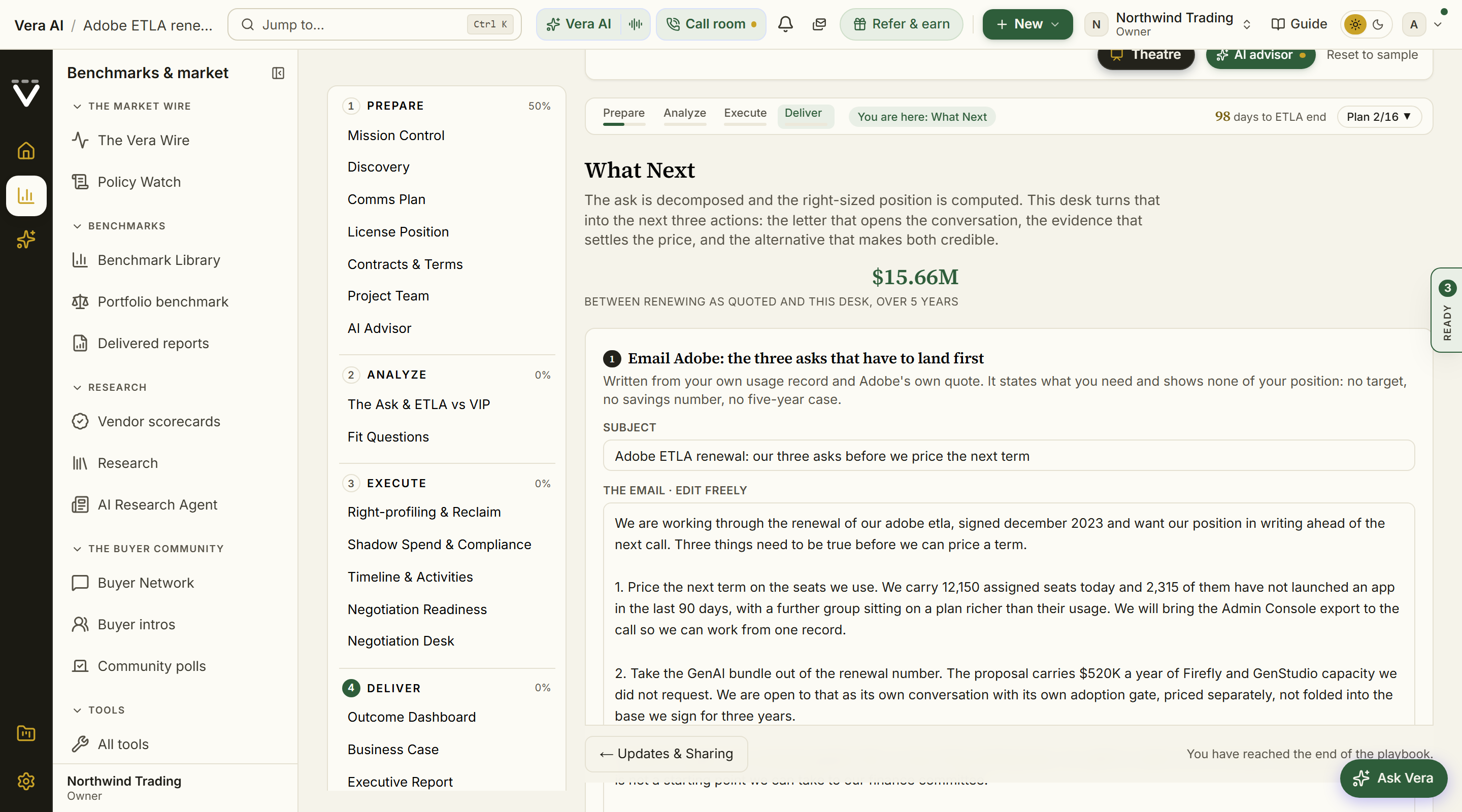
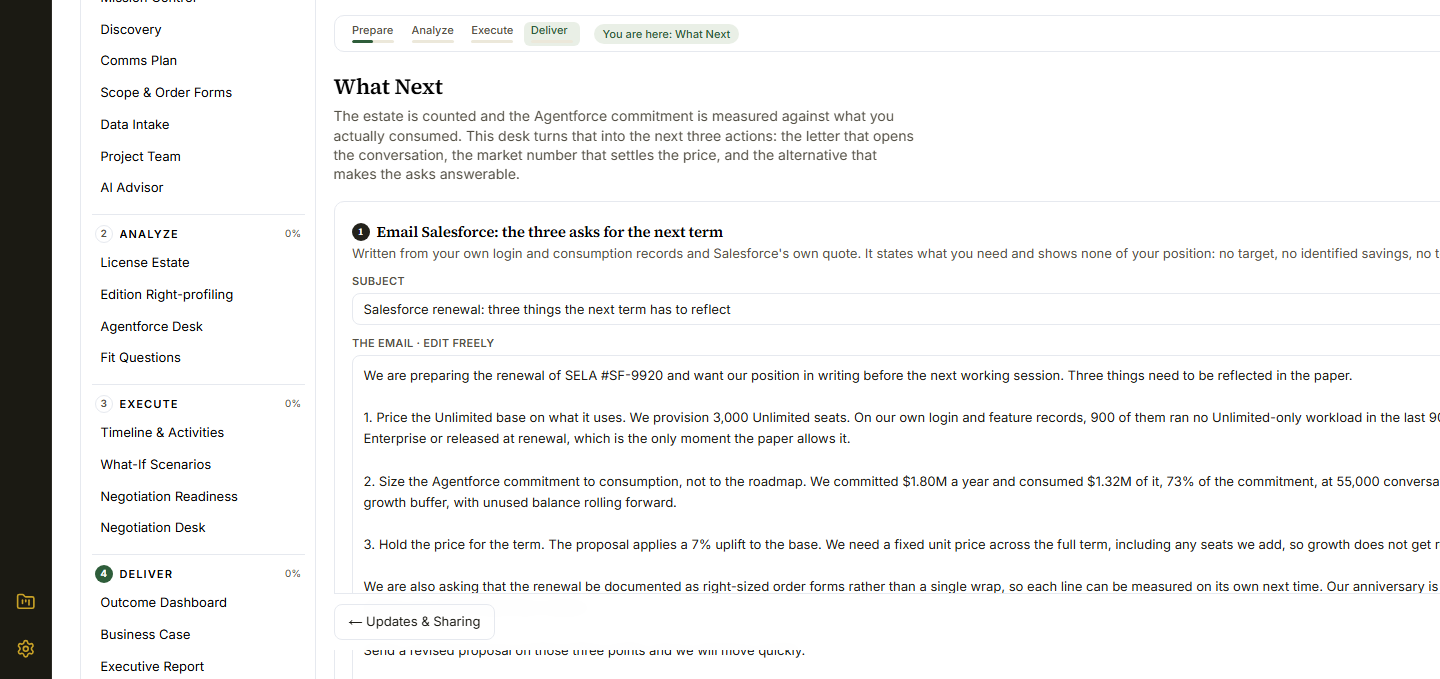
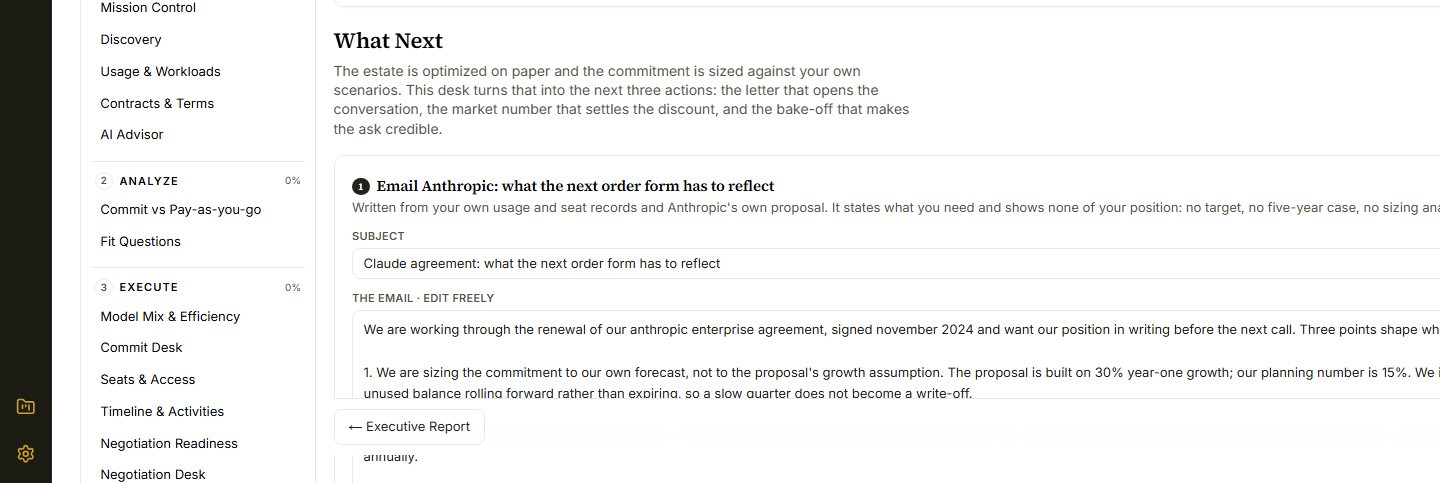
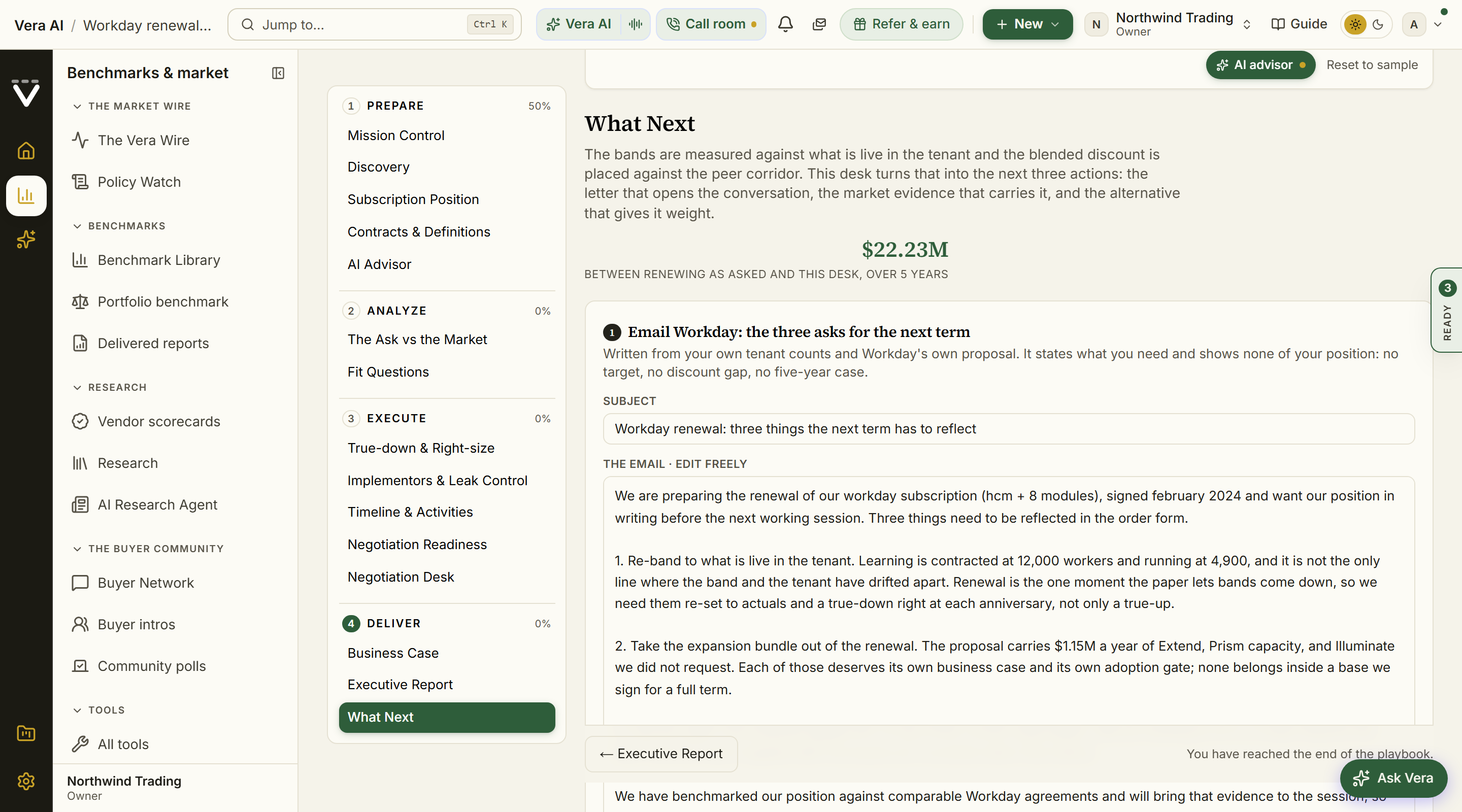
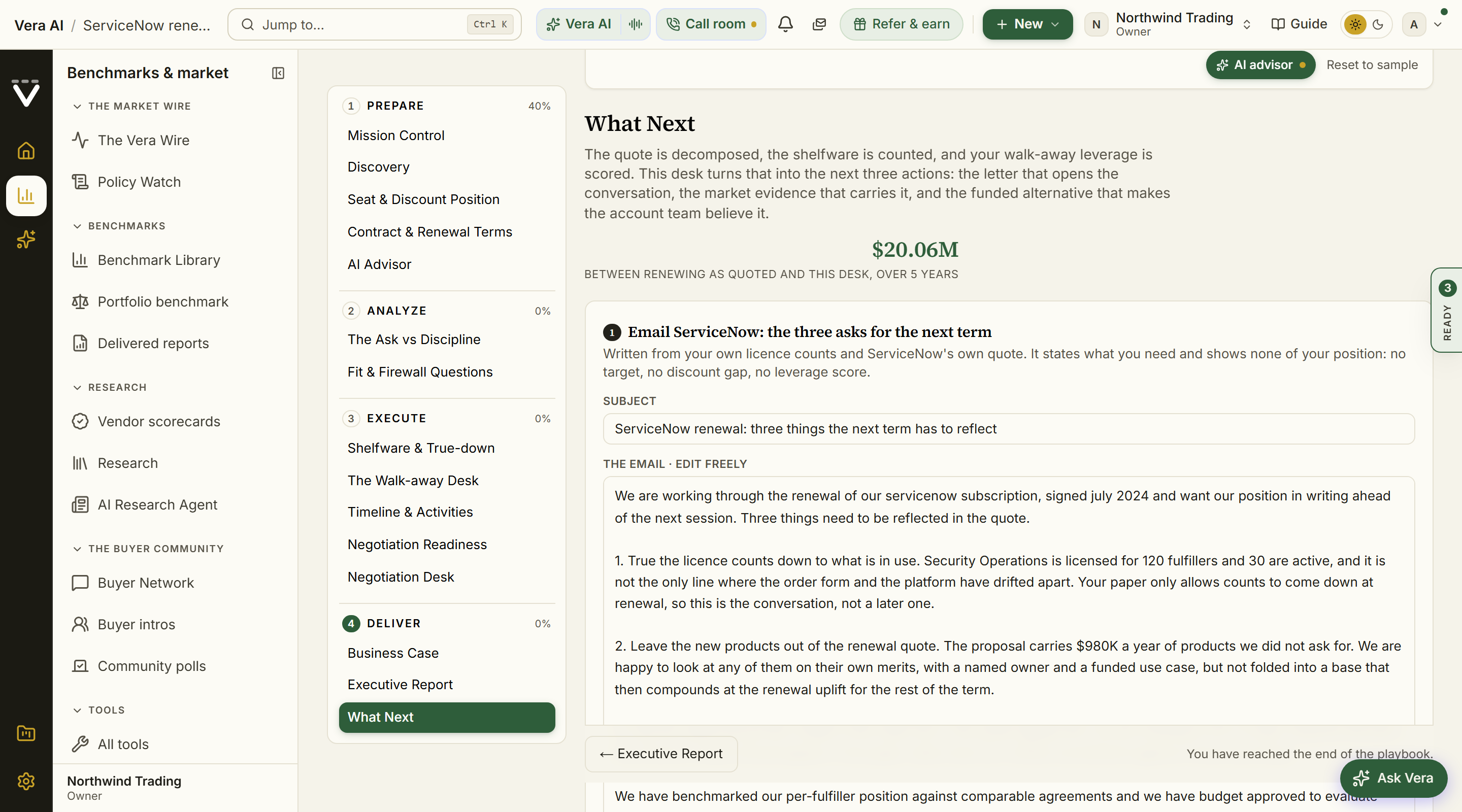
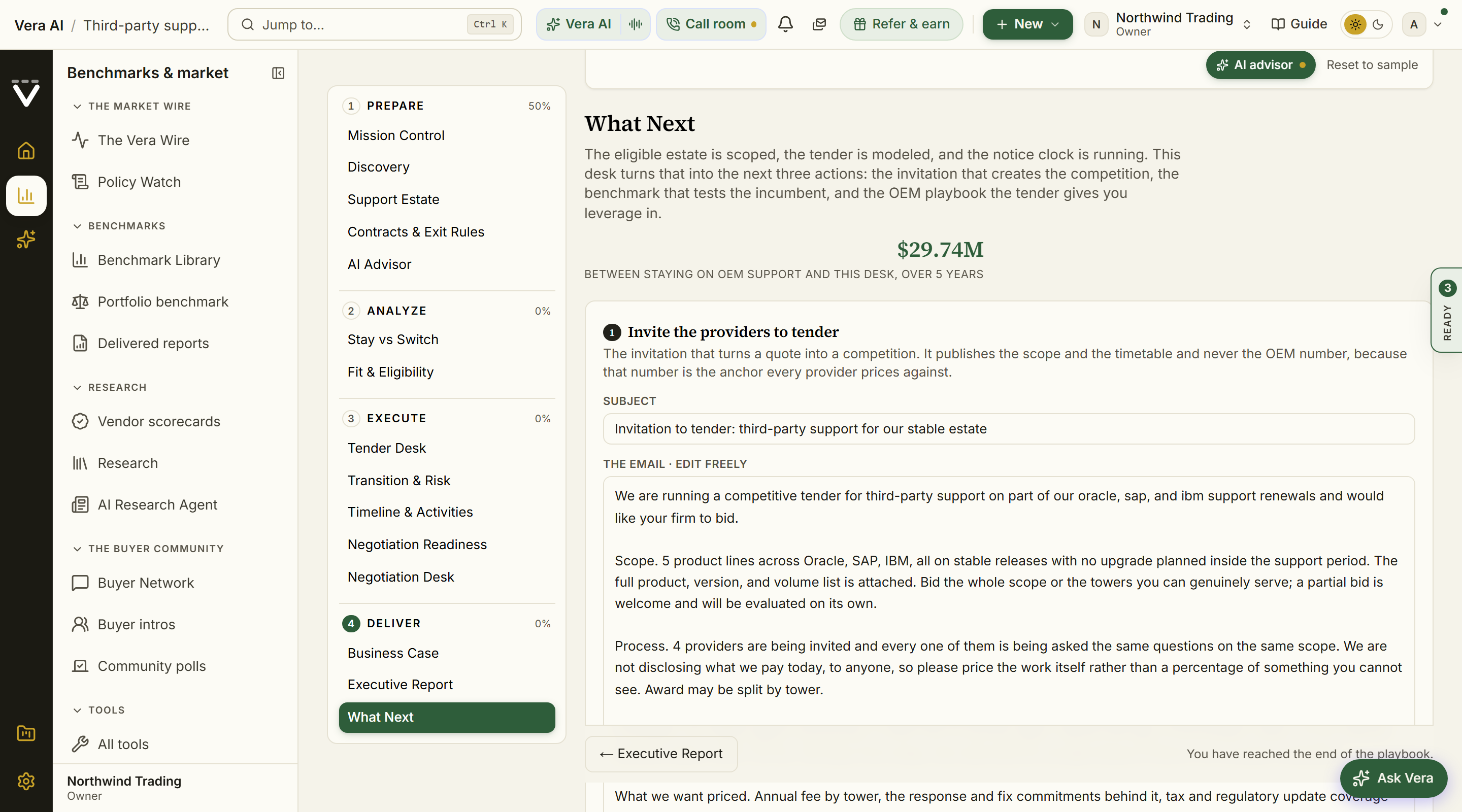
On the screen
- The drafted vendor email: the ask that playbook exists to land, composed from the figures your own run produced, in an editable subject and body. Copy it or open it in your mail app; nothing sends from the platform, and the draft carries no greeting or sign off so you add your own. Editing takes over from the computed draft, and one link restores it.
- The exit ramps: two or three moves that carry the vendor with them, the matching benchmark tool, a negotiation case seeded on that vendor, and the costed alternative or the BATNA playbook that prices your walk away.
- Ask Vera and the position digest: a question carrying your run's headline numbers, and a copyable summary of where the run landed.
Vendor-facing drafts state your asks and your own usage facts only. Your target, your corridor, and your savings estimate stay in the digest and the Ask Vera question, never in the email. The third-party support draft is a tender invitation by design: it publishes the scope and the timetable and never what you currently pay the OEM.
Next: Chapter 04 · Insight
Was this page helpful?
Thank you. Your note goes straight to the team that writes this manual.