License compliance is really two jobs. The first is knowing, week by week, what is installed and whether you are covered. The second is a position you can put in front of an auditor or a vendor and defend line by line.
Vera AI by VendorBenchmark has a path for each. Agentless discovery is licensing run by AI with no human operator: small read only scanners, or one collector, report what every machine runs, and AI builds the position against what you pay for. Same Day ELP is the human checked path: you send the paper and the deployment data, AI drafts, and two analysts check every line before it reaches you. Here is how they differ, where each one stops, and when each fits.
The automated path runs itself
Software Discovery rolls out two read only scanners once, through Intune, Configuration Manager, Group Policy, Ansible, cron or SSH, and machines report every six hours, daily or weekly. Software Discovery+ is agentless: install the collector on one machine and once a day it scans every machine on its list remotely, Windows over WinRM and Linux over SSH, with nothing installed on the machines.
From then on AI names every installed title, holds the installs against your contract lines and ranks the fixes: paid and unused, installed with no contract, audit risks and renewals to cut. Under Managed, a workspace owner picks the publishers and sets Weekly or Monthly. On that day, overnight, the platform writes one licensing report per publisher and mails it to the members who asked for it.
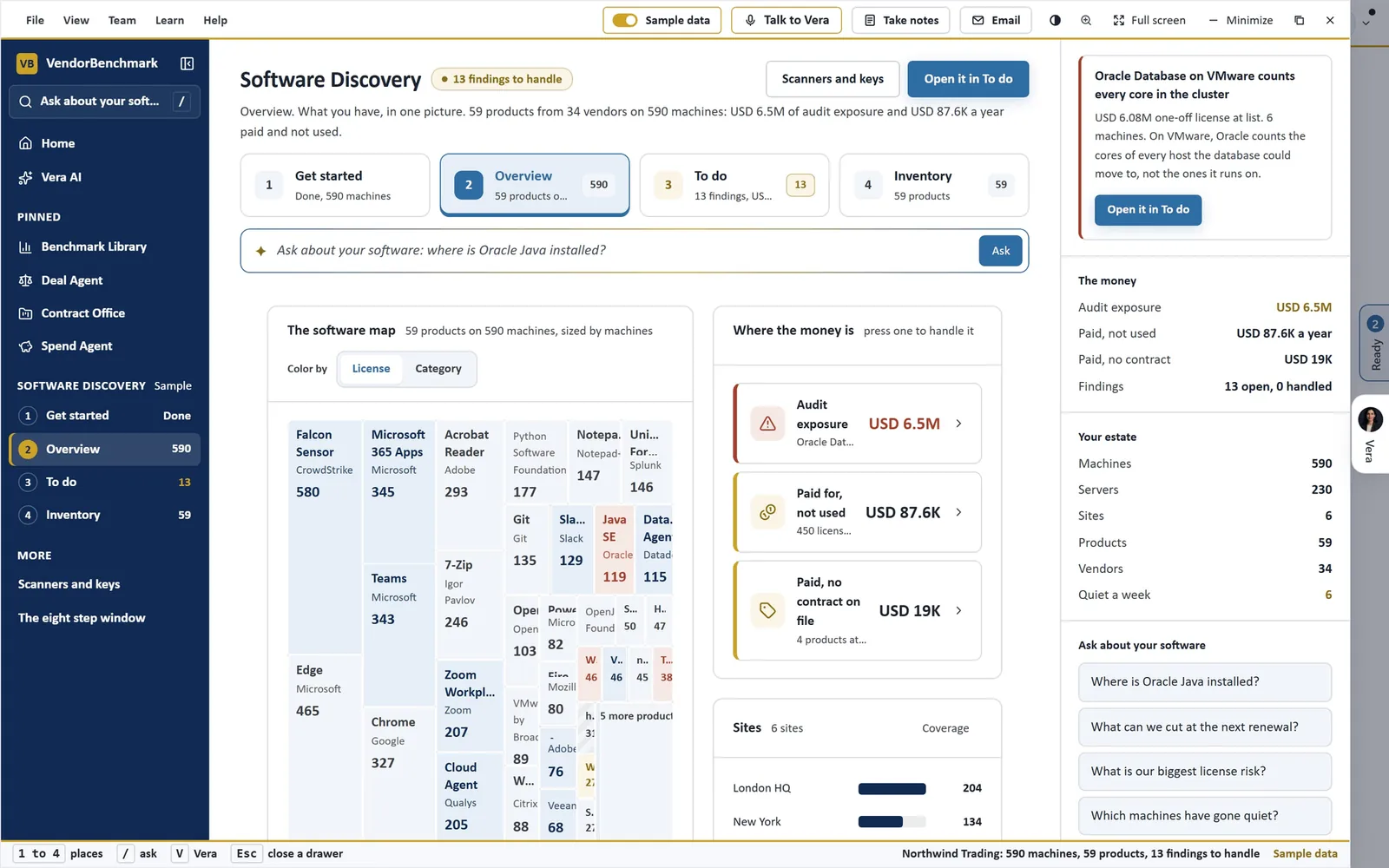
The automated path. Software Discovery's Overview on the sample estate: every product on one map sized by machines, where the money is, and questions to ask about the estate. No analyst stands between the scan and the screen.
The human path puts two people on it
Same Day ELP starts from the paper. You send the signed agreement and every amendment, every order form still in force and the deployment data the product's guide lists, with the reason you need it: an audit letter, a renewal, an internal review or an acquisition. AI drafts the position, an analyst reviews every line against your contract terms and the product rules, and a second analyst runs the QA check. It comes back within 24 hours of a complete submission.
What comes back is built to be argued: the position by product and metric, the exposure at list in US dollars, a what if, the levers ranked by value and an Excel workbook, with the vendor's own analysis on Microsoft, Azure, SAP and Salesforce. It covers 41 products across ten vendors.
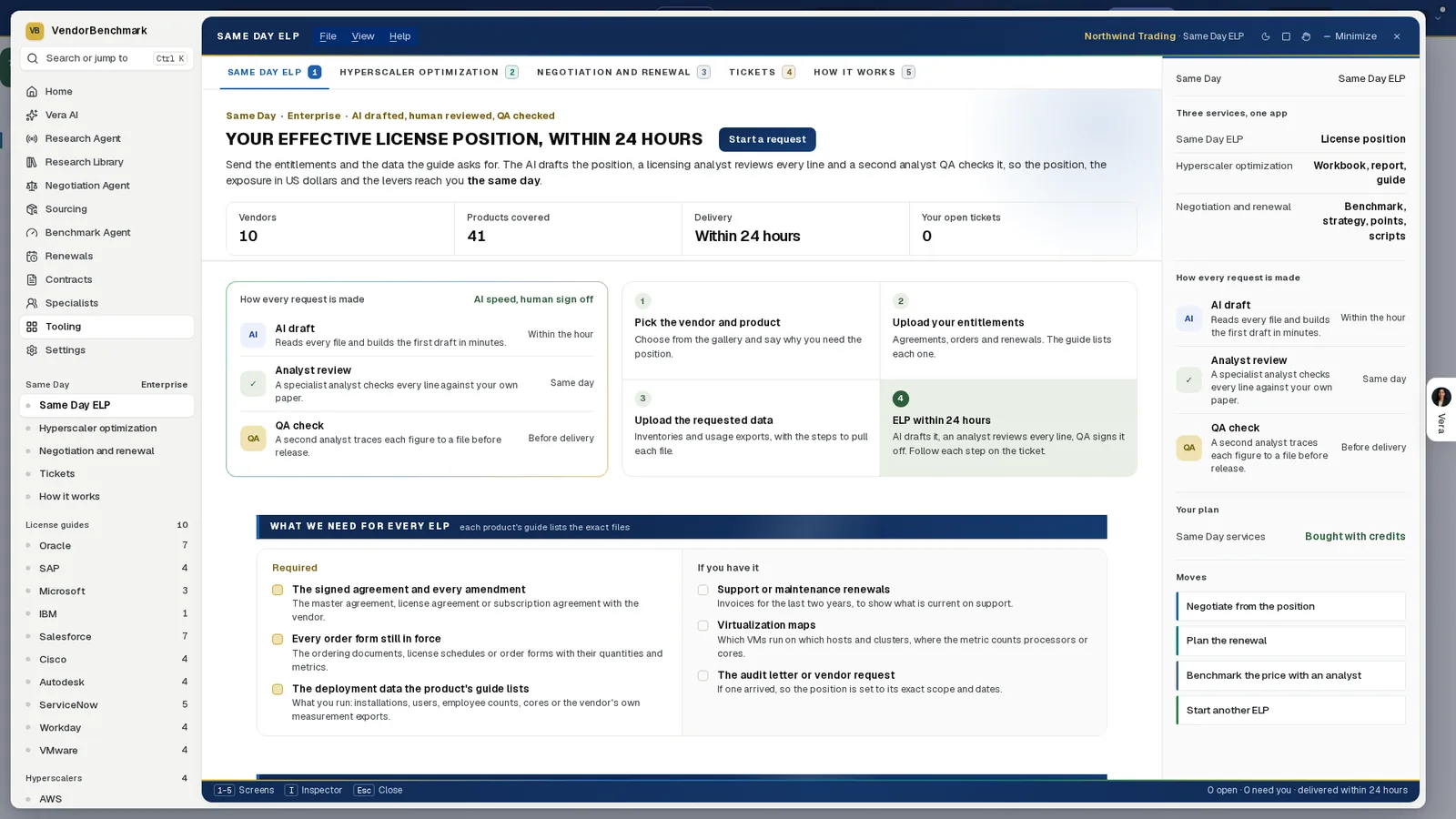
The human checked path. The Same Day ELP tab: how every request is made, with the AI draft within the hour, the analyst review the same day and the QA check before delivery, above the items every ELP needs.
Where the two paths differ
| Question | Agentless discovery | Same Day ELP |
|---|---|---|
| Who does the work | Scanners and AI, with no human operator | AI drafts, an analyst reviews, a second analyst QA checks |
| What goes in | What every machine has installed, and your contract lines | Your agreements, amendments, order forms in force and deployment data |
| How often | Scans every six hours, daily or weekly; reports weekly or monthly | One position per request, when you need it |
| What comes out | Paid and unused, no contract, audit risks, renewals to cut | Position by product, exposure in USD, remediation ranked, workbook |
| Best moment | Every week, to stay current | Before an audit, a renewal or a deal |
The limits sit on both sides, and they are worth saying plainly. A scan sees installs, not paper. For every major publisher, Software Discovery+ lists what a true position needs beyond the scan, such as cores and clusters, the agreement and the license statement, named users and the vendor's own consoles, and why the position is wrong without them. Prices on the risk steps are published list prices, never what you pay. And the Java scan never says an install is licensed, because it does not read your Oracle contracts.
Same Day ELP has limits too. It is a position at a point in time, as good as the files you send, and its clock waits on you when one is missing. It is not a weekly watch.
A scan tells you what is installed. A position you defend in front of a vendor needs the paper, and people who read it.
Choose by the moment
- Every week, across the estate. Agentless discovery. Nothing installed that changes a machine, and the biggest money and the biggest audit risk first.
- An audit letter arrives. Same Day ELP, set to the letter's exact scope and dates, with two analysts on every line.
- A renewal or a true up is coming. Same Day ELP, for the position you will negotiate from.
- A deal or an acquisition. Same Day ELP, with the legal entities it covers named in the request.
The paths also feed each other. Java Scanner's Build the ELP hands the scan to the service: built by AI on the full scan, checked by an analyst and a second analyst, and delivered within 24 hours. IBM License Position's Hand off carries a self serve position to an analyst review in 24 hours. Start automated, and call in people when a number is about to go in front of a vendor or an auditor.
Where it sits
This article sits between two clusters of the library.
- Agentless discovery covers licensing run by AI, with no human operator.
- A license position every week shows the automated position in detail.
- How Same Day ELP works follows a request through the 24 hours.
- The QA behind a Same Day ELP shows what the two analysts check.
The Same Day ELP guide covers this cluster, and the Same Day ELP page has the coverage and the clock rules.
What to do first
- Start with the scan. Load the sample estate, or scan one laptop, and see what the automated path finds.
- Mark the moments that need people. The next audit window, renewal or deal on a vendor you run at scale.
- Read the upload guide for that vendor. Pull the paper early, so the request is complete on the day you need it.
- Run both. Keep the weekly position running, and send a Same Day ELP when the figure is about to go in front of a vendor.
Questions buyers ask
Is an automated license position enough for an audit?
It shows what is installed and where an audit would start. For a major publisher, a true position also needs facts the scan cannot see, such as cores and clusters, the agreement and named users. That is where Same Day ELP and its two analysts come in.
Does agentless discovery need a person to run it?
No. The scanners or the collector report on schedule, AI names the titles and builds the position, and Software Discovery+ can mail a report per publisher weekly or monthly.
Can the two paths share work?
Yes. Java Scanner's Build the ELP and IBM License Position's Hand off both pass a self serve position to an analyst review in 24 hours.
What does each path need from us?
Discovery needs the scanners rolled out once, or one collector, plus your contract lines. Same Day ELP needs your agreements, amendments, order forms in force and the deployment data the guide lists.