We build AI agents, and we still put a human analyst one press away on Home. That is not modesty. Some questions turn on judgment a model does not have: an odd contract structure, a vendor priced in a way the market data does not cover, a number a board will hold you to.
Ask a human is the part of Vera AI by VendorBenchmark where a person answers instead of a model. This article covers what you can ask for, how a request moves, and when a person is worth the wait.
Three speeds, and the third is a person
Every price question in the platform can be answered three ways. The band on Home that offers the third puts it plainly: humans are still more accurate than AI.
| Path | How fast | What comes back |
|---|---|---|
| Benchmark Library | Seconds | A verdict from the vendor, your annual value, the discount and the term, with no upload |
| AI benchmark | 5 to 10 minutes | Vera reads the quote, prices every line and writes the report, with the counter drafted |
| Ask a human | Within 24 hours | A VendorBenchmark analyst's answer, written by hand, as Word and PDF |
The first two are the right tools for most questions. The third is for the ones where a person's judgment is worth a day.
What you can ask a person for
Upload the contract, the quote or the order form, and select what you need back, in any combination.
- A benchmark. What it costs, what comparable buyers pay and where yours ranks.
- A negotiation strategy. The levers in order, the counter and the walk away point.
- Talking points. What to say on the next call and how to answer back.
- Research. How this vendor prices and what changed this year.
- A full analysis. All four as one document, with the recommendation first.
- A call. Time with the analyst once the answer is with you.
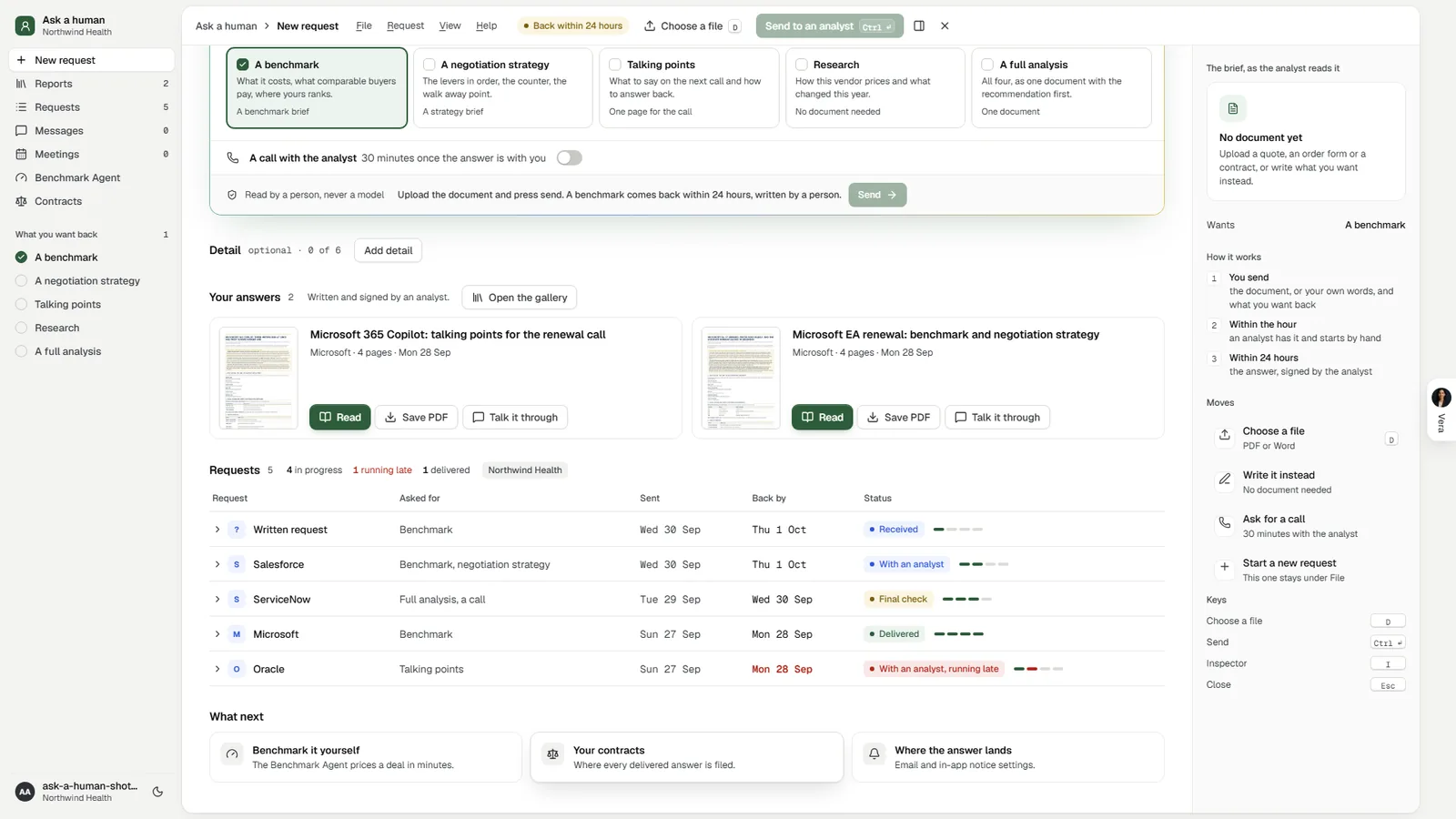
Ask a human. Tick what you want back, from a benchmark to a full analysis, and add a call with the analyst if you want one. The line under the choices says it plainly: read by a person, never a model.
How a request moves
Ask a human works as a ticketing system. Upload up to five files, PDF or Word, add a note for the analyst if you like, and name anyone else who should get the report. The receipt carries the request number and four stages: Received, Assigned, In progress and Delivered.
The report arrives as Word and PDF, by email to you and every recipient you named, and in the window. Each request keeps one conversation with the VendorBenchmark team. Rate the report with a thumb; a thumb down opens Resubmit, where you say what should change, free of charge, twice per request.
The Entitlement Agent can start a request for you. Send to a human on a contract opens Ask a human with the vendor, the name, the value a year and the term already in it. Nothing is sent from the menu: you read the request, change it and send it yourself.
When to call a person in
An analyst answers within 24 hours, not 10 minutes. These are the moments worth the wait.
- The stakes outgrow self serve. A large audit, a hostile renewal, a deal above your comfort line.
- The paper is unusual. An expert read of an odd structure is cheap next to signing it unread.
- The AI says it cannot place the deal. A vendor priced as a rate or a yearly uplift has no discount range, and the Self Drop Benchmark says so and offers to send it to an analyst.
- The report needs more comparables. An analyst review of a Self Drop Benchmark can add comparables from the firm's files.
- A board will read it. The analyst sends a report your board can read, written and signed by hand.
The specialists are a different tool. They are twenty prepared AI seats, plus Vera's own, that you bring onto a live vendor call, four at most on one call, each arguing in its own voice. They work fast and beside you; the analyst works by hand, in writing.
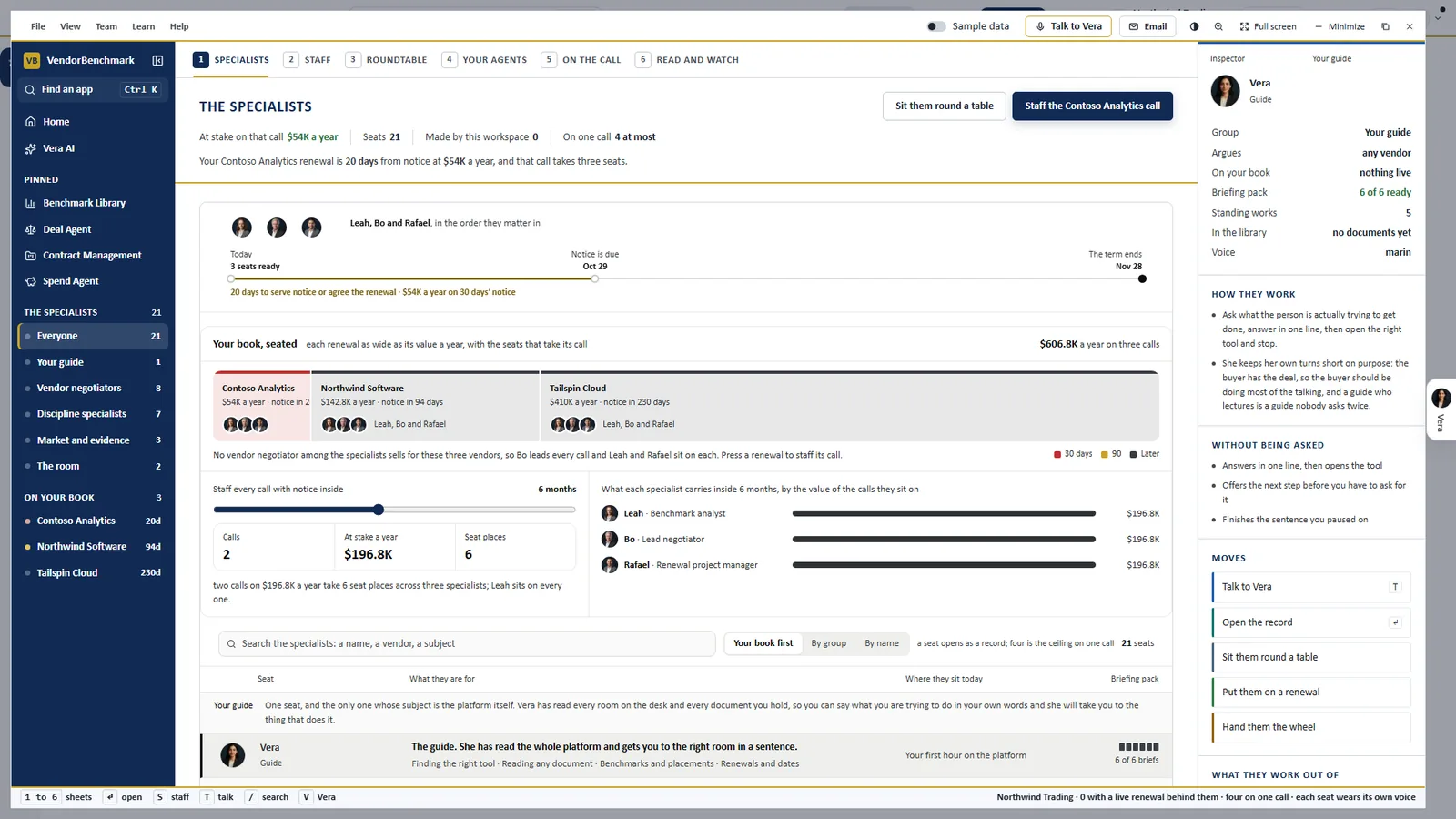
The specialists. Twenty one seats, Vera's first, staffed onto the renewal call nearest its notice date, with four as the ceiling on one call. Hand them the wheel sits among the moves.
Use the agents for speed. Call a person when the answer has to carry a signature.
Where it sits
The analyst is the human control in our guide to governed autonomy.
- Grounded or it does not ship shows how the AI's own answers cite their sources.
- The autonomy ladder sets how far the agents may go before a person presses.
- Same Day ELP puts an analyst on every line of an AI drafted license position, and a second analyst checks it.
- Ask a human is where the request starts.
Our earlier post makes the longer case for a person on the benchmarks that matter.
What to do first
- Pick one deal. Choose a renewal where the stake or the paper makes a second opinion worth a day.
- Send the document. Open Ask a human from Home, upload the quote or contract and tick what you want back.
- Add the readers. Name the colleagues who should get the report, so it reaches them the moment it lands.
- Compare and rate. Read the analyst's answer beside the AI benchmark, rate it, and resubmit if it missed the point.
Questions buyers ask
Is the analyst's answer written by AI?
No. A VendorBenchmark analyst writes it by hand. The request screen says it plainly: read by a person, never a model.
How long does it take?
The promise is within 24 hours of submission. The report arrives as Word and PDF, by email and in the window.
What can I ask for?
A benchmark, a negotiation strategy, talking points, research, a full analysis or a call, in any combination.
What if the report misses the point?
Give it a thumb down and press Resubmit with what should change. Resubmitting is free of charge, twice per request.
Who sees my documents?
Your organization and, where you request an analyst review, the VendorBenchmark analyst assigned to your engagement. Your contract data is never used to train any AI model.