AI for software renewals in Vera AI, the platform from VendorBenchmark, is a group of AI agents that watch every notice date, read the vendor's paper, benchmark the price, write the plan and draft each move of a renewal, from the notice date to the signature. It is for the procurement lead, IT asset manager or contract owner who holds more renewals than there are weeks to prepare them.
This post follows one renewal in the order it happens: the date, the overnight read, the six stages, the negotiation and the signature. The product page for the whole run is Renewals, and the window that holds it is the Deal Agent.
PART ONE
Why the notice date is where a renewal starts
Every agreement has a renewal clock, and the date that matters is rarely the renewal date. It is the last day to give notice. Miss it and the contract renews as it stands. We described that trap in the auto renewal clause, and the scale of the problem in the renewal calendar problem.
The renewal calendar reads the expiry and notice dates from every agreement and counts them down. Each renewal owner gets real calendar invites with prep reminders 120, 90 and 60 days out. When a renewal enters the window, a memo goes to its owners with the leverage, a fair target and the first three moves. Notice dates inside 30 days come first on the Today view.
PART TWO
The time it saves on each renewal
The work on a renewal is mostly finding things: the date, the price history, the market figure, the right clause. That is the part the agents take. Here is one renewal run both ways. The hours are illustrative.
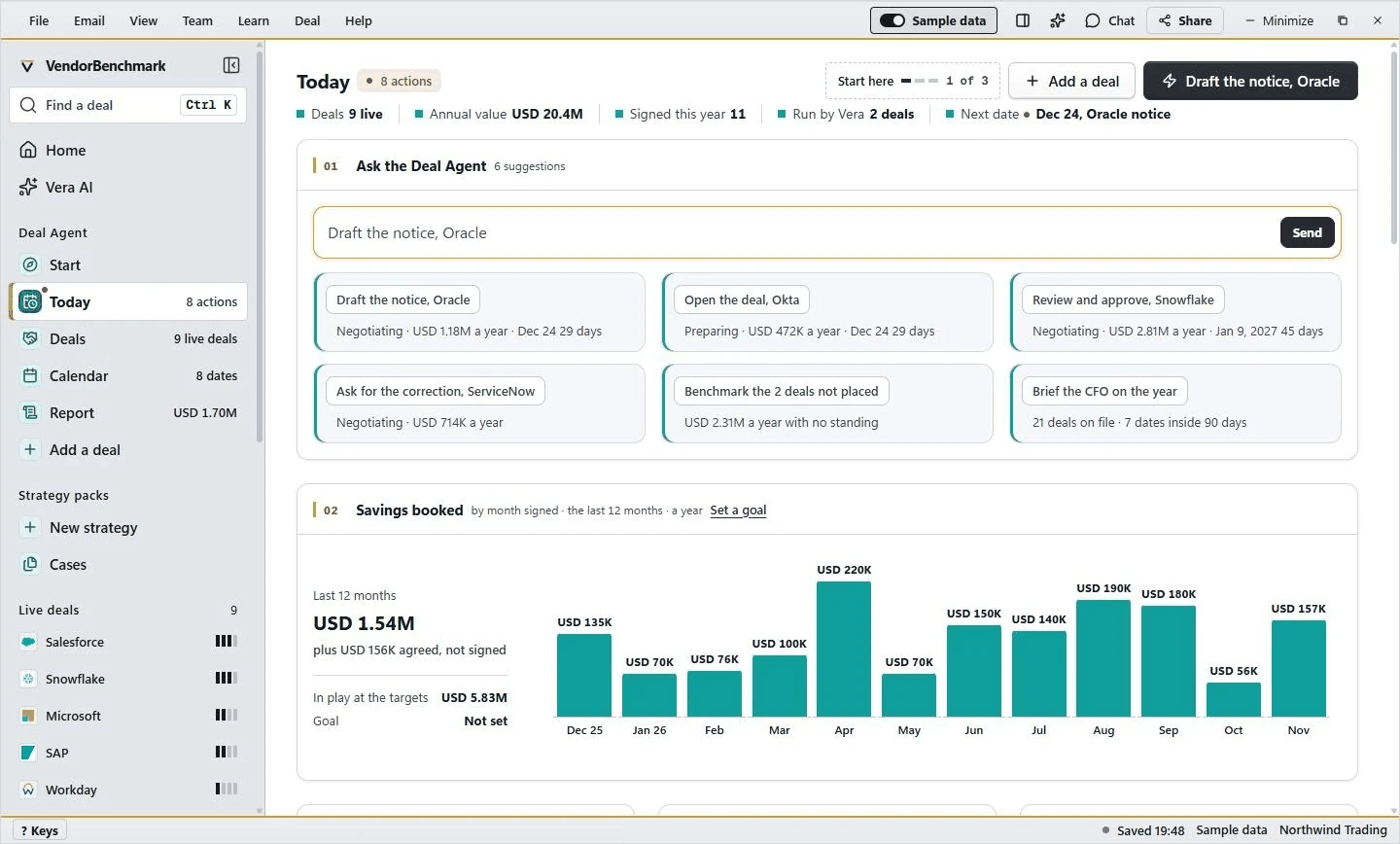
The Deal Agent's Today view on sample data: the live deals, the suggested next steps and a chart of savings booked by month.
THE SAME JOB, TWICE
TODAY, BY HAND
- Find the contract and read it for the renewal date, the notice period and the uplift clause
- Ask finance for the spend history and ask around for what others pay
- Write a plan and a notice letter, and put the deadline in a personal calendar
- Chase the vendor by email and forward each offer to the budget owner
Roughly 1 working day per renewal, spread across about 2 months
WITH VERA
- Upload the renewal quote or forward the vendor's email to your private deal address
- Read the verdict from the overnight read and the benchmark beside it
- Set the target and the walk away, and choose who runs the renewal
- Approve the drafted moves and send the notice letter yourself if you need it
About 30 minutes of your attention per renewal, most of it deciding
What changes: roughly 8 hours per renewal becomes about 30 minutes. For example, 40 renewals a year go from roughly 320 hours to about 20 hours, and no notice date passes without the paper being read first.
What the time depends on: how many documents sit behind the agreement, whether the quote prints a list price, and how many approvers your policy names. A renewal with a clean order form and one approver moves fastest. The reading shrinks; the approval chain takes as long as your people take.
PART THREE
How a renewal runs, step by step
A deal comes in as an uploaded quote, an email forwarded to your private deal address, or a connected source such as your Outlook calendar or Coupa. It opens at the stage its work is at, then moves through six stages in one window.
- Read. Every term with its page, and the billing held against the contract.
- Benchmark. What the deal costs, what comparable customers get and where it ranks. If the quote prints no list price, the screen says so once and compares rate against rate for the same product at the same size.
- Plan. The levers for price, cap and term, and the mandate you approve.
- Terms. Eight protections checked against what your contract holds. One it lacks becomes an ask before the negotiation starts.
- Negotiate. Every priced round on one ladder, with the next move drafted.
- Close. The outcome, what it saved and the record.
Six of the eight protections come from the Fair Renewal Rider: an indexed uplift cap, benchmark repricing, audit conduct rules, no retroactive true ups, co termination and change of control protection. The other two are a reduction at each anniversary and no automatic renewal. Your own positions on each live in your Contract policy.
PART FOUR
What the agents do before you sit down
Three pieces of work start without anyone remembering to start them.
- The overnight read. Switch it on once and pick a window of 60, 90 or 120 days. Each night every renewal inside it is read against the benchmark library, worst first, up to 20 a night per workspace. By morning each has a verdict: fine, or needs you, with one plain sentence saying why.
- The renewal war room. The Renewal war room job fires by itself about 45 days before a notice deadline. It writes the leverage read, the counter with a walk away, a week by week countdown and a notice letter held for your sign off.
- Rightsizing. Run Rightsizing before renewal about 90 days out. It compares what you own with what you use, ranks the cuts with the saving per line and says what not to cut. You and the license owners confirm every cut.
The night only reads. No email leaves overnight, and every action it takes lands in the audit log. One press on a verdict opens Vera on that renewal.
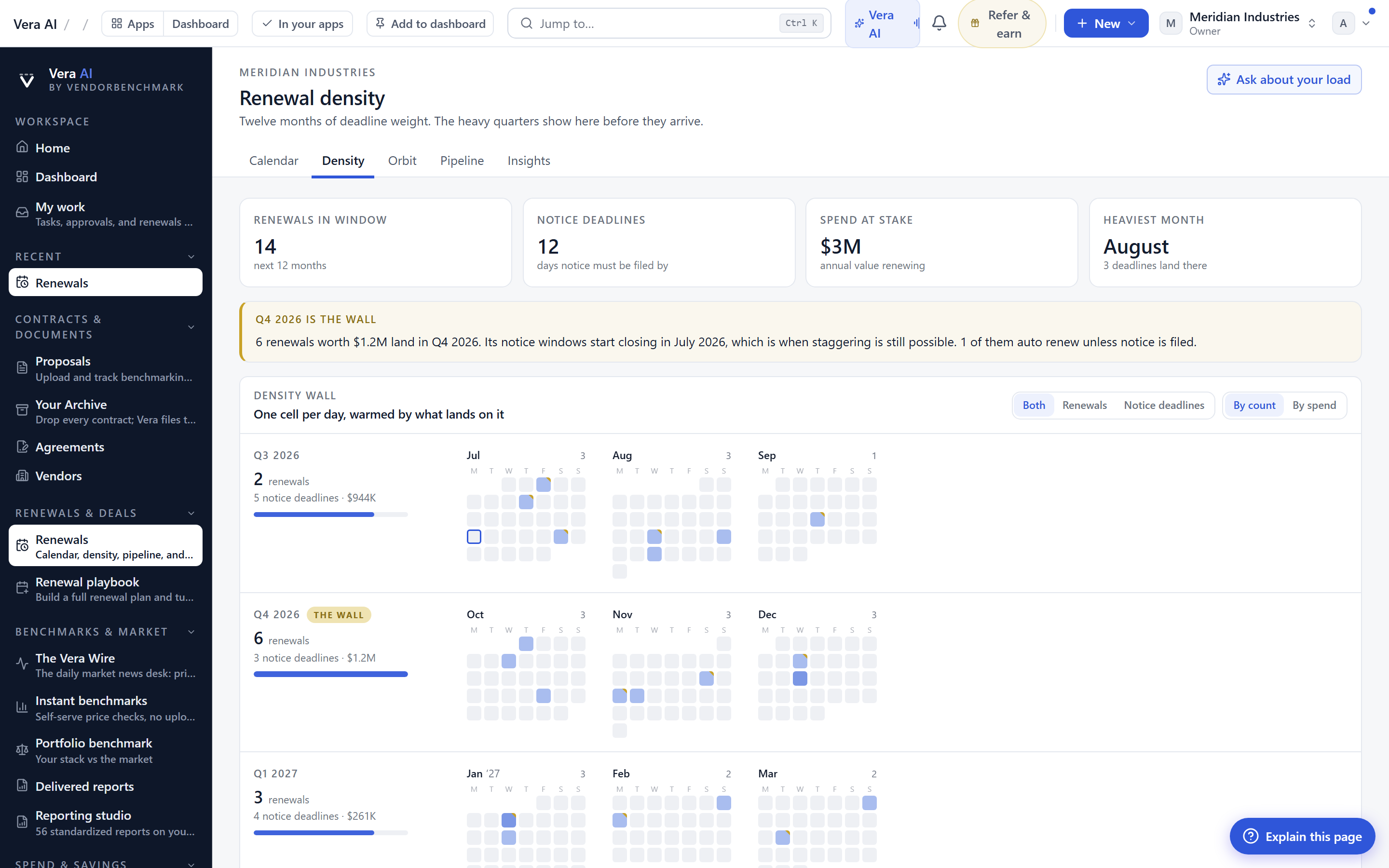
The Deal Agent's Calendar on sample data: twelve months of dates for every live deal, with the last day to give notice marked on each bar.
PART FIVE
Who negotiates, and who signs
You choose who runs each renewal. You run it yourself. Or Vera drafts and you send. Or Vera runs it and you approve. In the third case she sends alone only inside the target and the walk away you set. Anything outside them comes back to you.
For the long tail, AI Managed negotiates by email across the estate, inside limits an owner approves. When you meet the vendor, Vera on calls sits in and records what was decided.
The signature is never the agent's. Your approvers sign off in the order your policy sets, and signers sign in DocuSign or Acrobat Sign. Before that, Check before you sign reads the final paper and routes a brief to the people who approve. Mark as signed is a person's press.
The notice is drafted, never served. The letter is yours to send.
PART SIX
What the AI does, and what stays with you
On a renewal the AI reads the agreement and the quote, with the page behind each term. It compares the price with what comparable customers get, across a benchmark library that covers 4,100 vendors. It drafts the plan, the notice letter, the counter and the next move. The decisions that commit the company stay with people.
- It never signs. Every signature comes back to a person.
- It never serves notice of non renewal. The letter is written from the deal and dated a week before the notice date. You read it, copy it and send it.
- It never agrees a price above your walk away. Offers outside the mandate wait for your answer.
- It names itself. The AI says it is an AI in its first message to a vendor and copies you on every message.
- It cannot rescue a date that has passed. The calendar warns while there is time. If the window is already closed, the options are different, as we set out in recovering from a missed notice window.
PART SEVEN
Common questions
- Can an AI agent negotiate a software renewal on its own? It can run the negotiation by email inside a mandate you approve. It never signs, never serves notice and never goes above your walk away, and by default every offer waits for you.
- Where do the renewal dates come from? From your agreements. Expiry and notice dates are read from every one and counted down on the calendar.
- Does the vendor know it is talking to an AI? Yes. The AI names itself as an AI in its first message to a vendor and copies you on every message.
- What does the overnight read change? Nothing by default. It reads each renewal in your window and leaves a verdict. Proposals to change a renewal exist only where a workspace owner has raised the ceiling, and each one still waits for a person's press.
- Who gets the reminders? Each renewal owner, as real calendar invites 120, 90 and 60 days out. The dates also export to Excel, PDF and Outlook.
- Can I see it before loading my own contracts? Yes. The free trial needs no card, and every app opens on a sample company.
The short version: the agents find the date, read the paper, price the deal and draft every move between the notice date and the signature. The mandate, the notice and the signature stay with you. The longer guide is at autonomous renewals.