The Deal Agent is the AI agent in Vera AI, the platform from VendorBenchmark, that holds every software renewal and negotiation in one window, from the notice date to the signature: the calendar, the board of deals, the position, the plan and a counter drafted in your voice. It is for the procurement lead who runs several renewals at once and cannot give each one a week. The product page is at Deal Agent.
This post is the plain reference: what you give the Deal Agent, how to build a strategy with it, how one renewal runs, how it uses AI and what it will not do.
PART ONE
What goes into the Deal Agent
Everything you hold on the deal. One drop zone takes PDF, Word, Excel, CSV, email or text, up to 25 files of up to 25 MB each. Each file is read as it lands and sorted into one of four kinds.
- Existing contracts. Master agreements, order forms and amendments.
- Vendor proposals and quotes. The renewal quote and any revised offers.
- Vendor emails and notes. What the account team has already said.
- Entitlements and usage. License reports and deployment or usage exports.
You can add an aim in your own words, such as taking out shelfware or signing before the vendor's year end. The more you upload, the stronger the result: a usage report lets the options include a right sized renewal, and the vendor's emails let the talking points answer what has already been said.
PART TWO
The time it saves
A renewal is weeks of small tasks around a few decisions. Here is one renewal both ways. The hours are illustrative, and they depend on how many documents the deal has, how clean they are, how many rounds the vendor takes and how many approvers sit between you and a signature.
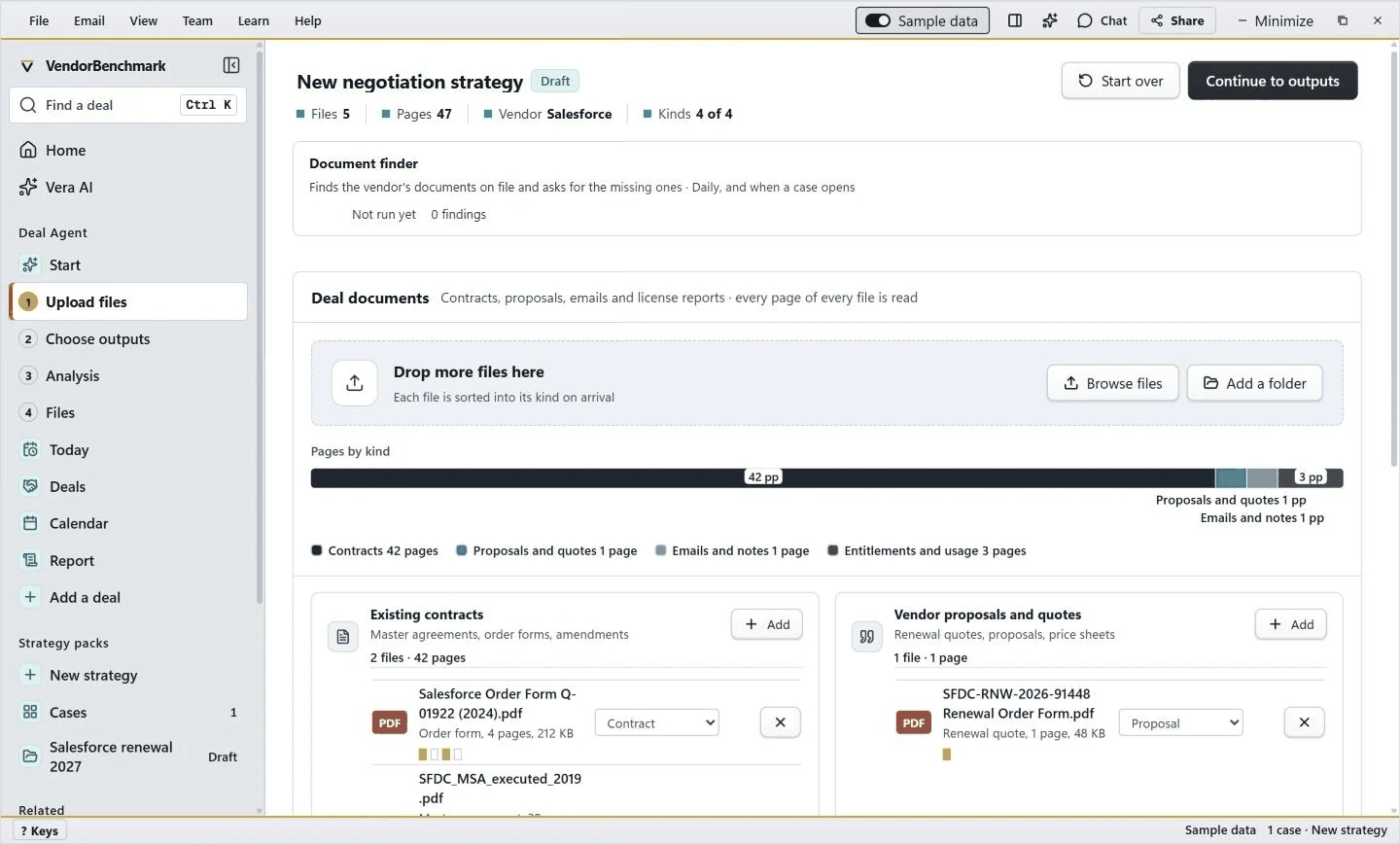
The Deal Agent on sample data: a new negotiation strategy, with the deal documents sorted into contracts and vendor quotes.
THE SAME JOB, TWICE
TODAY, BY HAND
- Find the contract, the order forms and last year's quote in shared drives and inboxes
- Put the notice date in a calendar and hope someone sees the reminder
- Ask around for what comparable buyers pay and set a target by feel
- Write each counter to the account team from a blank page
Roughly 2 weeks of effort on one renewal, spread across about 8 weeks of calendar time
WITH VERA
- Drop the contract, the quote, the vendor's emails and the usage report on Upload files
- Choose the outputs and press Create the negotiation strategy
- Read the strategy and approve its target onto the deal
- Forward each vendor email and decide on the drafted counter
About 30 minutes to set up, then a few minutes on each offer
What changes: roughly 2 weeks of gathering and drafting becomes about 30 minutes of setup plus your decisions. For example, 6 vendor emails at about 10 minutes each come to roughly 1 hour on top.
PART THREE
How to build a strategy with the Deal Agent, step by step
- Upload files. Drop everything on the deal and check each file landed in the right kind. Write your aim if you have one.
- Choose outputs. The negotiation strategy comes first: the options, the recommendation, positions, walk aways and next steps. You can add talking points for the first call, the arguments for the best discount, a price benchmark against comparable customers and the first email to the vendor.
- Watch the analysis. Ten steps run as a task list: the files sorted and the vendor named, each kind read, the vendor researched, the price benchmarked, the options model built, the files written and every figure and source checked. A run takes a few minutes, longer for a large deal file.
- Read the files. The strategy as Word and PDF, the options model as an Excel workbook and the email as a draft. The same files arrive by email, to a member of your workspace.
- Approve the target. When the strategy's target is right, approve it onto the deal. From there the deal has a number to be measured against.
PART FOUR
One renewal, from the first read to the close
Around the strategy sits the deal itself. The site describes six steps, and the Read and Benchmark steps fill in on their own once the paper and the emails are in.
- Read. Offers, concessions, deadlines and the tactics in play, read from the emails and the paper.
- Benchmark. The peer price, the vendor's quarter and your alternatives. The pricing comes from the AI benchmark.
- Plan. The target, the walk away and the asks, in order.
- Terms. Your standard, fallback and walk away line for every term.
- Negotiate. Counters in your voice and talking points for every call.
- Close. The report and the board paper, with a lessons digest so the knowledge stays in the team.
Across every deal you get three views. Today puts what needs you first. The board tracks every deal by stage with the money at stake. The calendar shows every renewal by month with the notice dates counting down. A simulator tests alternative terms before the call, with the financial impact of each.
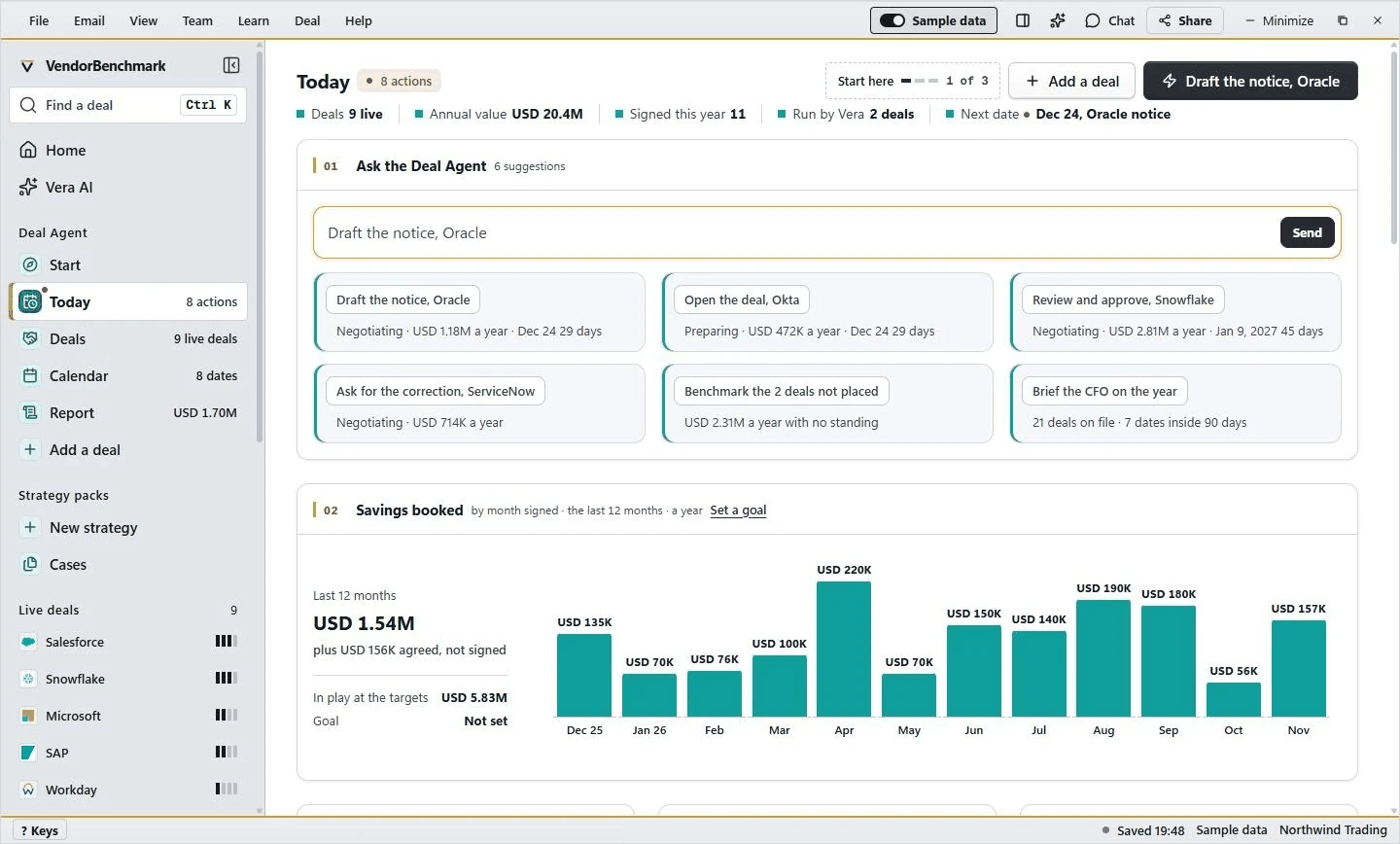
The Deal Agent's Today view on sample data: live deals, suggested next steps and a chart of savings booked by month.
Timing is part of the position. The Deal Agent knows when the vendor's quarter closes, for the reasons set out in vendor fiscal calendars. How a position is held across rounds is covered in the negotiation war room.
PART FIVE
How the Deal Agent uses AI, and what stays with you
The AI reads, compares and drafts. It reads the contracts, quotes, emails and usage reports and sorts them. It researches the vendor, benchmarks the price and builds the options model. Forward a vendor's email and it names the tactic, such as an artificial deadline, logs what was conceded and drafts the counter in your voice, grounded in your numbers.
It shows where each answer came from. Every finding carries its file and page, and pressing it opens that file at that page. Every figure in the files is checked against its source before a file is written, and a figure that cannot be traced is left out.
What stays with you is authority. You choose who runs the deal: the team runs it, Vera drafts and a person sends, or Vera runs it and a person approves. Where Vera runs it, she works inside a written mandate: how hard to push, what may be disclosed, how often it returns to you, the annual spend it may commit and when the authority lapses.
A guardian reads each draft against that mandate and allows, rewrites, blocks or escalates it, and each ruling is logged with the rule and the reason. You decide every offer: accept, counter with a steer, or walk away. The ghost writing is described in forward the vendor email, get the counter in your voice.
Vera never signs. Your people do.
PART SIX
What the Deal Agent will not do
- It does not sign. The signature is always a person's.
- It does not accept an offer. Every offer comes back to you, and the agent never agrees a price above your walk away.
- It does not serve notice. It can draft a notice of non renewal from the deal's own dates. Sending it is yours.
- It does not act outside the mandate. A draft that breaks a rule is rewritten, blocked or escalated before it goes anywhere, and the agent never writes to a vendor without naming itself as an AI.
- It does not place a deal it cannot benchmark. A deal typed in by hand carries only the figures typed, and is not placed against comparable customers until its quote is benchmarked. A step that cannot do its work says Skipped and why.
For a renewal you want carried by email inside your limits, the Deal Agent hands over to AI Managed renewals, which brings every offer back to you. For the live conversation, Vera on calls joins the vendor call with the position. The whole negotiating pattern is laid out in how AI agents negotiate for you.
PART SEVEN
Common questions
- What do I give the Deal Agent? Forward the vendor's emails and drop the proposals, the contracts and your usage. The agent reads the deal from there.
- How long does a strategy take? A run takes a few minutes, longer for a large deal file. The files open in the window and are also sent to you by email.
- Can it negotiate a renewal on its own? It can carry a renewal by email inside your limits, round after round. You approve the goal and decide every offer, and it never signs.
- What does it do with a vendor's deadline? It classifies the tactic, such as an artificial deadline, and drafts a counter grounded in your numbers. Concessions and commitments are logged to the deal.
- Does it know when the vendor's quarter closes? Yes. The vendor fiscal calendar tells you when the quarter closes, because timing is leverage.
- Can I try it without a live deal? Yes. With Sample data on, the Deal Agent plays a sample renewal through every step without sending anything, and the free trial needs no card.
The short version: the Deal Agent keeps every renewal's dates, position and correspondence in one place and drafts the next move. The mandate, the offers and the signature stay with people.